
Spectral Capital Advances Quantum Integration with Telecom Acquisitions Amid Liquidity Pressures
Spectral Capital shifted from an incubator to a quantum technology operator, leveraging patent assets and telecom acquisitions to build its QaaS platform.
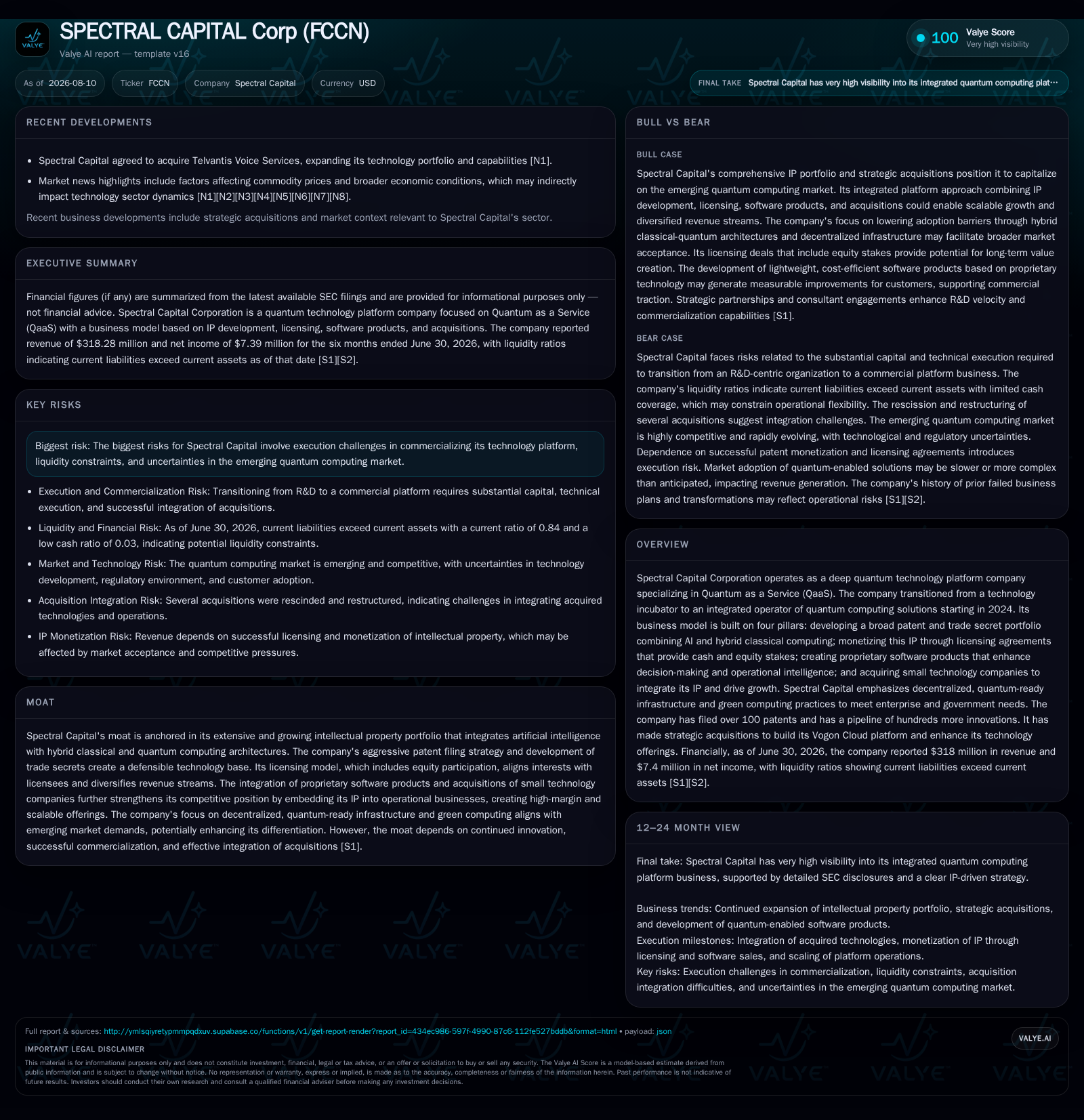
Spectral Capital Corporation is executing a multi-pronged strategy combining intellectual property development, licensing, proprietary software creation, and strategic acquisitions to realize quantum computing's commercial potential. The company’s recent integrations of telecommunications businesses 42 Telecom and Telvantis have driven its initial revenue streams and operational scale but have also introduced significant integration complexity and liquidity challenges. Despite a working capital deficit at quarter-end June 2026, management is pursuing equity financing and debt facilities while advancing its patent pipeline and AI-augmented hybrid quantum-classical offerings. Spectral occupies a specialized role in the emerging Quantum as a Service (QaaS) space with a patent-driven moat, although commercialization risks and funding constraints persist.
Recent Operating Update
Spectral Capital Corporation’s latest quarterly filing as of June 30, 2026 highlights its transition from an incubator model toward operating integrated quantum computing solutions combined with telecommunications assets [S2]. The company reported total revenues of approximately $646.8 thousand for the six months ended June 2026 compared to no revenues in the comparable period last year, reflecting the contribution from their recently acquired subsidiaries—42 Telecom (acquired August 2025) and Telvantis (acquired December 2025) [S2][S3]. This consolidation expanded Spectral’s revenue base but also introduced significant operational complexity.
Despite revenue generation, Spectral recorded a net loss of $2.0 million during this period, influenced by operating expenses outpacing gross profit (gross margin remained thin at around $5.5 thousand), underlining challenges in scaling operating leverage during early-stage commercialization [S3][S21]. Cash flow from operations was negative at $1.55 million for the six months ended June 30, reflecting ongoing investment in integration efforts alongside routine operational costs [S4].
The balance sheet shows total current liabilities of $162 million exceeding current assets of $136 million, resulting in a working capital deficit of approximately $25.7 million at quarter-end [S2][F1]. A key item within liabilities is $16.4 million in contingent consideration tied to acquisition agreements that is expected to be settled by issuing shares rather than cash—a non-cash obligation mitigating immediate liquidity pressure but highlighting future dilution risk [S2]. Excluding this contingent consideration reduces the working capital deficit to approximately $9.3 million.
Management acknowledges continuing liquidity constraints which they aim to alleviate via equity raises—including an S-1 registration for a Nasdaq listing—and ongoing exploration of debt or private placements while moderating discretionary spending [S3][S6]. The company also utilizes an accounts receivable financing facility secured against trade receivables from Telvantis and 42 Telecom’s operations as interim funding support [S3][S4].
Business Model Analysis
Spectral Capital leverages a four-pillar growth engine within the emerging Quantum as a Service (QaaS) sector: (i) building an extensive intellectual property portfolio blending AI with hybrid classical-quantum architectures; (ii) monetizing this IP via licensing deals that yield upfront cash flows plus equity stakes in licensees; (iii) developing proprietary software products that embed patented processes driving operational intelligence enhancements; and (iv) acquiring smaller technology firms—particularly telecommunications-focused ones—and deploying their IP to significantly improve top-line revenue and margins therein [S1]
This integrated approach attempts to bridge the often-cited "valley of death" between deep quantum research and commercial application by coupling IP-driven innovation with operational businesses that generate immediate revenues.
Patenting activity has been aggressive; in 2024 alone Spectral filed over 100 patent applications spanning AI, quantum computing innovation such as photonic qubit processing methods, hybrid system architectures, signal processing algorithms, and autonomous systems intertwined with machine learning advancements [S1]. Further pipeline innovations exceed 400 inventions currently under review for phased filings through subsequent years
Licensing arrangements are structured not only for cash inflows but also for strategic equity participation in licensee companies aligned with artificial intelligence or autonomous systems domains—embedding long-term upside while diversifying revenue beyond subscriptions or single sales models common among SaaS providers [S1]
The addition of telecom entities allows Spectral to anchor part of its business in steady voice termination service contracts within international markets via Telvantis and 42 Telecom. However, this segment currently dominates revenue generation with over 90% concentration among three major customers—a typical scenario for smaller telecom operators but one that imposes client concentration risk affecting predictability should any contract termination occur abruptly [S20]
The technical integration involves applying proprietary automated workflows powered by AI-enhanced analytics into legacy telco operations aiming to improve gross margins by optimizing cost structures and enabling new product offerings crafted on Spectral’s IP stack. This operation-driven growth objective highlights the dual role acquisitions play: immediate cash flow generation plus deployment testbed for their integrated quantum-software IP ecosystems [S1][S6]
Industry Structure and Competitive Position
Spectral functions within the vanguard tier of quantum technology platforms specializing in QaaS—a market still nascent but accelerating with enterprise clients’ growing appetite for advanced computational capabilities beyond classical limits. Their focus on decentralized quantum infrastructure complemented by green computing initiatives reflects market interest in scalable energy-efficient solutions consistent with global environmental priorities.
Peers range across several categories such as hardware-focused developers IonQ or D-Wave; integrated stack providers like Rigetti Computing or IBM Quantum; AI-hybrid platform innovators; IP licensors; and cloud-native quantum services exemplified by Microsoft Azure Quantum. Unlike players focused solely on hardware or software layers, Spectral combines patent-intensive R&D with operational business integration through acquisitions—a distinctive strategy that potentially anchors their moat through diversified revenue streams that mix licensing royalties, equity appreciation, subscription fees for SaaS products built on their IP, plus telecom service earnings.
This makes them simultaneously vulnerable to scaling risks inherent in acquisition-driven models while offering unique access points across customers seeking quantum readiness alongside existing communications infrastructures.
Growth Drivers
Key growth catalysts include accelerating enterprise/government demand for hybrid classical-quantum solutions embedded with AI-driven analytics addressing complex optimization problems inaccessible to conventional architectures. The expansion of Spectral’s patent portfolio directly fuels licensing opportunities providing both immediate cash injections and strategic stakes fostering aligned interests.
Moreover, phased releases of new proprietary software products leveraging patented algorithms aim to capture higher-margin recurring revenue associated with subscription models typical in SaaS deployments.
Acquisitions serve dual purposes: expanding operational scale within telecommunications markets generating near-term revenue; and acting as platforms to demonstrate practical value-addition from integrated quantum/AIdriven workflows accelerating adoption curves within these sectors.
Their commitment to green computing infrastructure appeals increasingly amid regulatory push towards sustainable IT environments—potentially enhancing differentiation vis-à-vis competitors focused narrowly on performance without commensurate environmental considerations.
Risks and Watchpoints
While the strategic shift toward becoming an integrated operator mitigates some early-stage incubation uncertainties, substantial risks endure:
- Liquidity remains tight given working capital deficits despite contingent consideration being noncash; dependence on further capital raises introduces dilution risk.[S2][S3]
- Concentration risk tied to few telecom customers heightens vulnerability if contracts are lost or challenged.[S20]
- Integration complexities across multiple jurisdictions create execution hazards that could delay synergy realization or inflate costs.[S6]
- Rapid technological change necessitates continuous R&D investment without guaranteed returns—patent success alone does not assure market acceptance or sustainable competitive edge.[S1]
- Intense competition from well-funded incumbents possessing established brands and broader product portfolios may pressure pricing power.[S1]
- Delays or failures in achieving profitable operations could increase going concern uncertainties given recurring losses since inception.[S1]
These factors underscore monitoring milestones such as successful completion of stock offering & Nasdaq listing approval; improvements in operating cash flow margins from telecom subsidiaries post-integration; expansion of licensing deals evidencing recurring fees or equity recognition; steady additions to active patent grants; customer retention rates particularly among top paying clients; acceleration toward scalable SaaS product rollouts utilizing patented analytics algorithms.
What To Watch Next
Spectral's path forward requires tracking key developments:
- Outcome of proposed public equity offering registered in July 2026 which aims to shore up liquidity essential for sustaining R&D investments and integration activities.[S3]
- Integration progress metrics from newly acquired telecom subsidiaries focusing on revenue growth acceleration & margin improvement reflecting effective deployment of proprietary IP tools.[S1][S6]
- Expansion velocity of patent portfolio filings & grants supporting licensing discussions with OEMs or institutional partners indicating technology leadership momentum.[S1]
- Emerging sales traction for proprietary software products leveraging their hybrid AI-quantum IP stack providing scalable subscription revenue streams.
- Any changes in customer concentration profiles signaling diversification or shifts indicative of revenue stability challenges.[S20]
- Developments around decentralized quantum infrastructure initiatives helping position Spectral distinctively within cloud-based QaaS value chains.
Financial Profile Discussion
At June 30, 2026, Spectral held cash and cash equivalents totaling $5.27 million against current liabilities reaching $162 million resulting in a reported working capital deficit near $25.7 million which narrows notably if contingent consideration liabilities ($16.4 million) are excluded since these obligations will settle via share issuance rather than demand immediate cash outflows [F1][S2]. The absence of significant long-term debt maturities during the near-term evaluation window reduces refinancing risk but sustained operational cash burn ($1.55 million consumed over six months) underscores pressing need for successful capital raises including planned Nasdaq listing based public offering registered mid-2026 [F1][S3][S4].
Revenues derive predominantly from consolidated telecommunications businesses while core quantum/IP segments remain early-stage without direct contributions yet reinforcing heavy R&D spend commitments outlining high intensity investment needs versus still limited profit conversion capacity characteristic across deep tech startups engaged in frontier innovation fields such as QaaS [F1][S3][S21]
Overall leverage appears manageable given low debt levels relative to asset base although working capital management remains constrained requiring vigilant monitoring amid uncertainty surrounding timing and scale of upcoming financings [F1][S2][S3]. This financial setup typifies early commercial-phase quantum technology platforms balancing patent-development led moats against external financing dependencies until robust product-market fit emerges clearly.
This analysis synthesizes publicly disclosed filings as of August 10, 2026 ([S1], [S2], et al.) along with sector context insights pertinent to quantum technology platform companies innovating at the crossroads of AI, hybrid computing architectures, IP monetization strategies, and nascent real-world applications transformation.
Disclaimer: This is research-only, informational analysis and not investment advice. It may include AI-generated interpretation and general industry context. Always verify important details using primary sources.

Comments