
Carlyle Group Advances AUM Growth Through Multi-Segment Capital Deployment
Carlyle's Q2 2026 results demonstrate accelerated asset growth and fee revenue expansion driven by effective capital deployment across private equity, credit, and secondary investment strategies.
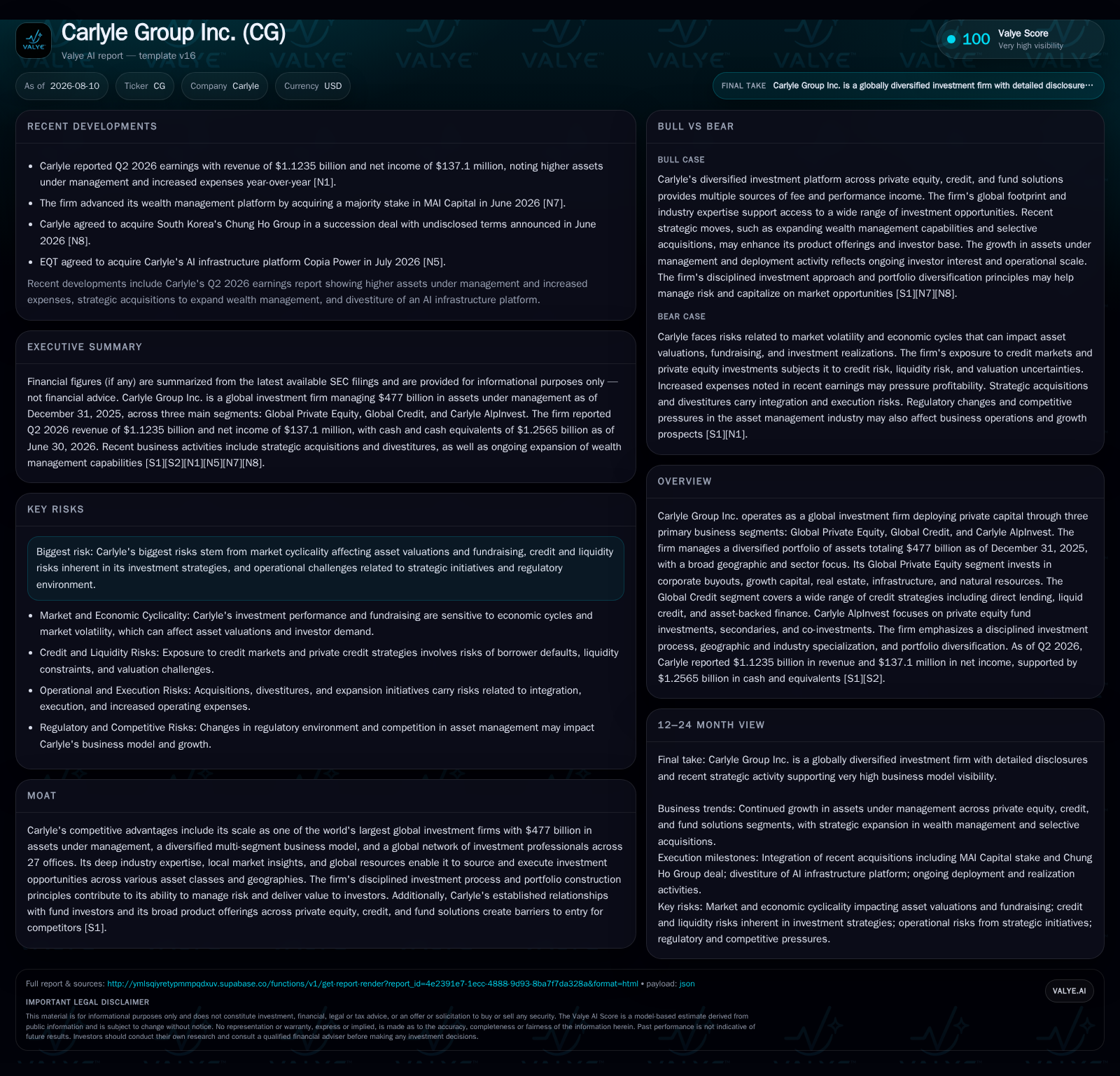
Carlyle Group’s latest quarterly filing reveals strengthening operating momentum as assets under management (AUM) continue to grow through robust fundraising and disciplined capital deployment. The firm’s diversified platform spanning Global Private Equity, Global Credit, and Carlyle AlpInvest supports stable management fees and fluctuating performance fees linked to investment exits. Despite market volatility affecting carried interest recognition, Carlyle reported $1.12 billion in revenue and $137 million in net income for Q2, reflecting progress in scaling fee-earning assets. Its global reach and multi-strategy approach position it well against peers like Blackstone and KKR, though cyclicality and execution risks remain key watchpoints for the remainder of 2026.
Q2 Operating Momentum: Multisegment Capital Deployment Drives Fee Growth
Carlyle Group’s second quarter of 2026 highlights continued momentum in asset growth supported by strong capital inflows and active investment deployment across its diversified platform [S2]. The firm reported revenue of approximately $1.12 billion with net income of $137 million for the quarter, evidencing steady progress despite fluctuations in performance fee components driven by market volatility
Central to this progress is Carlyle’s ability to attract substantial commitments from limited partners (LPs), with full-year 2025 inflows reaching $53.7 billion—a significant increase over prior periods—and deployment exceeding $54 billion across its investment segments during the year [S1]. These trends have extended into the first half of 2026, underpinning a growing fee-bearing asset base that supports recurring management fees.
The company’s strategic allocation emphasizes diversification both by asset class—spanning corporate buyouts and growth equity within Global Private Equity; direct lending and structured credit products in Global Credit; plus secondaries and co-investments via Carlyle AlpInvest—and geographically through its network of 27 offices worldwide [S1][S2]. This breadth mitigates concentration risks while enabling Carlyle to capitalize on dislocations or evolving investor demand across regions.
However, the firm’s revenue mix reflects inherent cyclicality tied to performance fees derived from carried interest [S2][S1]. While management fees scale predictably with rising AUM (which stood at $477 billion as of December 31, 2025), performance fees are subject to timing of exits and valuation changes within portfolio companies. Market volatility during early-to-mid 2026 has tempered upside potential in carried interest accruals, evidenced by swings in net investment gains/losses on consolidated funds reported this quarter
Business Model: Revenue Streams Anchored by Scale and Investor Alignment
Carlyle operates a business model centered on managing private capital committed by institutional investors under long-term arrangements typically lasting a decade or more. Revenues largely derive from management fees—calculated as a percentage of AUM—providing stable recurring income streams, complemented by performance fees (carried interest) that accrue when investments exceed return hurdles.
Its three core segments articulate these activities distinctly. Global Private Equity focuses on buyouts, growth equity, real estate, infrastructure, and natural resources investments. The segment’s fundraising successes include flagship funds like its largest U.S. real estate fund "CRP X" alongside IPOs spanning Japan, India, and the U.S., which provide exit liquidity critical for performance fee realization [S1]
Global Credit encompasses direct lending augmented by structured credit products such as CLO issuances; it deployed $29.9 billion in 2025 alone, more than doubling prior years’ activity levels [S1]. Carlyle AlpInvest specializes in secondary market transactions and co-investments alongside fund interests, enhancing portfolio diversification
This segmentation enables Carlyle to offer LPs diversified exposure across private markets while smoothing earnings volatility since declines in one area can be offset by steadier streams elsewhere.
Competitive Landscape: Scale and Diversification Versus Leading Peers
Within global alternative asset management, Carlyle ranks alongside major players like Blackstone Group and KKR & Co., each operating multi-strategy platforms combining private equity with expanding credit businesses but differing slightly in product emphasis or geographic focus.
Blackstone notably leads in real assets alongside private equity and credit innovation; KKR balances private markets exposure with growing credit capabilities; Apollo Global Management is distinguished by its credit-centric strategies including opportunistic lending.
Carlyle differentiates itself through deep sector expertise delivered by locally embedded teams combined with breadth across public-to-private transitions facilitated via AlpInvest’s secondary investments platform. This global network provides a competitive moat through enhanced deal sourcing capabilities not easily replicated by smaller or less diversified firms.
Growth Drivers: Fundraising Strength Meets Expanding Demand for Alternatives
Robust fundraising underpins much of Carlyle’s recent AUM growth amid intensifying competition for limited partner capital allocations driven by institutional appetite for alternatives beyond traditional asset classes.
Successful closes of flagship funds such as CAP VI in Asia and life sciences-focused pools underscore Carlyle’s ability to meet sophisticated investor mandates targeting thematic sectors or regional innovation clusters [S1][S2]. Increasing allocations to direct lending strategies amid low-rate environments bolster demand for flexible credit solutions provided by the Global Credit segment. Similarly, growth in secondary markets driven by LPs seeking liquidity supports AlpInvest’s scaling efforts.
Macro tailwinds include low yields in public markets prompting rebalancing toward private assets; regulatory changes favoring private capital deployment; and demographic factors increasing pension funds’ need for long-duration assets aligned with private market risk-return profiles.
Management commentary during the Q2 earnings call emphasized maintaining fundraising momentum balanced against disciplined capital deployment aimed at portfolio quality preservation rather than volume chasing—critical for fee stability amid volatile fundraising cycles [N4][S2]
Risks & Watchpoints: Cyclicality and Execution Challenges Amid Uncertainty
Despite positive drivers, several risks warrant attention:
- Market cyclicality remains a key vulnerability as economic fluctuations affect portfolio valuations that influence unrealized gains and carried interest accruals.
- Geopolitical tensions particularly impacting Asia-Pacific regions integral to some funds introduce uncertainty affecting supply chains or regulatory regimes [S1].
- Regulatory evolution globally demands heightened compliance efforts increasing operational complexity.
- Execution risk arises from managing a broad geographic footprint requiring effective coordination among investment teams plus integration of technology resources supporting due diligence and risk oversight [S1].
- Competition intensifies for scarce high-quality deal flow among large alternative managers; sustaining proprietary insights or scale advantages is essential.
Forward Indicators: What To Monitor In Upcoming Quarters
Key operational metrics will provide insight into Carlyle’s trajectory: - Fundraising progress relative to targets indicates sustainability of AUM growth. - Exit volumes via IPOs or sales impact realized proceeds driving carried interest visibility. - Capital deployment pace balanced against quality controls affects future management fees while preserving portfolio integrity. - Expense trends reveal cost discipline essential for distributable earnings margins. - Shifts in client composition toward new strategies or geographies could signal strategic pivots enhancing competitiveness [N4][S2]. These factors collectively offer deeper understanding beyond headline earnings reflecting underlying business-model health critical for medium-term outlook accuracy
Financial Profile Discussion: Liquidity, Profitability & Leverage Snapshot
At quarter-end June 30, 2026, Carlyle held approximately $1.26 billion in cash supporting short-term liquidity needs amid complex operations [F1]. Total debt last disclosed at about $6.5 billion dates back to end-2023 without update from current quarter filings; thus net leverage context remains unclear but aligns broadly with industry norms balancing debt costs against yield generation within portfolios [F1].
Profitability reflects effective conversion of growing fee-bearing assets into tangible income despite fluctuations in performance-related components—net income was $137 million for Q2 after absorbing elevated expenses tied to staffing expansions and technology investments discussed during earnings calls [S2][N4]
Overall, Carlyle maintains a financially sound profile characterized by adequate liquidity reserves coupled with prudent leverage usage common among peers—factors supporting investor confidence amid variable market conditions.
This analysis synthesizes information from SEC filings through August 10, 2026 ([S1], [S2], [S3]), corroborated news reports (), and validated financial data ([F1]). It aims to provide an informed perspective rooted in detailed operating evidence combined with established industry understanding.
Disclaimer: This is research-only, informational analysis and not investment advice. It may include AI-generated interpretation and general industry context. Always verify important details using primary sources.

Comments