
NIKA Pharmaceuticals Balances Exclusive Licensing with Manufacturing Expansion Amid Liquidity Challenges
NIKA Pharmaceuticals focuses on proprietary prescription drugs and dietary supplements with exclusive rights and manufacturing ventures, facing near-term liquidity constraints.
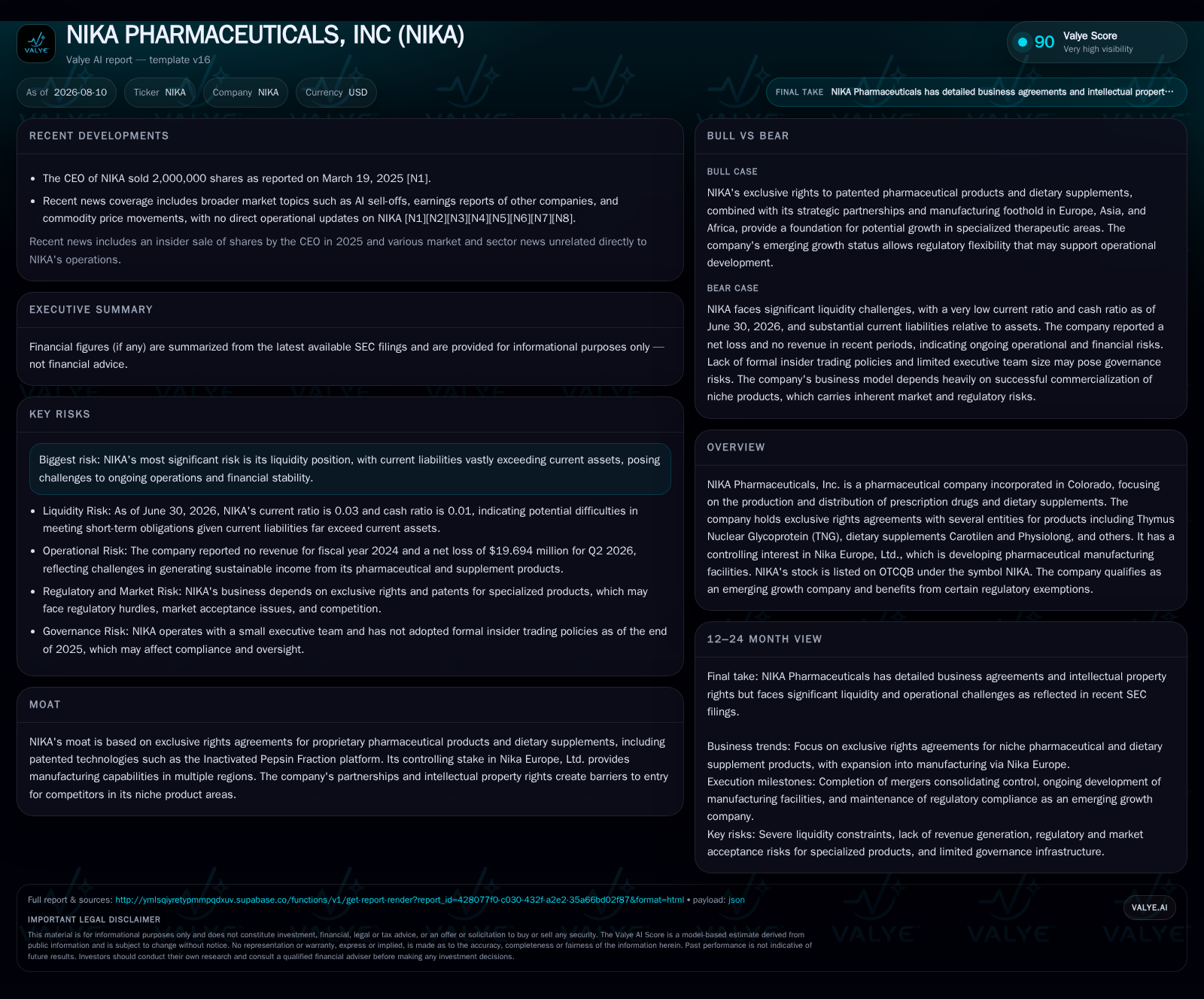
NIKA Pharmaceuticals leverages long-term exclusive rights agreements for niche pharmaceutical products and dietary supplements, supporting its position through intellectual property and an expanding manufacturing footprint in Europe. The company’s growth hinges on product commercialization of compounds like Thymus Nuclear Glycoprotein (TNG) and patented supplement formulations, while navigating its status as an emerging growth company that offers regulatory flexibilities. However, significant liquidity pressures highlighted by a current ratio near 0.03 and net debt over $330,000 pose substantial operational risks. The firm’s strategic focus on exclusive licensing and joint ventures could support future scalability if financial stability improves.
Recent Operating Update
NIKA Pharmaceuticals’ latest quarterly report as of August 10, 2026, reiterates its ongoing operations in exclusive licensing and manufacturing development without reporting revenue generation to date [S2][F1]. The firm discloses no current requirement to detail risk factors under Form 10-Q due to smaller reporting company status.
Despite this, balance sheet metrics as of June 30, 2026, indicate cash & equivalents totaled $2,932 while current liabilities were $340,624, resulting in an acute current ratio near 0.03—a precarious liquidity position that raises concerns about operational continuity absent capital infusions or debt restructuring [F1]
Despite this financial pressure, NIKA continues strengthening strategic assets such as its controlling stake in Nika Europe, Ltd., aiming to establish substantial pharmaceutical manufacturing facilities capable of producing multiple dosage forms to supply its licensed products across broad geographies including Europe, Asia, and Africa [S5]. This move situates NIKA midstream in the pharma value chain where proprietary formulation development blends into expanded production capabilities—key to scaling revenue beyond licensing fees into product sales.
Business Model Analysis
NIKA fundamentally operates under a business model centered on acquiring exclusive rights via long-term licensing agreements for both prescription pharmaceuticals and specialty dietary supplements. Notably, the company secured a 15-year exclusivity agreement with VITAL FE Joint Stock Company for Thymus Nuclear Glycoprotein (TNG), a Phase III clinical trial-stage drug targeting HIV/AIDS immunomodulation originally evaluated in the late 1990s [S1][S7]. This IP underpinning allows NIKA to pursue commercialization rights without engaging directly in early-stage drug discovery—a common cost-intensive hurdle faced by biotech peers.
Complementing TNG are dietary supplement licenses obtained from MICAR 11 Ltd., including Carotilen and Physiolong. These products are positioned anatomically to support epithelial metabolism regulation, immune system fortification, convalescence stimulation, and physical/mental recovery through patented soft gelatin capsule formulations [S1][S7]. Exclusivity over these niche nutraceuticals may command higher margins than commodity supplements if effectively commercialized through targeted distribution channels.
Revenue mechanics depend primarily on two levers: direct sales contracts for products manufactured internally or via partners like Immunotech Laboratories BG's IPF platform, which benefits from US patents granted for formulations based on Inactivated Pepsin Fraction technology; and licensing fee income rooted in territorial exclusivities across multiple continents [S7][S5]. Production costs are shared equally with joint venture partners under agreements typically spanning nine years or longer terms.
Margins are likely sensitive to manufacturing scale efficiencies at the new facility under construction in Europe. Once operational capacity is reached—covering injection and tablet forms—NIKA can better leverage fixed costs reducing COGS per unit. However, initial capital outlays and variable costs associated with quality control compliant with stringent pharmaceutical regulations will presumably depress margins until scale matures.
Industry Structure and Competitive Position
Operating within the mid-to-late value chain segment of pharmaceuticals and dietary supplements distinguishes NIKA from early-stage biotech firms focused on discovery or late-stage clinical entities awaiting regulatory approval. Its niche targeting immunomodulatory drugs such as TNG places it alongside public biotech companies developing similar therapies but with more advanced phase III data or established partnerships.
In the dietary supplement arena, NIKA competes against numerous non-patented general health product providers; however, ownership of patented technologies like IPF capsules introduces moderate barriers to entry relative to unprotected formulas common among peers. Furthermore, exclusive geographic licensing adds distribution channel control not typically found among generic supplement producers.
Peers encompass a blend of contract manufacturing organizations (CMOs) expanding production capabilities for small pharma clients; pharmaceutical manufacturers focusing on immune treatments; and specialty supplement firms protecting product uniqueness via patents. NIKA’s partnership-centric model resembles emerging growth OTC-listed companies working through collaborations rather than vertically integrated R&D-commercialization frameworks.
Growth Drivers
Key growth drivers include:
- Exclusive Licensing Exploitation: Capitalizing on rights agreements to introduce licensed products into international markets remains fundamental. Scaling sales of TNG or nutraceuticals would propel top-line recognition beyond currently unreported revenue levels [F1][S1].
- Manufacturing Capacity Expansion: Completion and commissioning of the European pharmaceutical factory promises to increase production scale across multiple formulations. Higher output could improve margin profiles while enabling prompt supply commitments aligned with market demand signals.
- Strategic Partnerships: Continued collaboration with Immunotech Laboratories BG fosters co-development opportunities leveraging patented IP platforms that might fuel pipeline breadth expansion into related immunomodulatory therapies or improved supplement lines over time [S7].
- Emerging Growth Company Status: This designation allows NIKA incremental flexibility in accounting standards adoption; mitigating near-term compliance expense burden which can be redirected toward operational milestones instead [S6].
- Market Demand Trends: Rising global awareness around immune health supplementation combined with increasing prevalence of target conditions can drive consumer uptake if effective marketing channels materialize.
Risks and Constraints
NIKA faces several acute risks including:
- Liquidity Crisis: Cash depletion reflected by extreme current ratio metrics signals imminent funding needs which if unmet could jeopardize day-to-day operations or planned factory build-out continuation without debt restructuring or equity raises [F1].
- Limited Revenue History: Absence of recognized revenue despite operating since at least early 2024 highlights execution risks related to product commercialization timelines or regulatory market entries.
- Dependency on Licensing Partners: Heavy reliance on third-party IP owners such as VITAL FE or MICAR constrains autonomous product innovation scope; any disputes or license terminations could materially impact future prospects [S1][S5].
- Regulatory Hurdles: Given complex approval pathways for prescription drugs like TNG plus compliance burdens for manufacturing pharmaceuticals at scale, delays can stall revenue generation indefinitely.
- Governance Concerns: Limited executive team size without formal insider trading policies might heighten oversight weaknesses common in early-stage OTC companies affecting investor confidence [S9].
- Market Competition: Broader pharmaceutical competition from generic immunotherapies plus entrenched supplement brands offering alternative nutrition solutions challenge NIKA’s ability to gain meaningful market penetration quickly.
What To Watch Next
Analyst attention should focus on several milestones:
- Progress Updates from Nika Europe Facility: Timelines regarding construction completion phases and commissioning stages will indicate capacity utilization feasibility—key for scaling sales volumes.
- Commercial Launch Announcements: Entry dates for TNG distribution or dietary supplement rollout into covered regions will provide tangible revenue visibility.
- License Renewal Negotiations or New Agreements: Expanding the portfolio of exclusive rights beyond current arrangements could diversify product mix reducing concentration risks.
- Working Capital Improvements: Any capital raise disclosures altering cash runway assumptions will be pivotal to sustaining operational activities given entrenched net debt levels.
- Regulatory Filings for Product Approvals: Approvals or setbacks reported will directly affect pipeline viability assessments as much historic clinical data remains over two decades old.
Financial Profile Discussion
As of June 30, 2026, NIKA Pharmaceuticals exhibits considerable financial strain that constrains near-term growth execution options. Cash & equivalents stood at $2,932 while total debt approximated $340,624 yielding net debt close to $337,692—a levered position exacerbated by a meager $9,942 in current assets versus identical-sized current liabilities resulting in a razor-thin current ratio near 0.03 [F1]. Such imbalance reflects potential accounting classifications possibly inclusive of loans payable but nonetheless signals critical liquidity squeeze requiring immediate financing action to continue business functions safely.
In summary, while NIKA’s asset base anchored by exclusive intellectual property rights combined with manufacturing footholds establishes a foundation for future growth in niche pharmaceutical areas supported by demonstrated clinical proof points from legacy trials; substantial liquidity challenges coupled with nascent revenue streams constitute major watchpoints requiring active remediation over subsequent quarters.
Disclaimer: This is research-only, informational analysis and not investment advice. It may include AI-generated interpretation and general industry context. Always verify important details using primary sources.

Comments