
Target Hospitality Strengthens Revenue Visibility Amid Industry Cyclicality with Vertical Integration
Target Hospitality leverages long-term contracts and modular lodging assets to sustain revenue despite sector volatility.
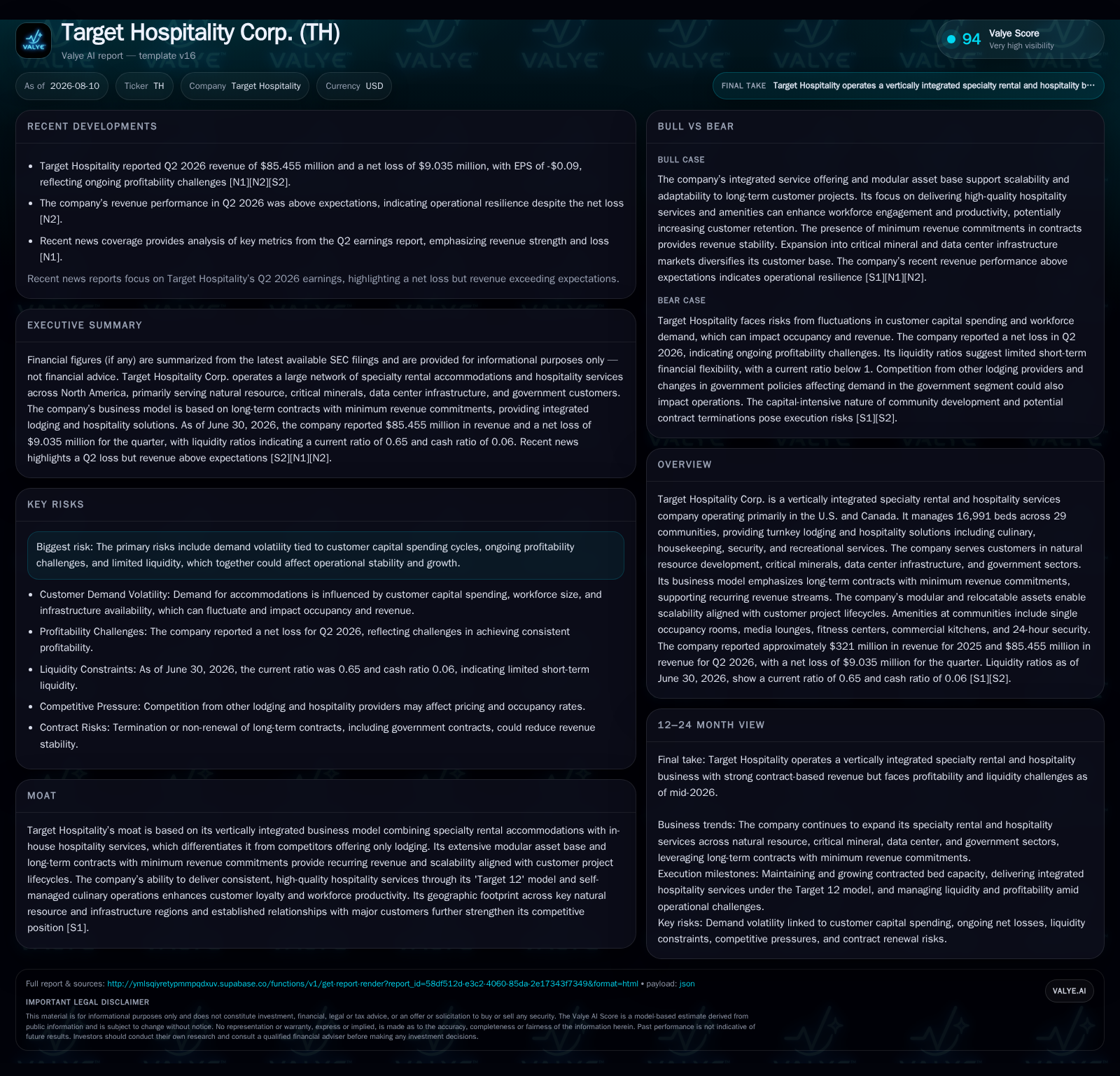
Target Hospitality Corp. reported stable operational scale managing nearly 17,000 beds across North America within specialty rental and hospitality services primarily serving natural resource and infrastructure sectors. The company’s business model centers on long-term, minimum revenue commitment contracts that underpin recurring revenue streams and align with customer project lifecycles. Its vertically integrated service offering, encompassing modular lodging and in-house culinary and hospitality services, differentiates it from peers focused solely on lodging. However, operating losses and liquidity constraints persist amid demand cyclicality tied to capital spending fluctuations in key end markets. Monitoring contract renewal trends, occupancy rates, and working capital dynamics will be key to assessing future stability and growth.
Recent Operating Update: Q2 2026 Context
Target Hospitality’s latest quarterly filing dated August 10, 2026 [S2] reveals continued operational scale managing specialty rental accommodations across its established footprint of approximately 16,991 beds in 29 communities throughout the U.S. and Canada. This capacity mix primarily comprises modular lodging units that are both interchangeable across geographic regions and relocatable to match evolving customer project timelines — a critical flexibility given the multi-phase nature of natural resource and infrastructure development projects it supports [S1]. Importantly, nearly all revenues remain contractually secured with long-term agreements featuring minimum revenue commitments that underpin recurring income visibility.
While Target Hospitality surpassed revenue estimates for Q2 2026 according to market reports [N2], it also sustained operating losses reflecting ongoing profitability challenges during occupancy rate fluctuations inherent to its sector’s cyclical capital spending environment [S2][N1]. Liquidity continues to be constrained as indicated by a current ratio of approximately 0.65 at June-end 2026 alongside net debt near $175 million [F1], underscoring the delicate balance between managing working capital demands linked to project phasing and service delivery costs.
Management emphasizes maintaining high client retention with historical renewal rates above 90%, supported by their integrated hospitality service model which adds value beyond simple lodging provision [S1]. The company's August investor call reinforced these points while spotlighting operational execution as vital during industry headwinds [S3].
Business Model Overview
Target Hospitality operates within the specialty rental and hospitality services industry by providing turnkey workforce accommodations combining modular lodging assets with in-house culinary services, housekeeping, security, recreational amenities, and site management solutions. This vertical integration distinguishes the company relative to peers limited to rental lodging alone. Revenue is generated through leasing these modular units under long-term contracts that generally include minimum revenue guarantees ensuring baseline cash flows irrespective of utilization levels.
Contract structures average about five years in length with exclusivity provisions that foster high switching costs for customers who rely on consistent service quality across multiple regions. Long-term minimum revenue commitments protect against income volatility from fluctuating workforce sizes during different project phases. Furthermore, Target Hospitality’s redeployable asset base enables scaling capacity up or down efficiently in line with evolving demand — a competitive edge compared to fixed-location alternatives.
Operating margins reflect a blend of lodging rental yields augmented by higher-margin ancillary hospitality services delivered via the 'Target 12' proprietary model emphasizing culinary excellence and customer experience enhancements designed to improve workforce productivity and satisfaction.
Industry Structure and Competitive Position
The specialty rental/hospitality sector serves multi-industry project-driven workforces often located in geographically constrained or infrastructurally immature settings. Key competitors span from specialized modular lodging providers such as Black Diamond Group to hospitality outsourcing firms lacking asset ownership. Target Hospitality’s vertical integration across both asset leasing and full-service hospitality presents a meaningful moat by simplifying vendor management for clients while enabling tighter quality control.
Furthermore, its footprint concentrated in North American resource-intensive regions including parts of the Southwest U.S., Midwest states, Nevada, plus Canadian territories aligns with ongoing capital expenditures across several high-growth segments like critical minerals extraction vital for electrification supply chains [S1]. This geographic positioning enhances customer access while mitigating risk concentration inherent in single-region operators.
Benchmarks within the sector highlight contract renewal rate stability above industry norms coupled with minimum revenue commitments providing resilient backlog visibility. Target Hospitality’s weighted average contract length of around five years exceeds typical durations seen at peer lodging-only companies where short-term leases prevail.
Growth Drivers
Several structural growth factors underpin demand:
- Natural Resource and Critical Minerals Development: Rising global energy transition standards heighten investment in mining projects requiring extensive workforce housing solutions.
- Data Center Infrastructure Expansion: Increasing digitalization mandates significant construction activity often outside urban centers where local housing is scarce.
- Government Workforce Housing Contracts: Federal investments in infrastructure modernization foster stable requirements for turnkey accommodation services.
- Outsourcing Trends: Industrial clients increasingly prefer integrated hospitality providers to mitigate operational complexity internally.
- Modular Asset Scalability: Ability to deploy relocatable lodging units rapidly aligns well with multi-phase project growth cycles reducing capital inefficiencies.
- Geographic Market Expansion: Entering new resource-rich regions sustains pipeline diversification reducing concentration risk.
- Enhanced Service Offerings: Elevating culinary and guest experience supports differentiated positioning driving loyalty.
Risks and Watchpoints
Despite these strengths, Target Hospitality faces persistent headwinds:
- Demand Volatility: Exposure to cyclical capital spending patterns means quarterly occupancy rates can fluctuate materially impacting profitability potential [S1].
- Liquidity Constraints: Operating losses combined with modest current ratio (~0.65) highlight tight working capital necessitating careful cash management [F1].
- Contract Renewal Risk: Although historical renewal exceeds 90%, any significant non-renewals could disrupt cash flow stability given client concentration.
- Lease Renewal Uncertainties: Ownership or leasing terms on land hosting communities introduce risks if arrangements cannot be extended favorably.
- Labor Availability: Retaining skilled hospitality workers at remote sites affects service quality metrics crucial for customer satisfaction.
- Operating Cost Inflation: Rising wages/material costs pressure margins absent commensurate price adjustments.
- Natural Disasters/Disruptions: Remote locations face elevated risk profiles for unexpected shutdowns affecting operations.
- Regulatory Complexities: Compliance requirements especially related to government contracts pose adherence risks potentially incurring penalties or delays.
What To Watch Next
Investors should monitor upcoming milestones including:
- Quarterly occupancy rates per region indicating demand strength or softness.
- Contract renewals securing or expanding minimum revenue commitment backlog over forthcoming quarters.
- Capital deployment announcements supporting asset base growth or community expansions aligned with new projects.
- Updates on any refinancing efforts addressing liquidity or leverage metrics within the balance sheet context [S2][F1].
- Operational efficiency initiatives offsetting inflationary pressure impacting EBITDA margins.
- Management commentary regarding customer diversification efforts particularly toward emerging critical minerals projects or data center clients.
- Service quality metrics or customer satisfaction survey results reinforcing moat sustainability through elevated hospitality offerings.
Financial Profile Discussion
At June 30, 2026, Target Hospitality held approximately $6.07 million in cash equivalents juxtaposed against current liabilities near $98.85 million yielding a conservative current ratio of about 0.65 [F1]. This signals tight near-term liquidity requiring judicious management amid fluctuating working capital needs related to ongoing project execution. Total debt stands around $181 million last verified March 31, 2024 [F1], reflecting substantial leverage relative to available liquid assets but consistent with an asset-heavy operation where modular lodging units serve as collateralizable infrastructure.
Free cash flow generation remains challenged under these conditions; however strategic emphasis on securing longer-duration contracts embedded with minimum revenue commitments offers some downside protection by anchoring recurring revenues regardless of short-term volume dips [S1]
This analysis highlights Target Hospitality’s positioning as a vertically integrated specialist in workforce accommodations serving sectors vulnerable to capital cycles but supported by contractual safeguards like minimum revenue commitments that enhance revenue visibility compared to non-integrated peers. Its core strengths rest on scalable modular assets combined with turnkey hospitality services fostering high client retention rates above industry norms.
Disclaimer: This is research-only, informational analysis and not investment advice. It may include AI-generated interpretation and general industry context. Always verify important details using primary sources.

Comments