
Clorox Expands Health and Hygiene Reach with GOJO Acquisition Driving Growth
Clorox’s recent quarterly results highlight growth from its GOJO acquisition while grappling with ERP-related margin pressures and integration challenges.
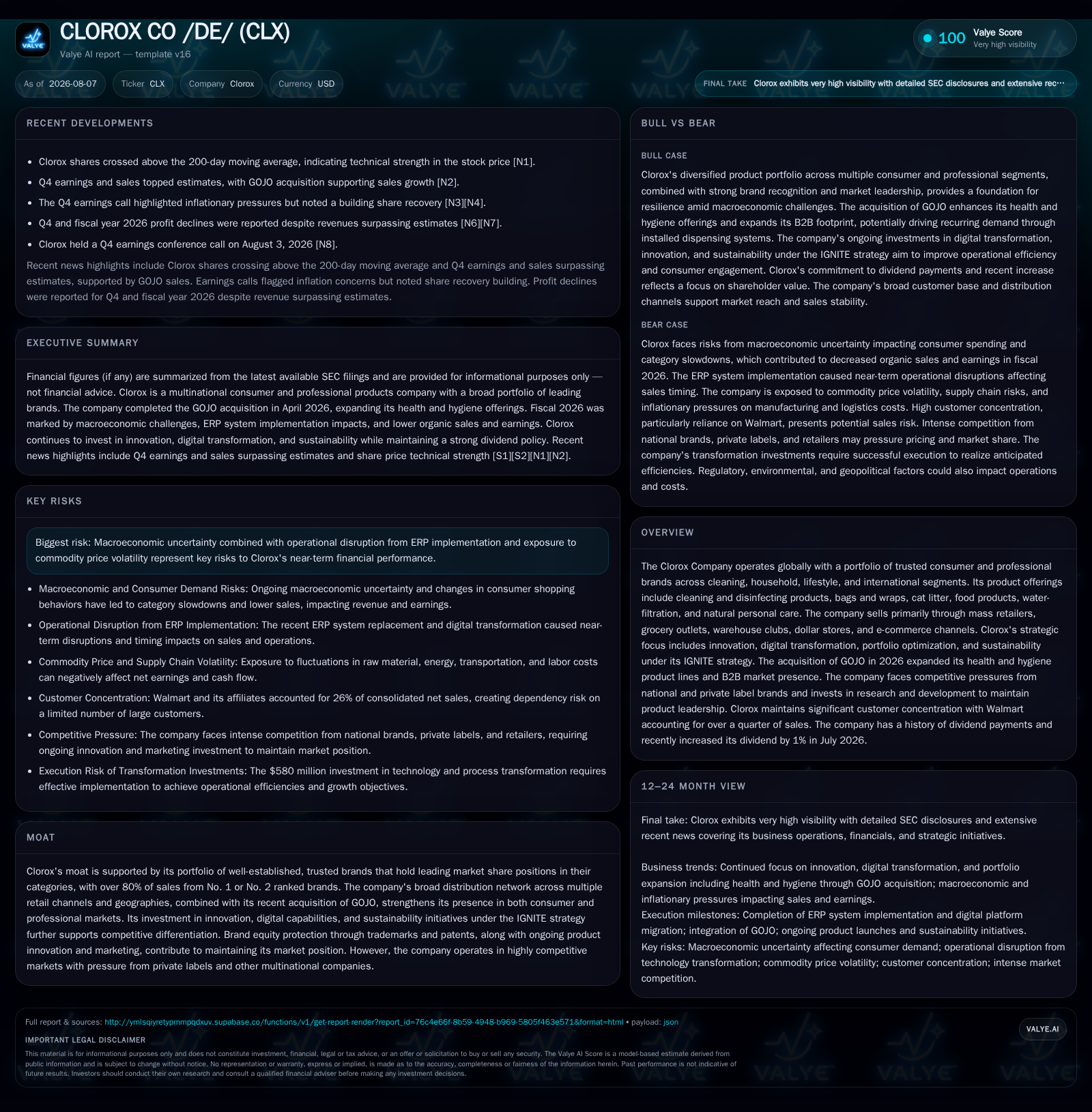
In Q3 2026, Clorox demonstrated a dynamic operating environment as the integration of GOJO's health and hygiene portfolio fueled segment sales growth even amid near-term disruptions from a major ERP rollout. The company continues to leverage its trusted brands across diversified channels including mass retail and B2B, while navigating margin compression driven by operational inefficiencies and commodity cost volatility. Clorox's strategic IGNITE plan balances innovation, digital transformation, and portfolio optimization to sustain long-term growth prospects despite competitive pressures and customer concentration risks. Key markers to watch include ERP stabilization progress, realization of acquisition synergies, and trade promotion effectiveness.
Q3 Operating Dynamics: Acquisition Strength Meets ERP Disruption Headwinds
Clorox’s third quarter ending March 31, 2026 offers a pivotal snapshot where strategic expansion via acquisition intersects with internal operational challenges. The Health & Wellness segment showcased robust net sales of $630 million supported significantly by the newly acquired GOJO business (operating as Clorox Purell), which enhanced the company's footprint in institutional hygiene markets [S2]. This B2B channel expansion leverages GOJO's established installed base of dispensing systems that drive recurring demand—an important diversification beyond traditional consumer channels.
However, this growth was tempered by gross margin pressure linked to the company’s enterprise resource planning (ERP) system rollout. The implementation introduced temporary inefficiencies impacting order-to-cash cycles, inventory management, and supply chain logistics [S2], [S14]. These operational disruptions coincided with elevated SG&A expenses partly due to increased marketing efforts and residual cybersecurity costs associated with a prior cyberattack net of insurance recoveries [S2]. Such short-term dilution in profitability is notable as it affects adjusted EBIT despite an overall segment adjusted EBIT aggregate of $321 million across all segments.
This dual dynamic illustrates how Clorox’s near-term financial performance incorporates both momentum from strategic asset additions and transient headwinds from digital transformation initiatives—a balance critical for analysts monitoring segment margin recovery trajectories.
Multi-Segment Revenue Architecture Anchored by Trusted Brands and Channel Breadth
Clorox’s revenue model revolves around four reportable segments: Health & Wellness; Household; Lifestyle; and International [S1], [S9]. Each segment contributes through a portfolio dominated by household names such as Clorox® cleaning products, Glad® bags and wraps (now fully owned post-P&G joint venture buyout), Brita® water-filtration systems, Burt’s Bees® natural personal care offerings, Fresh Step® cat litter, among others. Over 80% of total sales stem from brands ranking No. 1 or No. 2 in their categories [S1], underscoring deep brand equity as a core moat protecting against private-label encroachment.
Distribution channels extend across mass retailers including grocery chains, warehouse clubs like Costco or Sam’s Club, dollar stores targeting value consumers, home hardware outlets, drugstores as well as increasingly important e-commerce platforms [S1]. This broad omnichannel presence helps mitigate concentration risk but also requires intricate category management to optimize SKU assortments amid marketplace consolidation trends [S9]. To this end, Clorox's IGNITE strategy actively pursues SKU rationalization alongside innovation-driven new product launches (e.g., Clorox PURE wipes and Fresh Step Lightweight Litter) that respond to evolving consumer preferences for convenience and sustainability [S14].
The termination of the Glad joint venture has posed standalone operational challenges stemming from lost shared R&D resources previously provided by P&G. Clorox must now independently sustain innovation pipelines while managing licensing agreements for essential IP supporting Glad products [S12]. This change highlights a material shift in research collaboration dynamics within the Household segment.
(Re)Defining Competitive Moat amid Private Labels and Multiplier Peers’ Moves
In highly commoditized categories like household cleaning supplies and bags/wraps where private-label penetration rises steadily, Clorox leverages brand reputation combined with product performance differentiation backed by consistent trade promotion investment [S25]. Compared with multinational CPG peers like Procter & Gamble or Reckitt Benckiser who also invest heavily in hygiene portfolios via acquisitions (e.g., Reckitt’s prior integrations of health products), Clorox must balance scale advantages versus agility afforded by focused brands.
Brand loyalty remains fundamental as consumers weigh attributes such as efficacy against lower-cost alternatives offered by store brands at major retailers. Marketing spend efficiency becomes key when competition includes discount grocers expanding private-label ranges—pressuring gross margins through yield management on pricing tiers [S25]. Moreover, retailer consolidation enhances buyer power; large customers negotiate tougher trade terms or impose packaging requirements that can elevate costs or limit promotional flexibility [S9].
The addition of GOJO into professional health/hygiene channels provides Clorox a differentiated lever for recurring revenue streams leveraging installed dispensing units—a strategic edge less exposed to typical shelf-space constraints faced in consumer retail aisles.
Growth Catalysts: Innovation, Digital Advancements, and Portfolio Expansion Post-GOJO Buyout
Growth initiatives revolve around accelerating product innovation within high-potential categories underpinned by IGNITE strategy objectives [S1], [S14]. This includes ongoing launches across multiple segments showcasing line extensions tailored for premiumization (e.g., Burt’s Bees lip care expansions) and sustainability-oriented offerings responding to consumer environment-consciousness.
Digital transformation extends beyond ERP stabilization towards enhanced e-commerce penetration efforts. Clorox aims to optimize shopper engagement via data-driven merchandising tactics encompassing dynamic pricing models, search ranking prominence on retailer websites, and targeted digital advertising calibrated for consumer behavior shifts [S14]. Accelerated adoption of e-commerce bolsters direct interaction metrics—an important growth vector offsetting decelerating brick-and-mortar traffic amid macroeconomic headwinds.
Acquisition-led diversification remains central with the integration of GOJO not only broadening product mix but deepening B2B market access—especially institutional healthcare—which is less susceptible to volatile consumer demand patterns. This strategic rebalancing enriches recurring revenue potential compared with primarily one-off consumer packaged goods purchases.
Systemic Risks: Commodity Inflation, Integration Complexity, Customer Concentration Effects
Price volatility of raw materials such as resin for plastic packaging or disinfectant chemicals directly affects gross margins—and fluctuating input costs challenge pricing strategies that risk volume loss if passed incompletely to retail customers [S7], [S25]. Supply chain interruptions related to ERP implementation compound cost pressures through inefficiencies or delayed order fulfillment impacting customer satisfaction metrics.
Customer concentration represents another salient risk factor; major retailers including Walmart exert sizeable negotiating leverage influencing pricing thresholds or promotional cadence negatively affecting net sales or trade spending ratios [S9]. Similarly post-GOJO acquisition exposure increases dependence on consolidated distributors or group purchasing organizations within healthcare sectors potentially affecting contract renewals/pricing power.
Integration risk permeates both acquisitions (GOJO) requiring personnel alignment plus technology/system harmonization alongside standalone segment changes such as Glad business separation from P&G joint venture R&D support [S12]. Failure to deliver anticipated synergy benefits expeditiously may temper profit recovery timelines.
What to Monitor Next: Execution Markers for ERP Stability, Acquisition Synergies, Market Share Recapture
Critical indicators for near-term performance include measurable cadence in ERP process normalization evident through improved supply chain KPIs (inventory turnover rates; order cycle times), gradually improving gross-margin percentages signaling mitigation of disruption costs alongside optimized trade spend efficiency enhancing volume gains [S2], [N1].
Further integration milestones will unfold regarding GOJO assimilation focusing on cross-selling opportunities between consumer hygiene products and professional markets plus synergy realization visible in future adjusted EBIT contributions above Q3 levels. Observing new product revenue contributions will indicate innovation success against competitive private labels.
Retailer relationship dynamics warrant close attention especially contracts renewal status reflecting impacts on pricing/mix coupled with distribution reach stability in evolving channel structures including growth in e-commerce share percentage.
Financial Profile Discussion
As of fiscal Q3 end in March 2026, Clorox reported cash and cash equivalents totaling approximately $1.19 billion against current liabilities exceeding $3.15 billion resulting in a current ratio below unity at 0.84 suggesting working capital management remains challenged amidst ongoing transformations [F1], [S2]. Total debt stands near $2.48 billion reflecting elevated leverage primarily attributable to the financing of the $2.15 billion GOJO acquisition closed earlier in April 2026 along with payouts related to Glad joint venture buyout from P&G amounting to $476 million paid in March 2026 [S5], [S19].
This increased indebtedness places constraints on liquidity flexibility while raising interest expense burdens adversely impacting net income margins if not offset quickly by accretive earnings growth from acquisitions or operational improvements. Management acknowledges credit rating pressure given S&P downgrade earlier in the year though maintaining investment-grade status currently limits refinancing cost upticks momentarily [S5]. Dividend policy continuity will depend on free cash flow generation trending positively post-ERP stabilization facilitating deleveraging priorities yet preserving shareholder returns.
Disclaimer: This is research-only, informational analysis and not investment advice. It may include AI-generated interpretation and general industry context. Always verify important details using primary sources.

Comments