
Liquidity Strength and AI Integration Define RICHTECH ROBOTICS’ Quest for Commercial Scale
RICHTECH ROBOTICS combines strategic U.S. facility investment with advanced AI partnerships amid ongoing internal control remediation.
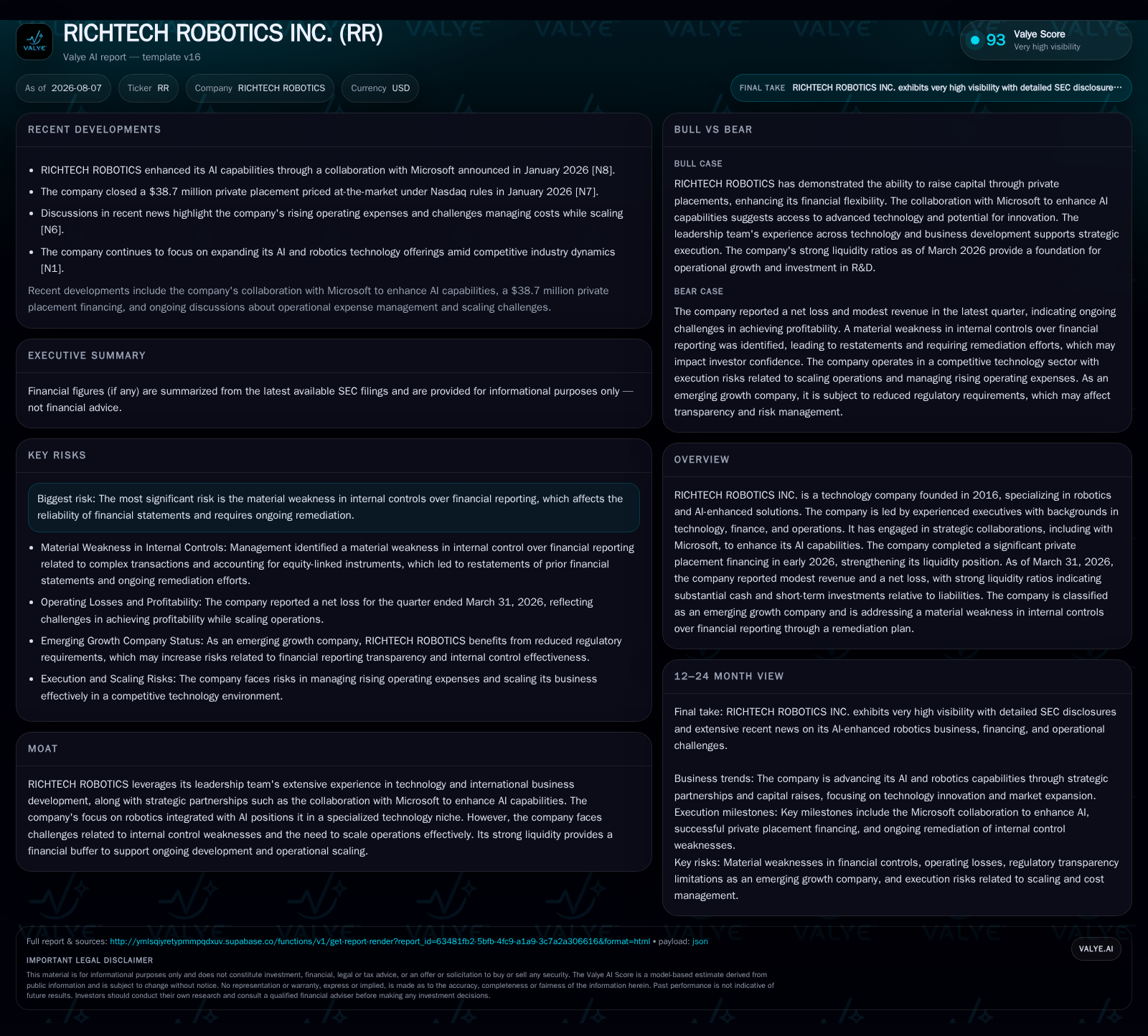
RICHTECH ROBOTICS is advancing from R&D toward scalable commercial service robotics deployment by acquiring a U.S.-based manufacturing and testing facility, strengthening its operational infrastructure. The company’s strategic collaboration with Microsoft enhances its AI-driven robot autonomy capabilities, critical in the competitive service robotics landscape. Despite modest revenue and sustained operating losses, Richtech maintains a robust liquidity position, providing runway for growth investments while managing material weaknesses in internal financial controls that continue to pose risks to compliance and financial reporting.
Strategic Facility Acquisition Signals Transition Toward Scalable Manufacturing
RICHTECH ROBOTICS marked a significant operational inflection point with the acquisition of a 79,325 square foot property in Las Vegas for $21.18 million in cash during the first half of 2026 [S4][S6]. This facility will serve multifaceted purposes including warehousing, assembly, light manufacturing, research and development (R&D), robotic testing, and critically, data collection/model training to enhance the company's AI-embedded robotic systems [S4]. Owning such a facility reduces reliance on third-party suppliers and contract manufacturers, thereby shortening supply chain lead times—a crucial step for transitioning from prototype-scale R&D toward volume deployment capability.
The facility's usage for collecting real-world robotic operating data feeds into continuous improvements through machine learning model training, which is central to advancing robot autonomy—an important product differentiation factor in service robotics. This data-driven refinement loop typically improves uptime and reliability metrics which are vital KPIs affecting customer adoption rates and recurring maintenance contract renewals.
AI Partnership with Microsoft Enhances Core Autonomous Capabilities
RICHTECH’s ongoing strategic collaboration with Microsoft exemplifies its approach to leveraging leading-edge AI infrastructure and algorithms to bolster its embodied AI systems [S1]. Such partnerships provide access to cloud-based computing power, pre-trained AI models, and technical expertise that accelerates the development of autonomous navigation, obstacle avoidance, and task execution capabilities in Richtech's robotic hardware.
This collaboration aligns Richtech within an increasingly technology platform-dependent service robotics ecosystem where software sophistication—not just physical hardware—is a key competitive differentiator. Enhancements from this partnership support more complex service workflows typical in commercial cleaning or indoor delivery applications where robots must safely interact alongside employees—a domain where collaborative robots (cobots) thrive.
Crucially, these AI-powered capabilities enable stronger business model economics through increased potential for software license sales tied to continuous feature upgrades and improved robot performance analytics.
Evolving Business Model Combines Robotics Hardware with Recurring Software Revenue
RICHTECH generates revenue principally through the sales of service robotic units customized for commercial applications such as cleaning and indoor delivery automation [S1]. Alongside initial hardware sales, the company is developing a recurring revenue stream via software licensing fees and maintenance contracts that provide predictable revenues beyond unit shipments
This dual revenue approach mirrors industry leaders such as iRobot’s consumer-facing cleaning robots combined with subscription services. For Richtech, maintenance contracts underscore reliability commitments pivotal for commercial users relying on consistent performance. Software updates under licensing models facilitate ongoing robot autonomy improvements derived from model training driven by operational data collected at scale.
Competitive Environment Demands Innovation amid Capital Intensity
The service robotics sector is characterized by rapid technological evolution requiring substantial R&D outlays to maintain parity or lead over incumbents like Boston Dynamics—with highly mobile multi-terrain robots—and iRobot—which has entrenched consumer market share [S1]. Emerging firms such as Richtech must consistently innovate their embodied AI systems to avoid obsolescence given competitors’ greater financial resources.
Richtech faces typical capital-intensive challenges during transition from development to commercialization including balancing high R&D expenditures against operating losses. Its ability to differentiate through AI integration underpinned by strategic alliances is critical but also intensifies reliance on external technology platforms.
This landscape pressures operating margins negatively until sustainable scales are achieved; customer acquisition costs remain elevated given slow commercial adoption cycles which typify service robotics relative to consumer electronics.
Growth Drivers Pivot Around Commercial Adoption and Geographic Expansion
Key demand drivers supporting Richtech’s growth trajectory include increasing labor costs that incentivize automation adoption among commercial customers across food service, retail, healthcare, hospitality sectors, which the company's offerings target [S1][N1]. Furthermore, emerging acceptance of collaborative robots working in shared human environments reduces barriers related to workplace safety concerns.
Richtech’s geographic expansion strategy manifests not only through mainland U.S. facility acquisitions but also plans hinted at from previous event filings indicating intention to broaden market reach beyond limited initial deployments [S4]. Expansion efforts align well with KPIs such as scaling robot deployment numbers—the tangible measure of customer adoption—and diversifying operational environments enhances model robustness when feeding back into AI training loops.
Government incentives catalyzing robotics innovation further complement these secular demand trends though no direct subsidies were disclosed yet.
Operational Risks Include Compliance Remediation and Scaling Complexities
RICHTECH continues under watch due to a material weakness in internal controls over financial reporting related primarily to complex financing transactions including warrant accounting identified during recent audits [S15][S20]. This weakness has delayed SEC filings contributing to Nasdaq Listing Rule 5250(c)(1) compliance notices received in mid-2026 requiring the company to submit remediation plans by November 2026 or face delisting risk [S3].
This governance issue intersects materially with investor confidence since reliable disclosures underpin capital market access necessary for funding ongoing operations. Additionally, growing pains inherent in scaling manufacturing/testing infrastructures introduce execution risks common among emerging tech companies striving to shift from low-volume prototypes to higher-volume production without compromising product quality or timing.
Continued remedial efforts along with improved control frameworks will be critical near-term confirmations mitigating this elevated risk factor.
Upcoming Milestones: Nasdaq Compliance, Deployment Metrics, and Revenue Expansion
The immediate regulatory milestone revolves around achieving Nasdaq compliance for timely SEC filing adherence before mid-November 2026 conditional extensions expire [S3]. Successful resolution would prevent potential delisting while restoring financial statement credibility.
Operationally, forthcoming quarterly releases will provide fresh insights into whether expanded manufacturing capability translates into substantive increases in deployed robot units sold and additive recurring software revenues—both fundamental metrics signaling transition success toward commercialization scale [S2][S3]. Monitoring changes in gross margins may signal improving cost absorption efficiencies arising from facility utilization.
Overall progress against these parameters will shape market perceptions of Richtech’s trajectory within a capital-hungry industry segment.
Financial Profile Discussion: Robust Liquidity Underpins Growth Funding Needs
Managing this cash burn prudently while ramping commercial revenues should be an overarching corporate priority given anticipated delay before break-even profitability emerges—a pattern consistent with emerging growth enterprises reliant on equity financings or strategic partnerships.
This analysis synthesizes publicly disclosed financial filings up to August 7, 2026 along with recent event filings describing operational milestones at RICHTECH ROBOTICS INC. The company operates within a highly specialized niche blending robotics hardware manufacturing with advanced artificial intelligence integration targeting commercial service applications. Its future hinges on successful scaling execution amidst regulatory compliance remediation while leveraging strong liquidity alongside strategic technological collaborations. Industry-wide challenges including adoption inertia and technological obsolescence remain salient risks alongside financing dependencies typical of capital-intensive growth stage firms.
The information herein does not constitute investment advice and reflects conditions as known by the filing dates cited.
Disclaimer: This is research-only, informational analysis and not investment advice. It may include AI-generated interpretation and general industry context. Always verify important details using primary sources.

Comments