
Lam Research Advances Wafer Fabrication Leadership through Efficiency and R&D Amid Industry Cyclicality
Lam Research reports improved gross margins and robust cash flow, leveraging technological strength in semiconductor equipment amid sector cyclicality.
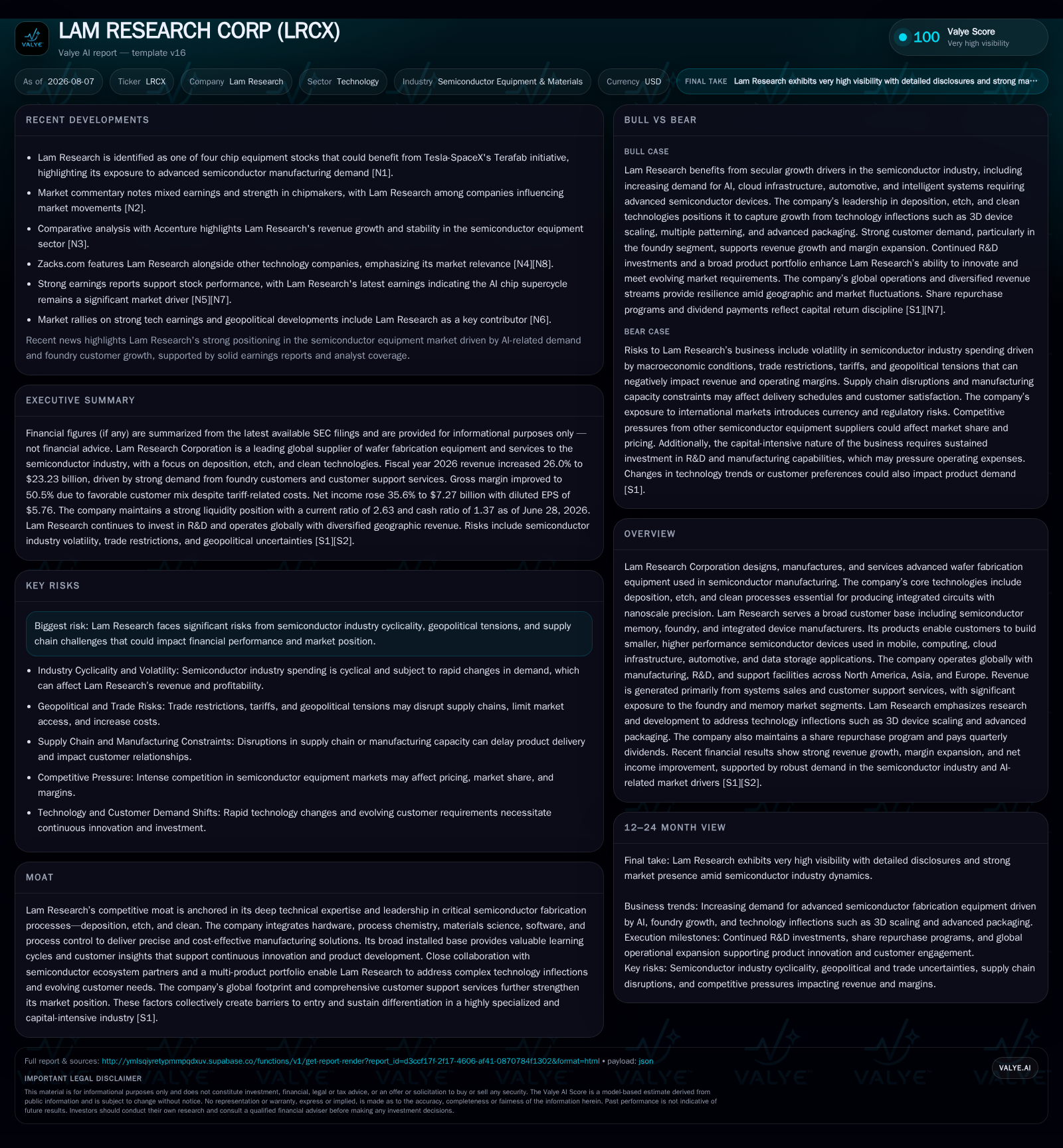
In its latest quarter ended March 29, 2026, Lam Research demonstrated incremental gross margin gains driven by factory efficiency improvements alongside solid cash generation from operations. The company’s core business centers on advanced wafer fabrication equipment — particularly deposition, etch, and clean technologies — that serve the foundry, memory, and integrated device manufacturing segments globally. Lam’s competitive moat is sustained by intensive R&D and broad installed base learning cycles. Industry cyclicality and geopolitical risks remain key challenges, but product innovations aligned with semiconductor node miniaturization support longer-term demand. Lam’s financial profile remains strong, with healthy liquidity and manageable net debt position.
Latest Operational Update Strengthens Margin Profile
Lam Research reported a modest but noteworthy rise in gross margin to 49.8% for the three months ended March 29, 2026 compared with 49.6% in the prior December quarter [S2]. Management attributes this improvement largely to factory efficiency gains rather than pricing or volume changes. This suggests internal operational leverage is actively enhancing profitability despite semi industry volatility.
Parallel to margin enhancement, operating cash flow totaled $4.4 billion during the nine-month period ending March 29, driven by net income near $5 billion plus non-cash charges such as depreciation/amortization and equity-based compensation [S2]. Working capital movements were negative but manageable within overall liquidity.
This quarterly update indicates Lam is navigating the typical capital spending fluctuations of semiconductor fabs while extracting incremental operational efficiencies that bolster its financial performance.
Business Model: Capital Equipment Sales Combined with Recurring Support Services
Lam operates at the critical upstream segment of the semiconductor value chain supplying advanced equipment used in wafer fabrication processes — primarily deposition, etch, and clean technologies essential for integrated circuit production at nanoscale geometries [S1]. Customers include foundries (contract chip manufacturers), memory makers (DRAM/flash), and integrated device manufacturers spanning multiple end markets such as mobile computing, cloud infrastructure, automotive electronics, and data storage solutions.
Revenue chiefly derives from sales of complex capital equipment systems that require substantial engineering expertise to produce [S1]. These are multi-phase purchase decisions with long sales cycles influenced by fab capacity expansions or upgrade/replacement cycles. Complementary revenue streams arise from customer support services including maintenance contracts and consumables such as process chemicals tied to Lam’s systems.
The company’s ability to integrate hardware precision with advanced process chemistry and software-controlled process yields creates high switching costs for customers. This installed base advantage not only generates recurring service revenues but also accelerates R&D learning cycles allowing Lam to sustain innovation velocity.
Industry Structure & Competitive Positioning
The semiconductor equipment sector is characterized by technological complexity requiring continuous R&D investment coupled with high fixed costs embedded in manufacturing facilities [S1]. Lam Research competes closely with Applied Materials and Tokyo Electron in etch and deposition tools; ASML specializes in lithography whereas KLA occupies process control/inspection niches. Each peer has carved distinctive competitive moats based on technology focus.
Lam’s strength lies in its comprehensive multi-product portfolio covering all major fabrication steps except lithography. This breadth enables it to adapt across various chips’ technology inflections — for instance in response to increased adoption of EUV lithography or evolving 3D packaging techniques [N1], [S1].
Customer concentration risk exists given reliance on large foundry players like TSMC or Samsung for a significant portion of equipment demand; however broad end-market diversification into memory manufacturing partially balances this exposure.
Growth Drivers: Technological Complexity & End Market Demand
Fundamental demand drivers are structural: continued miniaturization of semiconductor nodes requires increasingly sophisticated process technologies that drive replacement/upgrades of fabrication tools [S1]. Growth in AI-centric logic chips expands demand for cutting-edge etch/deposition capabilities supporting high transistor density.
Macroeconomic trends such as foundry capacity expansion globally amplify capital spending opportunities while government initiatives encouraging domestic semiconductor manufacturing bolster regional fab investments.
Emerging segments like automotive semiconductors (ADAS systems) and IoT devices create incremental volume opportunities beyond traditional computing/memory markets.
In addition to new system sales growth prospects, expanding installed base size fuels recurring service revenue growth—a high-margin source less sensitive to cyclicality than upfront capital equipment sales.
Risks & Constraints: Cyclicality & Geopolitical Challenges
Semiconductor capital equipment spending exhibits marked cyclicality impacted by inventory rebalancing at fabs alongside macroeconomic headwinds. Sudden shifts can cause order volatility affecting quarterly revenue visibility.
Geopolitical risks notably US-China tensions pose supply chain disruption threats or market access restrictions—critical considerations given Lam’s global manufacturing footprint spread across North America, Asia, Europe [S1]. Regulatory export controls could constrain sales into certain regions or customers.
High capital intensity combined with fixed cost leverage amplifies earnings sensitivity during downturns; maintaining flexibility amid production capacity ramping is essential.
Continuous innovation mandates sustained high R&D expenditure—a double-edged factor driving future competitiveness but increasing operating expense base which must be balanced against revenue growth trajectory.
What to Watch Next: Backlog Trends & Margin Sustainability
Key near-term operational milestones include monitoring order backlog changes which indicate customer capex intent amid uncertain macro cycles. Growth or stabilization here would signal underlying demand resilience.
Tracking customer support revenue growth will reveal success in scaling installed base monetization—a vital component for expanding margin profile given higher relative profitability vs system sales.
Maintaining or further improving gross margins through factory efficiency or favorable product mix is another critical indicator reflecting operational execution quality.
Finally, announcements regarding new product introductions aimed at emerging node technologies or market segments will provide insight into ongoing R&D effectiveness and future growth paths.
Financial Profile Discussion
Lam Research demonstrates robust financial health supported by substantial liquidity—cash & equivalents reported at approximately $5.58 billion as of late June 2026 against total debt near $3.75 billion results in a net cash position exceeding $1.8 billion [F1]
The company's current ratio standing around 2.63 indicates sound short-term liquidity coverage [F1], effectively positioning it to fund continued R&D investment while sustaining share repurchases under an active $10 billion authorization framework outlined since mid-2024 with recent accelerated repurchase activity completed as of mid-2026 [S1].
Consistent free cash flow generation aligned with operating profit supports flexible capital allocation balancing shareholder returns via dividends—quarterly dividends stood at $0.26 per share during fiscal 2026—and reinvestment needs for technological development.
This financial strength provides resilience against sector cyclicality enabling management to maintain strategic investments necessary for competitive differentiation over time without compromising balance sheet flexibility.
This analysis synthesizes recent quarterly updates alongside broader annual context framing Lam Research Corporation's ongoing role as a technology leader within the capital-intensive semiconductor equipment landscape. While cyclical pressures persist industry-wide with evolving geopolitical factors requiring vigilance, Lam's focus on expanding operational efficiencies partnered with deep R&D proficiency supports durable competitive advantages essential for addressing next-generation semiconductor fabrication challenges.
This report does not constitute investment advice or research views.
Disclaimer: This is research-only, informational analysis and not investment advice. It may include AI-generated interpretation and general industry context. Always verify important details using primary sources.

Comments