
Cumberland Pharmaceuticals Repositions as Development-Focused Biopharma After $100M Brand Sale
The sale of its FDA-approved branded portfolio to Apotex marks a strategic pivot toward advancing rare disease pipeline assets amid manageable financial footing.
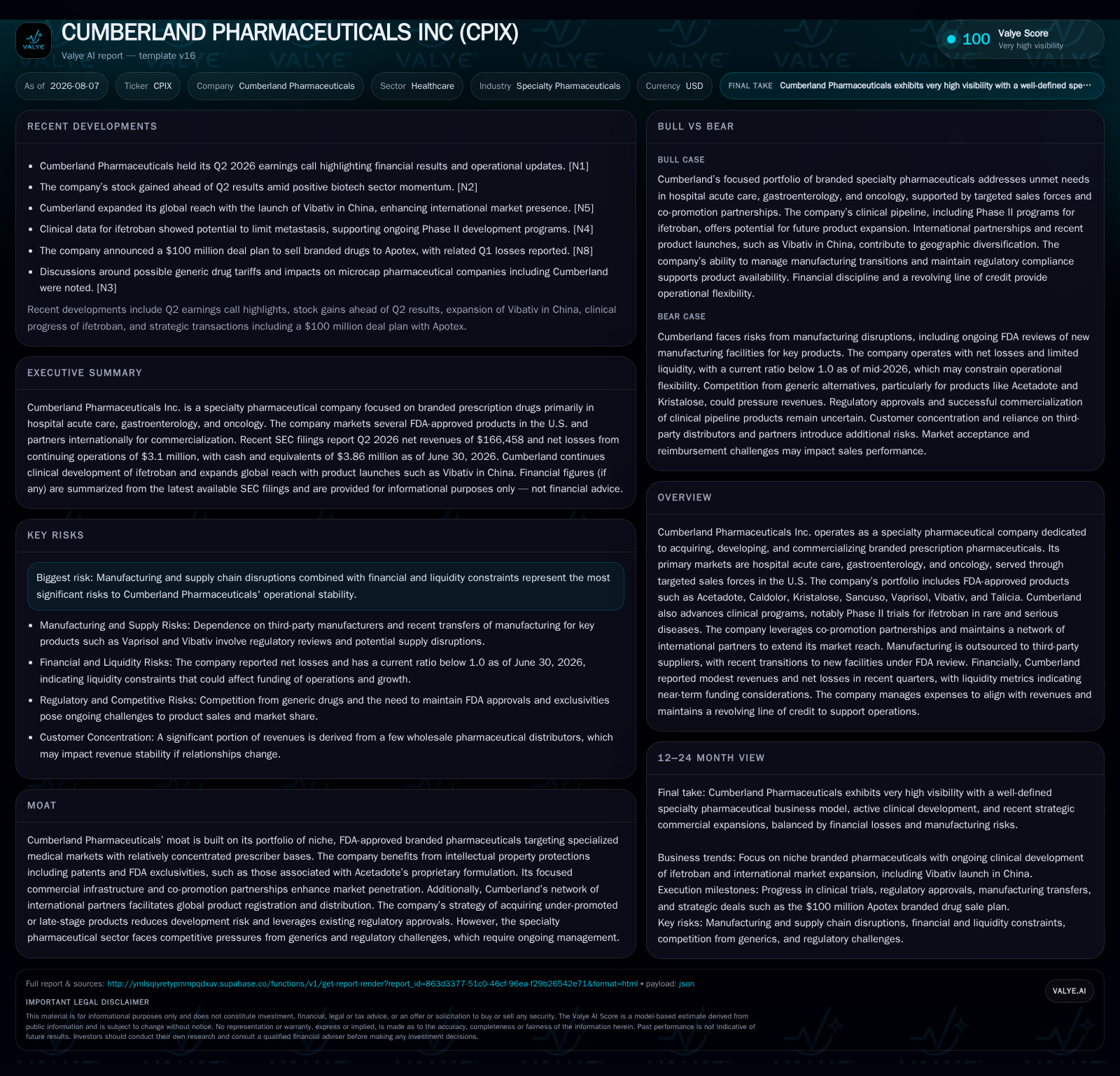
In Q2 2026, Cumberland Pharmaceuticals completed a $100 million divestiture of its branded U.S. commercial pharmaceuticals to Apotex, signaling a transition from a specialty pharma commercial model to a development-stage biopharmaceutical profile. This strategic transaction allows Cumberland to concentrate resources on clinical programs for its proprietary drug candidate ifetroban, targeting rare and serious diseases such as Duchenne muscular dystrophy. While this shift reduces near-term revenue significantly, the company retains substantial liquidity supported by no outstanding debt and $3.9 million in cash. The operating backdrop reflects cost discipline amid the revenues decline tied to the brand sale. Industry peers have similarly pursued niche portfolio optimization and pipeline prioritization, though supply chain and regulatory execution remain critical risk points.
Strategic Pivot Anchored by Brand Divestiture
In its latest Q2 2026 filing, Cumberland Pharmaceuticals announced the closing of a strategic transaction selling its portfolio of FDA-approved branded products to Apotex for $100 million in cash [S2][S16]. This divestiture includes well-established products such as Acetadote, Caldolor, Kristalose, Sancuso, Vaprisol, Vibativ, and Talicia that historically drove the company’s stable revenue streams. The sale effectively shifts Cumberland away from its role as a specialty pharmaceutical commercial entity towards focusing exclusively on development-stage biopharma activities centered around proprietary product candidates.
This shift is significant because it reduces direct commercial revenue nearly to zero from continuing operations; Q2 net revenues were only $166K compared with $381K a year earlier reflecting the impact of the sale [S2]. This contracting top line will test Cumberland's ability to sustain itself through clinical development phases primarily funded from cash reserves and any subsequent capital raises or partnerships.
Business Model Evolution: Commercial Brands to Clinical Pipeline
Historically, Cumberland derived revenues through targeted promotion of branded pharmaceuticals in niche hospital acute care, gastroenterology, and oncology markets within the U.S., supported by a small specialty sales force and international partnerships for global distribution [S1]. Their monetization strategy relied on prescription volumes driven by concentrated prescriber bases in hospitals—a business model common among peers like Eagle Pharmaceuticals and Avadel Pharmaceuticals.
The recent strategic deal offloads these marketed assets along with associated commercial personnel who transitioned to Apotex beginning July 31st [S16]. Post-sale, Cumberland retains majority ownership in Cumberland Emerging Technologies—a life sciences incubator—and focuses on advancing clinical programs notably ifetroban. This compound is undergoing Phase II trials targeting unmet needs in serious rare conditions including Duchenne muscular dystrophy-associated cardiomyopathy, systemic sclerosis, and idiopathic pulmonary fibrosis [S1][S16]. The outcome of these trials will be crucial KPIs determining future value generation.
By adopting this narrower development-centric model, Cumberland enhances capital efficiency by concentrating R&D expenditure on innovative pipeline assets rather than sustaining multiple commercial brands at limited scale. However, it exposes the company more directly to typical biotech risks such as regulatory delays or clinical setbacks that can hamper valuation.
Industry Context: Specialty Pharma Peer Strategies
Within the specialty pharmaceuticals sector—characterized by reliance on FDA approvals, intellectual property protection including patents and exclusivities, outsourced manufacturing contracts, and targeted sales force deployment—the decision to exit commercial branded businesses aligns with trends observed among peers who similarly optimize portfolios towards pipeline development when faced with competitive generic pressures and market access challenges.
Companies like Avadel Pharmaceuticals plc or Eagle Pharmaceuticals have likewise balanced mature brand management with investment in late-stage clinical assets addressing niche therapeutic segments. Cumberland's divestiture reduces exposure to low-growth legacy brand profit pools while positioning resources toward high-impact development programs addressing poorly met medical needs.
Growth Drivers
The primary growth driver now hinges on successful clinical progression of ifetroban across multiple indications characterized by high unmet needs but limited competition due to rarity or complexity of diseases treated [S1]. Positive Phase II results are foundation milestones required before regulatory submissions that could extend rights exclusivity and support eventual commercialization either directly or via licensing agreements.
Additionally, maintaining operational discipline post-sale while leveraging retained infrastructure such as CET Life Sciences Center supports efficient early-stage innovation incubation. Future business development remains plausible through selective acquisition or partnership deals anchored on complementary rare disease products or technologies.
Risks and Constraints
Key risks include reliance on successful trial outcomes for ifetroban; failures or delays could significantly impact viability given absence of alternative revenue sources following brand sales [S1][S2]. Further exposure exists regarding manufacturing transitions since all production is outsourced—a change under FDA review introduces potential supply chain vulnerabilities [S1]. Financial constraints manifest in diminished current revenue streams require strict cash management although proceeds from the $100 million sale plus existing cash balances provide a buffer [F1][S24].
External forces such as intensified generic competition during patent cliffs had likely catalyzed this restructuring; ongoing regulatory hurdles and reimbursement challenges may additionally restrict access or pricing power for new launches.
What To Watch Next
Investors should monitor:
- Progression milestones of ifetroban trials (patient enrollment rates, interim efficacy/safety data) which validate pipeline robustness [S1]
- Quarterly cash burn rates relative to remaining liquidity considering reduced commercial inflows [F1][S2]
- Updates on manufacturing compliance status as new contract facilities undergo FDA inspections
- Potential collaborations or licensing announcements that could inject capital or shared development risks
- Outcomes from initial market feedback on how Apotex manages prior Cumberland brands impacting residual co-promotion opportunities or royalty income streams
Financial Profile Discussion
Disclaimer: This is research-only, informational analysis and not investment advice. It may include AI-generated interpretation and general industry context. Always verify important details using primary sources.

Comments