
FS Bancorp Leverages Risk Discipline and Dividend Consistency Amid Interest Rate Challenges
FS Bancorp's Q2 2026 results highlight disciplined risk management, strategic funding adjustments, and stable dividend policy supporting resilience amid market pressures.
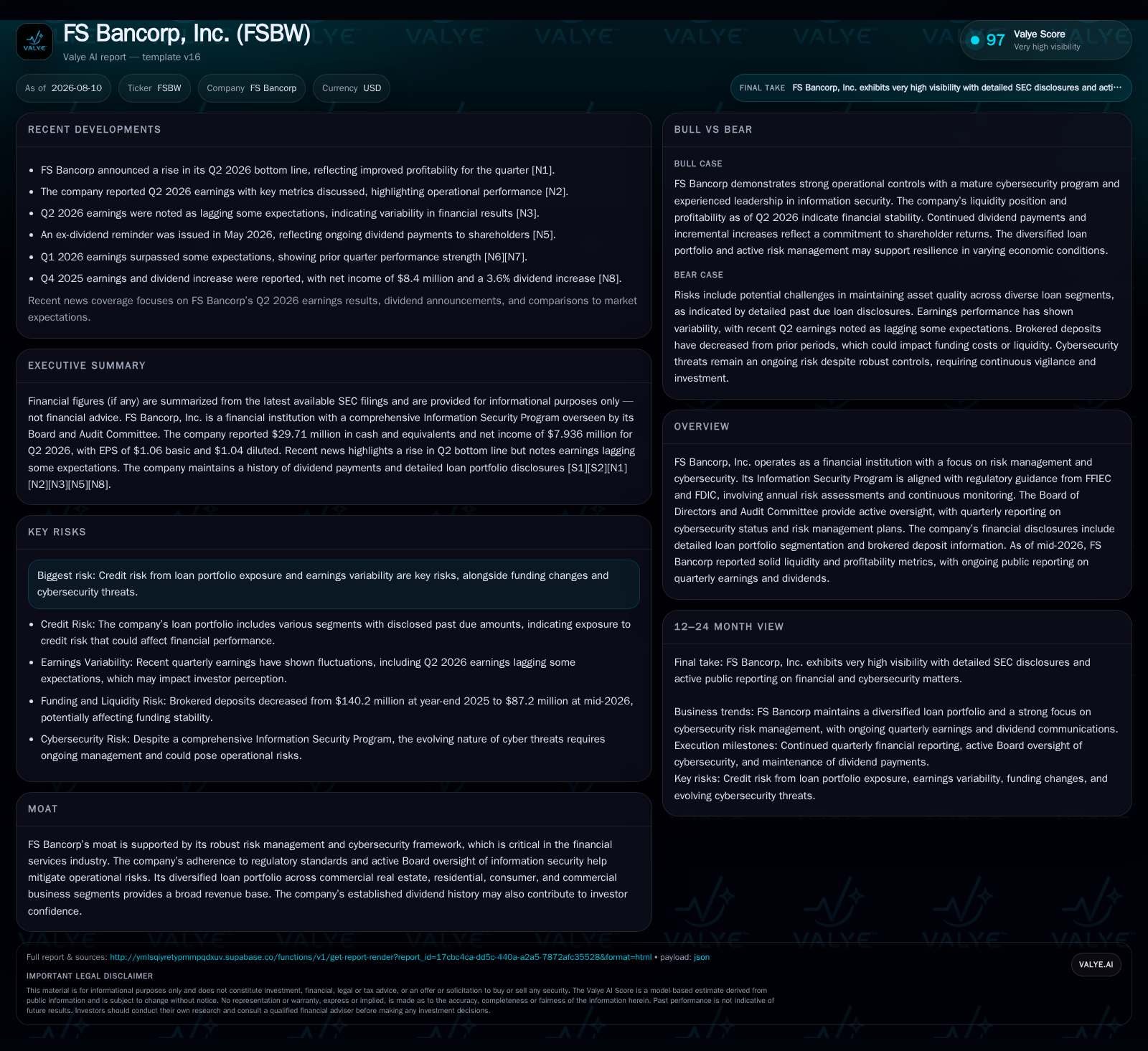
In its latest quarterly filing, FS Bancorp disclosed a meaningful reduction in brokered deposits alongside sustained diversification of its loan portfolio, both critical for liquidity and net interest margin stability. The company’s robust cybersecurity oversight framework continues to be a pillar of risk mitigation, endorsed by active Board and Audit Committee engagement. While credit risk and interest rate volatility remain key considerations, FS Bancorp’s steady dividend declarations reflect confidence in earnings durability.
Q2 Operating Update Reflecting Shift in Brokered Deposits and Loan Composition
FS Bancorp’s August 2026 quarterly filing reveals a notable $53 million reduction in brokered deposits since December 31, 2025, down to approximately $87 million as of June 30, 2026 [S2]. This sizeable decrease signals the company's strategic recalibration away from volatile wholesale funding towards more stable deposits or other sources. In regional banking, reliance on brokered deposits can heighten liquidity risk due to their potentially transient nature and higher interest costs compared with core deposits. The decline thus likely eases liquidity pressure and may incrementally improve the company’s liquidity coverage ratio (LCR), a crucial regulatory metric overseen by agencies like the FDIC. Continued disclosures on funding mix in subsequent quarters will confirm if this signals a durable funding shift or a tactical balance adjustment [S3].
Simultaneously, the firm adjusted amortized cost bases related to closed portfolios used in designated hedging relationships [S2], an accounting detail reflecting careful management of interest rate risk exposures on legacy assets. These hedging activities are important for protecting net interest margins (NIM) from fluctuations in market rates.
Core Revenue Drivers: Net Interest Margin Sustained by Diversified Lending Mix
FS Bancorp’s revenue model principally generates net interest income by lending funds at rates exceeding its deposit and borrowing costs, supplemented by fee income from deposit accounts and related financial services. The Q2 disclosures reaffirm diversification within its loan portfolio spanning commercial real estate (CRE), residential mortgages (including one-to-four-family loans), consumer loans such as home equity lines of credit (HELOCs), marine loans, and commercial business loans including warehouse lending [S1; S2]. This segmentation dilutes concentration risk—particularly significant given the cyclical nature of CRE—and supports consistent portfolio yield generation.
This loan mix is structurally important given prevailing higher interest rates that can compress rates on newer deposits while older fixed-rate lending contracts may yield less. Yet FS Bancorp managed robust net interest margins supported by this calibrated portfolio mix [S2], preserving profitability despite market volatility. Moreover, prudent credit underwriting evidenced by low non-performing loan ratios further buttresses margin stability by limiting excess provisions for loan losses [S2]. Confirmation through stable quarterly return on assets (ROA) or equity (ROE) would reinforce the margin resilience thesis.
Governance Strength: Board & Audit Committee's Oversight of Cybersecurity Risks
A standout feature underscored in FS Bancorp’s annual disclosure is its mature Information Security Program aligned with FFIEC and FDIC regulatory frameworks [S1]. Annual comprehensive risk assessments employ the FFIEC Cybersecurity Assessment Tool (FFIEC CAT), measuring program maturity alongside targeted measures such as penetration testing and vulnerability scans.
Active governance roles played by the Board of Directors—and specifically the Audit Committee—in overseeing this program enhance corporate accountability for cybersecurity risk. Quarterly status reports provide detailed updates on incidents, patch management, vendor risk, and disaster recovery plans [S1]. The leadership credentials reported—such as the CIO’s CISSP certification and over two decades of industry experience—add operational credibility to this oversight.
Given escalating threats in the financial services sector where data breaches can have systemic reputational impacts, FS Bancorp’s board-led cyber risk governance constitutes a critical protective moat relative to regional bank peers who may have less formalized programs.
Funding Strategy Recalibration Due to Brokered Deposit Dynamics
The reduction in brokered deposits—from approximately $140 million at year-end 2025 to $87 million at mid-2026—represents a material funding strategy shift [S2]. Brokered deposits often attract higher costs than retail core deposits due to their wholesale sourcing nature. While providing valuable liquidity buffers especially in growth phases or stress periods, overreliance can increase funding cost volatility.
By reducing this component, FS Bancorp may be proactively managing its cost of funds and enhancing overall balance sheet stability amidst a fluctuating interest rate environment. This cautious posture aligns with peers managing deposit mix carefully under regulatory scrutiny on deposit concentration risks.
Future monitoring should track whether this reduction persists or reverses depending on competitive deposit market dynamics or regulatory capital considerations.
Dividend Policy Highlights Consistent Shareholder Return Philosophy
On July 21, 2026, FS Bancorp declared a regular quarterly cash dividend of $0.29 per share payable August 21st to stockholders of record as of August 7th [S3]. This payout mirrors prior quarters’ dividend amounts signaling an ongoing commitment to returning capital consistently even as macroeconomic challenges persist.
In regional banking contexts where earnings variability can occur due to credit cost cycles or volatile funding expenses, maintaining dividend continuity helps anchor investor confidence. The dividend payout ratio must stay calibrated against retained earnings growth and capital adequacy standards but appears sustainable given recurring profitability.
Investor perception often prizes such consistency especially when paired with transparent capital management practices.
Growth Opportunities Grounded in Economic Activity and Regulatory Environment
FS Bancorp is positioned to leverage economic growth drivers stimulating demand for commercial loans across CRE sectors as well as consumer credit expansion—both traditional engines for regional banks [S1]. Interest rate environments that support favorable spreads on assets versus liabilities further bolster organic revenue potential.
Cross-selling additional products like payment solutions or wealth management services could enhance fee income streams outside pure net interest income reliance. Technological investments improving customer service also promise operational efficiency gains while strengthening competitive positioning.
Regulatory changes remain a double-edged sword; while compliance demands increase operational burdens particularly around cybersecurity programs, new authorizations may enable expanded offerings or geographic reach providing incremental scale benefits.
Risks from Credit Exposure, Interest Rate Sensitivity, and Cyber Threats to Monitor
Despite many strengths, several risks warrant attention. Credit risk stemming from borrower defaults—especially within CRE segments vulnerable to local economic downturn impact—is an ever-present challenge [S2]. Maintaining low non-performing loan ratios requires ongoing vigilance.
Interest rate risk remains salient; shifts affecting deposit pricing faster than asset repricing can squeeze net interest margins requiring effective asset-liability management strategies including hedging instruments evidenced in disclosed accounting treatments [S2]
Cybersecurity risks continue evolving rapidly; even with established programs, persistent threats necessitate sustained investment in defenses plus incident response capabilities backed by top-down governance oversight.
Financial reputational damage caused by any failure here could derail otherwise solid fundamentals.
What to Watch Next: Future Loan Quality Trends, Interest Margin Evolution, Dividend Sustainability
Upcoming quarterly disclosures will be crucial for observing whether FS Bancorp sustains reductions in brokered deposits confirming a longer-term funding shift enhancing liquidity resilience. Loan portfolio trends—growth rates by segment alongside non-performing loan ratios—will signal how effectively credit quality is being preserved amid economic cycles.
Net interest margin trends should be monitored closely to assess the continuing impact of evolving rate environments balanced against deposit cost pressures. Dividend declarations will also serve as barometers of management confidence in earnings durability ahead.
Board-level reports on cybersecurity risks provide qualitative insights into emerging threat landscapes affecting operational stability.
Financial Profile Discussion
Profitability metrics remain anchored by steady net income reported annually at about $33.3 million last year—a figure reinforcing sufficient earnings cover for dividend payouts observed in mid-2026 [F1; S3] [S1]. The firm maintains capital adequacy consistent with regulatory benchmarks ensuring capacity for organic growth or opportunistic acquisitions without compromising financial flexibility
Overall efficiency ratios balancing operating expenses against revenue streams will be instructive going forward given competitive pressure on margins common across regional banks.
This analysis synthesizes FS Bancorp's recent disclosures rooted primarily in its August 10th quarter report supplemented by annual context concerning its business model framework and strategic priorities. It aims to clarify how evolving funding approaches combined with steadfast governance around cybersecurity risk underpin its operating profile amid prevailing sector challenges. Continuing monitoring of loan quality metrics alongside margin performance will be key indicators of execution success going forward.
Disclaimer: This report is for informational purposes only and does not constitute investment advice or research views regarding any securities.
Disclaimer: This is research-only, informational analysis and not investment advice. It may include AI-generated interpretation and general industry context. Always verify important details using primary sources.

Comments