
AMG's Partnership Model Drives Record $942B AUM and Earnings Growth Amid Diversification
Affiliated Managers Group leverages a strategic partner model with independent investment firms to expand assets and fees.
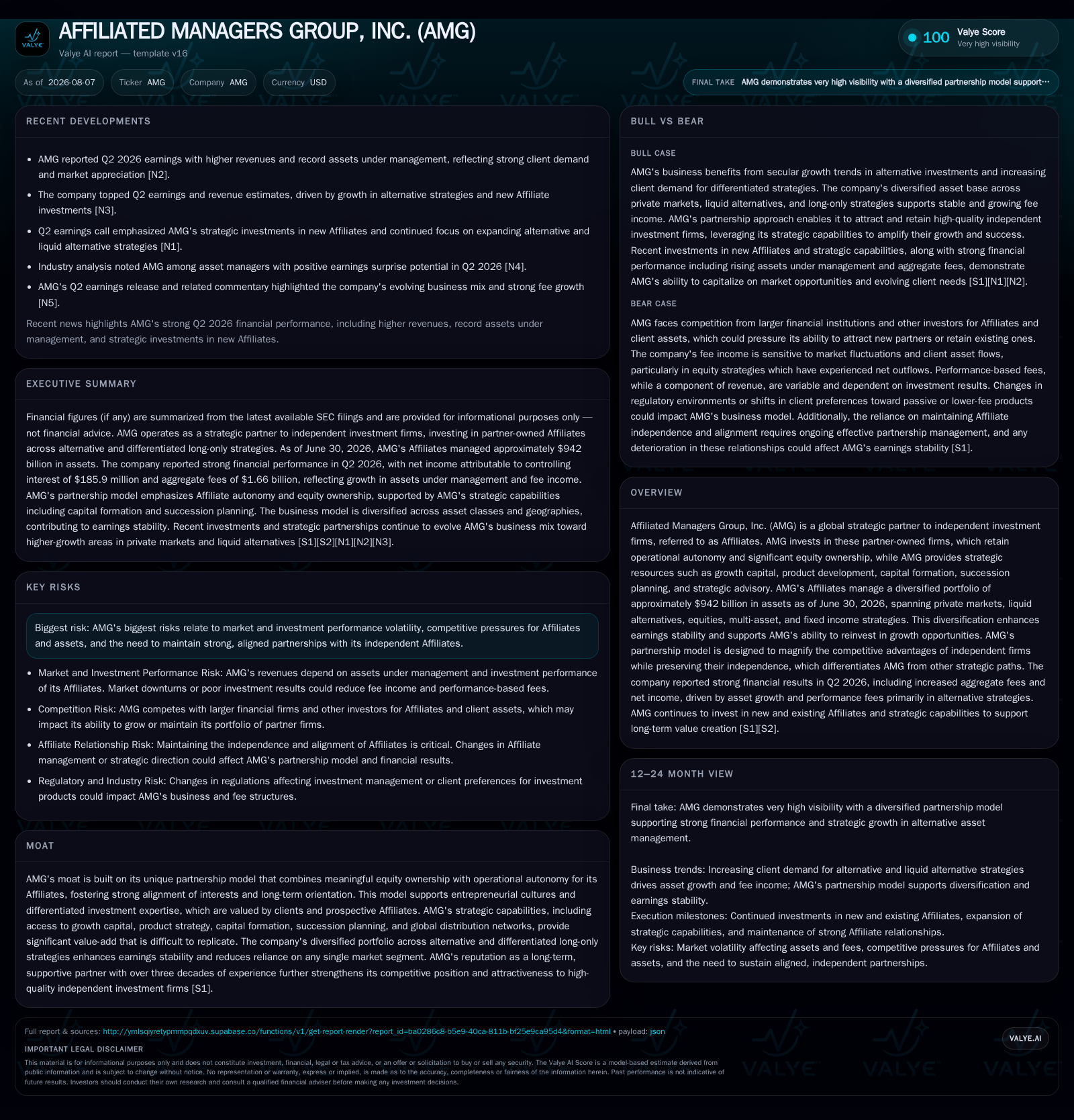
In Q2 2026, AMG reported record aggregate assets under management of approximately $942 billion, marking a 22% increase year-over-year and fueling a 46% rise in aggregate fees. Its distinctive approach, partnering with autonomous Affiliates that retain significant equity, enables AMG to diversify across private markets, liquid alternatives, and long-only strategies. This diversification fosters stable earnings and positions the firm well against industry pressures such as market volatility and fee compression. Capital deployment remains focused on investing in high-growth Affiliates and strategic value-add capabilities while maintaining an investment-grade balance sheet.
Recent Operating Update
Affiliated Managers Group (AMG) reported a strong Q2 2026 operating performance marked by record-breaking scale across its affiliate partnerships. As of June 30, 2026, AMG’s aggregate assets under management reached approximately $942 billion—a substantial 22% increase over the prior-year period [S2][S9][S17]. This growth was driven by both positive net inflows and market appreciation, highlighting sustained client demand during a complex macroeconomic backdrop.
The surge in assets fueled a commensurate rise in fee revenue; aggregate fees earned across AMG’s consolidated and equity method Affiliates rose an impressive 46% for the first half of 2026 compared to the prior year period [S9][S17]. This fee increase reflects robust asset-based fees supported by rising average AUM in private markets, liquid alternatives, equities, multi-asset, and fixed income strategies. Performance fees also contributed meaningfully due to strong investment returns within certain Affiliate strategies but can fluctuate given their dependence on relative outperformance benchmarks [S9][S15][S17].
Business Model Analysis: The Strategic Partnership Edge
AMG operates as a global strategic partner to leading independent investment firms—referred to as Affiliates—that retain operational autonomy along with significant equity stakes in their own businesses [S1][S8]. This partnership model is distinctive within asset management because it preserves entrepreneurial culture and aligns incentives between AMG and its Affiliates’ principals through meaningful equity ownership.
Instead of centralized portfolio management or direct product control typical of large diversified managers or private equity platforms, AMG provides strategic resources including growth capital, product development expertise, capital formation capabilities (distribution support), succession planning assistance, and strategic advisory services to accelerate Affiliate growth [S1][S8]. This upstream role as a capital allocator and facilitator allows AMG to leverage niche investment expertise embedded within independent firms while mitigating integration risks often associated with outright acquisitions.
Revenue principally comes from asset-based management fees calculated as a percentage of assets managed by Affiliates plus performance fees tied to investment returns exceeding stipulated benchmarks or hurdles [S1][S9]. This revenue-mechanic means AMG’s top line scales with growth in Affiliates’ AUM but remains vulnerable to fluctuations in investment performance and changes in client demand or fee structures. Therefore, maintaining a diversified portfolio across asset classes reduces exposure to any one strategy’s volatility.
Industry Structure and Competitive Context
AMG occupies a strategic middle ground between pure standalone independent boutiques—which may face capital constraints—and fully integrated large diversified asset managers such as BlackRock or Franklin Templeton that own their investment platforms outright. By combining capital provision with Affiliate autonomy, AMG strengthens retention of key talent at Affiliates while enabling scaling opportunities.
The asset management industry's ongoing secular trends toward alternative investments—private markets and liquid alternatives—as well as differentiated long-only strategies are a structural advantage leveraged aggressively by AMG’s growth investments [N1][N2][N3][S1]. This focus aligns with increasing institutional and wealth-client demand for active management beyond commoditized passive products which are putting fee pressure on traditional managers.
Competitively, AMG must maintain deep relationships with high-quality independent firms amid competition not only from other strategic partners or investors but also passively managed products gaining market share due to cost advantages [S11]. AMG’s ability to provide capital formation resources and maintain Affiliates’ independence is a notable differentiator among peers that pursue full mergers or acquisitions.
Growth Drivers
Several factors underpin AMG’s near-term growth prospects:
- Increasing global wealth expanding institutional and retail appetite for active management expertise in alternatives and long-only mandates [S1].
- Investment performance momentum which drives higher performance fees and supports organic asset inflows.
- Strategic capital deployment aimed at acquiring new Affiliates demonstrating durable client franchises in fast-growing niches (e.g., credit-focused funds from recent minority investments like BBH Credit Partners) [S2][N2].
- Product innovation, including expansion into evergreen private equity funds and active ETFs launched via the U.S. wealth platform leveraging AMG’s distribution reach [S8].
- Succession planning services which enhance loyalty among Affiliate principals supporting long-term partnership stability.
These drivers are evidence of intentional portfolio diversification strategy across multiple asset classes that reduces cyclicality impact on overall earnings while capturing secular shifts in investor preferences.
Risks and Watchpoints
AMG faces several notable risks inherent in its business model:
- Investment Performance Volatility: Significant swings can materially affect performance fee receipts integral to earnings variability. Underperformance relative to high-watermark provisions delays fee recognition until losses are recovered at individual Affiliates [S1].
- Market Downturn Impact: Broad declines reduce AUM base directly constricting fee revenue from management fees as well as causing potential affiliate restructuring or valuation impairments.
- Competitive Pressures: Intense competition from low-cost passive funds challenges fee pricing power particularly in long-only segments more vulnerable than alternatives.[S11]
- Affiliate Retention Alignment: Maintaining strong relationships requires continued offer of value-add capabilities without eroding Affiliate autonomy—strain here could result in loss or dilution of partners.[S1]
- Regulatory Risks: Evolving tax laws (including multinational tax reforms), AI-related compliance frameworks impacting affiliate operations, anti-money laundering enforcement dynamics all pose regulatory uncertainty burdens [S18][S20].
- Concentration Risks: Certain large Affiliates contribute disproportionately to results; operational or market issues here could skew outcomes materially.
Monitoring these factors includes tracking AUM organic flow trends versus market-driven shifts; watch for changes in affiliate composition that might signal concentration risk; observing quarterly fee yield fluctuations indicating pricing pressure; evaluating succession plan updates ensuring leadership continuity; scrutinizing regulatory developments impacting both AMG and affiliates.
What To Watch Next
Key milestones signaling ongoing execution include:
- Continued incremental new minority investments targeting high-growth sectors within alternatives such as credit funds (e.g., follow-ons post BBH Credit stake) which provide feed-forward visibility into capital deployment strategy.
- Quarterly AUM growth rates compared against broader industry benchmarks reveal if market share is expanding or contracting amid passive competition.
- Details on product launches or expansions within liquid alternatives or U.S. wealth-oriented solutions highlight innovations likely to deepen distribution penetration.[N1]
- Financial metrics like aggregate fee progression balanced against operating costs will indicate margin sustainability amid scaling initiatives.
- Succession planning announcements demonstrating multi-generational leadership transitions preserving independent culture.
Monitoring these markers offers insight into whether AMG’s partnership approach continues to generate consistent value creation versus cyclicality inherent in its revenue mechanics.
Financial Profile Discussion
As of June 30, 2026, AMG held $411 million in cash and equivalents against total debt of approximately $3.04 billion, resulting in net debt near $2.63 billion [F1]. The company’s current ratio stood at 1.97, indicating solid short-term liquidity [F1]. The company maintains sufficient liquidity to support ongoing investments into new Affiliates and capital return initiatives such as share repurchases [S10][S13].
This balance demonstrates effective capital recycling aligned with long-term partnership investment objectives while preserving shareholder value through disciplined buybacks amidst rapid asset growth.
Conclusion
Affiliated Managers Group’s latest quarterly results underscore the operational strength derived from its partnership business model that empowers independent investment firms while providing scalable strategic support. Record assets under management combined with rising aggregate fees illustrate successful navigation of secular industry trends favoring alternatives-driven active strategies. Capital deployment remains focused on affiliating quality firms exhibiting durable client demand complemented by innovation targeting both institutional and wealth channels. Although risks persist from market volatility and competition pressures particularly around fee structures, AMG's diversified portfolio across various asset classes helps smooth earnings volatility relative to pure-play managers. The company’s solid financial footing affords flexibility for continued strategic investments sustaining long-term affiliate success. Going forward, tracking affiliate growth dynamics alongside evolving regulatory conditions will be critical monitoring points for sustaining AMG's competitive moat.
Disclaimer: This is research-only, informational analysis and not investment advice. It may include AI-generated interpretation and general industry context. Always verify important details using primary sources.

Comments