
Avalon Holdings Executes DualSegment Growth Strategy Balancing Waste Management and Recreational Services
Recent quarterly disclosures highlight operational clarity and membership economics in Avalon’s distinct waste and leisure businesses.
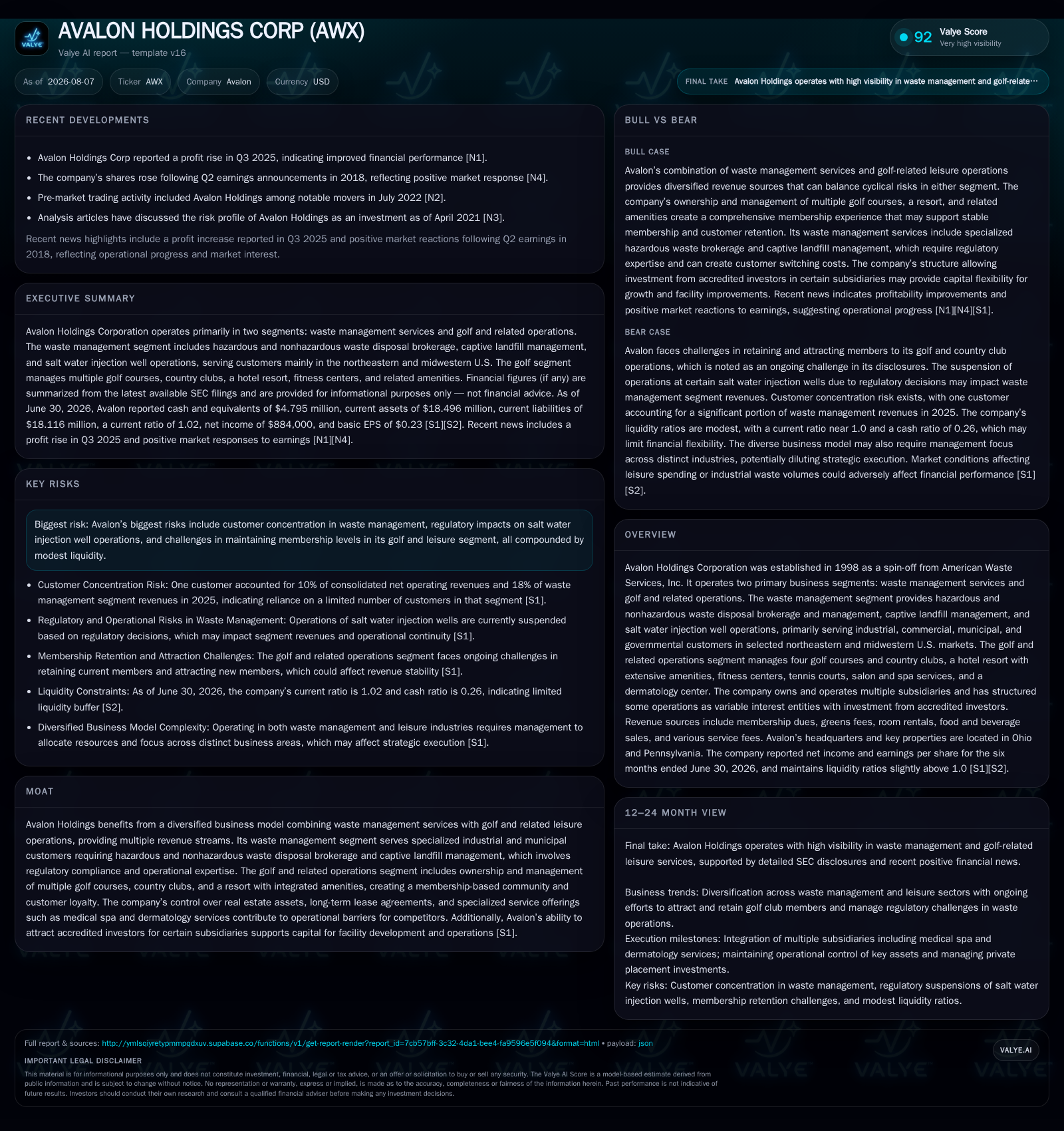
Avalon Holdings continues to operate a dual-segment business model combining specialized hazardous and nonhazardous waste disposal brokerage with golf course and resort operations. The company’s latest 10-Q clarifies revenue recognition policies and delineates the membership dues structure, emphasizing the separation of recurring dues from ancillary, discretionary spending. Operational expertise and regulatory compliance underpin its waste brokerage business, while the golf and resort segment faces typical discretionary spending fluctuations affecting customer retention and membership economics. Financially, Avalon maintains liquidity stability despite elevated net debt, balancing capital investment across its diverse assets.
Latest Quarterly Filing Sharpens Revenue Recognition Clarity and Membership Economics
Avalon's August 2026 10-Q filing provides granular detail on its revenue recognition framework, which is critical given its mixed service model spanning regulated waste disposal and leisure-based memberships [S2]. The company recognizes revenue when it has obtained clear contractual commitments: mutual approval, identified rights, payment terms defined, commercial substance present, and probable collection — in line with ASC 606 principles. This clarification underpins topline reliability by tying income to actual control transfer rather than billing alone.
Particularly noteworthy is the explicit separation in the Avalon Golf and Country Club membership structure: there are no up-front initiation fees nor mandatory minimum monthly spending levels [S2]. Annual dues cover access privileges but exclude food, beverages, or any other ancillary services such as spa or salon treatments. These optional expenditures are transacted à la carte at point of sale without discount guarantees or purchase obligations.
This delineation impacts revenue quality analysis as recurring membership dues represent a stable base while ancillary revenues show higher variability. Such clarity aids in forecasting cash flow patterns by distinguishing between committed recurring income versus discretionary spending swings.
Business Model Nuances: Dual-Segment Revenue Streams Demand Distinct Operational Expertise
Avalon’s business synthesizes two operationally discrete yet financially complementary segments — waste management and golf/resort operations [S1]. Within waste management, the company functions primarily as a brokerage intermediary specializing in both hazardous and nonhazardous waste disposal [S1]. Unlike fully integrated firms that own treatment facilities, Avalon leverages deep regulatory understanding and logistical agility to source cost-efficient disposal routes tailored to client requirements.
Its captive landfill management segment adds an asset-based revenue element involving operational oversight of controlled landfill sites [S1]. Furthermore, Avalon operates salt water injection wells through subsidiaries structured as investment vehicles attracting accredited investors who share in gross revenues [S1]. This model distributes operational risk while expanding service breadth.
In contrast, the recreational segment revolves around real estate ownership or long-term leases of multiple golf courses and related amenities including fitness centers, tennis courts, salons/spas, a dermatology center, and a hotel resort [S1]. Here revenue stems largely from membership dues granting access privileges accompanied by variable greens fees and on-demand ancillary offerings.
Operational KPIs differ markedly: contract backlog health and renewal rates dominate waste management metrics while membership counts, retention rates, average spend per member (inclusive of ancillary services), and capital reinvestment levels define recreational success. Both segments require capital expenditure investments for maintenance/upgrades that influence operating margins over time.
Competitive Environment Locks in Waste Brokerage via Specialized Knowledge; Leisure Segment Faces Discretionary Risks
The hazardous/nonhazardous waste brokerage market is fragmented with competitors ranging from pure brokers to treatment facility owners [S1]. Avalon’s ability to navigate complex environmental regulations confers a competitive moat by enabling it to deliver bespoke disposal options not always available through price alone. This intellectual capital anchors customer retention amidst industry pricing pressures.
On the leisure side, Avalon contends with public courses and regional country clubs competing for discretionary consumer spend [S1]. Its integration of diverse resort amenities attempts to create value-added differentiation fostering loyalty but remains subject to macroeconomic cycles impacting consumer leisure budgets. The absence of initiation fees indicates a lower upfront barrier but likely higher volatility in ancillary revenues tied to general economic conditions.
Qualitative peer contexts suggest Waste Management Inc. illustrates scale advantages in integrated services whereas ClubCorp Holdings typifies challenges managing discretionary membership-based revenue streams. Avalon occupies a niche balancing specialized industrial customers with regionally focused recreational offerings.
Drivers Behind Contract Backlog Health and Membership Retention Dynamics
Key performance indicators shaping near-term revenue outlook include backlog solidity in the waste business — specifically renewal rates on existing brokerage contracts — which reflect customer trust borne from cost-effectiveness and regulatory acumen [S2][S1]. Since these contracts often serve industrial or municipal customers with specific hazardous or nonhazardous disposal requirements, predictable volume flows depend heavily on regulatory persistence and economic activity within served geographies.
Simultaneously, golf segment membership count stability coupled with rates of spending on ancillary goods (such as spa treatments) provide insight into discretionary revenue robustness [S2][S1]. Given the absence of minimum spending mandates on memberships, the company must actively manage member engagement through amenity investment to maintain spending penetration. Capital expenditure decisions here are thus directly linked to customer retention economics.
Seasonality effects also play a role; weather-driven swings impact utilization rates for outdoor courses more than indoor spa/dematology services which might smooth cash flows somewhat. Overall growth drivers remain contingent on maintaining contractual relationships alongside enhancing amenity appeal.
Risks from Regulatory Pressure, Customer Concentration, and Capital Intensity Require Monitoring
Avalon's operations carry inherent risks stemming from evolving environmental regulations governing hazardous waste disposal practices—particularly those associated with landfill management and salt water injection wells [S1]. Adverse policy shifts could increase compliance costs or restrict operational capacity.
Customer concentration poses another material risk: reliance on a limited number of large industrial or municipal customers creates vulnerability should any major contract terminate unexpectedly [S1]. Vigilance around contract renewal probabilities becomes imperative given this dependency.
Capital intensity also weighs on financial flexibility since both segments require ongoing capital expenditures: maintaining landfill facilities' environmental safety standards is cost intensive while golf resort infrastructure demands periodic upgrades to sustain member appeal [S1]. Balancing these investments amid modest operating income levels requires careful liquidity management.
Indicators to Watch: Renewal Rates, Ancillary Service Penetration, Capital Spend Trajectory
Near-term monitoring should prioritize contract renewal metrics within waste brokerage operations as leading indicators of volume stability. Higher churn or pricing pressure here would signal risk to top-line consistency [S2]. Tracking membership growth or attrition alongside average ancillary spend per member will similarly spotlight the success of residential engagement initiatives within the golf segment.
Capital expenditure trends deserve scrutiny since upward trajectories beyond maintenance may foreshadow margin compression if not accompanied by commensurate revenue uplift through enhanced customer retention or new membership acquisition [S2]. Regulatory compliance incident frequency would also serve as an early warning sign for latent liabilities impacting future operating costs.
Collectively, these KPIs form an evidence-based dashboard enabling timely adjustments either operationally or strategically – especially important given Avalon’s relatively concentrated contract base.
Financial Position Discussion: Liquidity Stability Despite Elevated Leverage
As of June 30, 2026, Avalon held approximately $4.8 million in cash equivalents against total debt near $31.9 million resulting in net debt around $27.1 million with a current ratio roughly at 1.02 [F1][S2]. This indicates a limited but sufficient short-term liquidity buffer adequate for ongoing working capital needs but leaves limited room for unexpected shocks.
The company’s capital expenditure outflows remain steady reflecting the continuous need for asset maintenance across both segments—especially environmental compliance-driven investments in landfills alongside amenity upgrades supporting member retention [S2]
Interest expense payments absorbed nearly $1 million per quarter based on cash flow disclosures from prior periods indicating meaningful fixed financial commitments consistent with mid-sized specialized service providers carrying heavy infrastructure assets.
Ongoing tracking of contract renewals in regulated waste streams alongside membership retention dynamics will be instrumental in assessing future performance trajectories.
Disclaimer: This is research-only, informational analysis and not investment advice. It may include AI-generated interpretation and general industry context. Always verify important details using primary sources.

Comments