
Immix Biopharma Advances CAR-T Therapy for AL Amyloidosis with Solid Clinical Progress and Robust Funding
Immix Biopharma progresses toward regulatory milestones for its NXC-201 CAR-T cell therapy, backed by strong clinical trial data and financing.
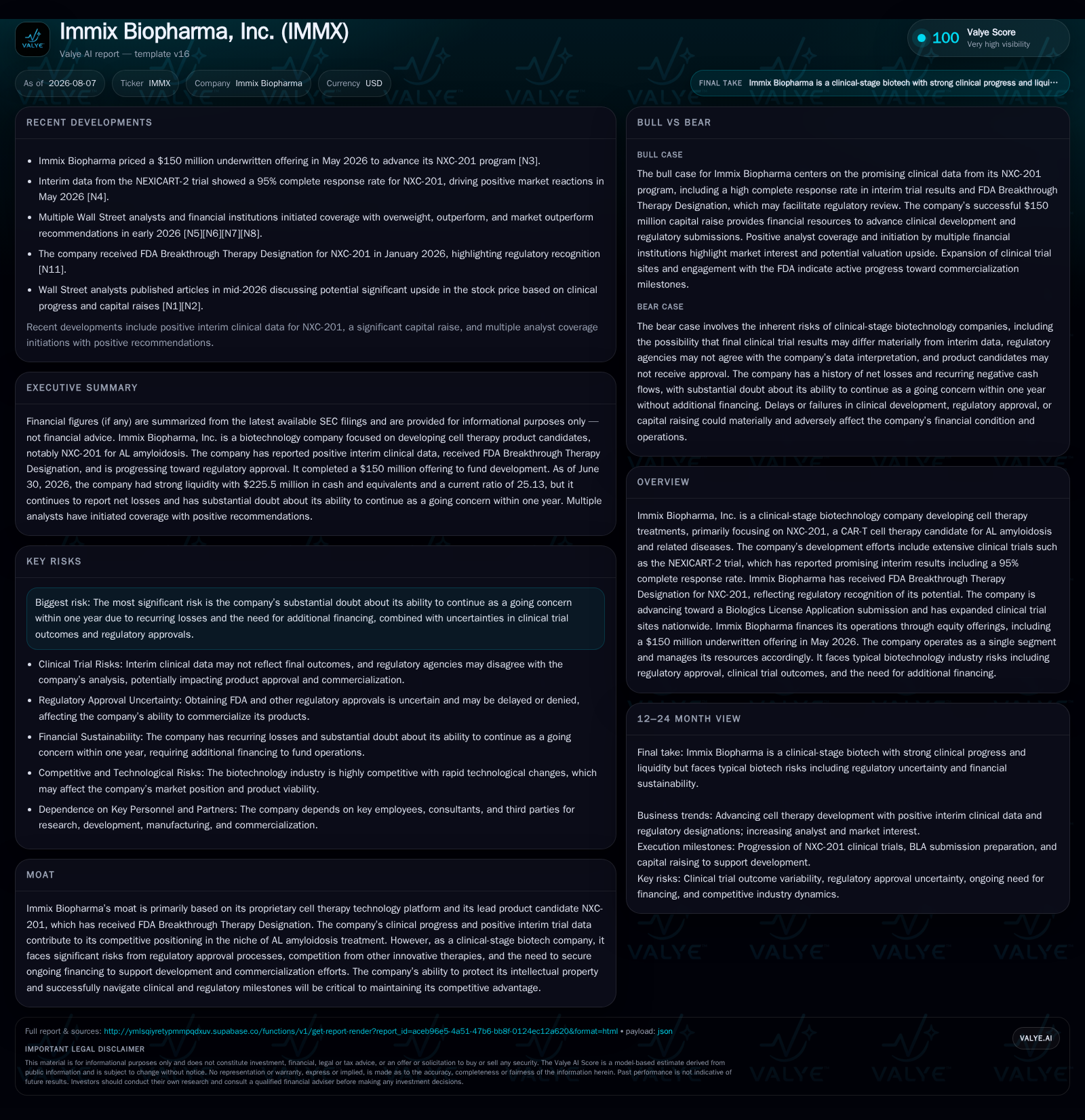
Immix Biopharma, a clinical-stage biotech focused on CAR-T cell treatments for AL amyloidosis, reported in its latest quarter continued progress with its lead candidate NXC-201, showing encouraging interim clinical results including a high complete response rate in its NEXICART-2 trial. The company holds the FDA Breakthrough Therapy Designation for NXC-201 and is preparing for Biologics License Application submission. A recent $150 million equity raise provides runway into late 2026, mitigating immediate funding concerns. However, as with many early-stage cell therapy developers, Immix faces risks related to final trial outcomes, regulatory approval uncertainties, and sustaining operations beyond current capital.
Recent Operating Update
Immix Biopharma's August 7, 2026 quarterly filing underscores sustained momentum in developing NXC-201, an autologous CAR-T therapy targeting AL amyloidosis—a rare plasma cell disorder characterized by amyloid light chain deposits [S2][S23]. The company has completed patient enrollment in the pivotal NEXICART-2 Phase 1/2 trial and expects topline results imminently within Q3 2026. This milestone is critical as it will inform progression to larger randomized trials or regulatory filings necessary for commercialization
The FDA granted NXC-201 Breakthrough Therapy Designation recognizing its potential to address significant unmet needs in this orphan disease space. This designation enhances regulatory engagement opportunities and may expedite review timelines. To support upcoming phases, Immix expanded its clinical trial footprint nationally to improve enrollment rates and patient heterogeneity—key operational levers influencing data robustness and eventual market acceptance [S1][S23]
A July 2026 corporate update noted the departure of an executive unrelated to company activities without operational impact but highlights ongoing management adjustments during this critical development period [S3]
Business Model Analysis
Immix operates exclusively within the biotechnology sector focusing on proprietary CAR-T therapies designed to selectively eliminate pathological plasma cells producing amyloidogenic light chains. Its value proposition hinges on demonstrating durable clinical responses (e.g., high complete response rates) with manageable safety profiles through rigorous clinical trials.
Revenue is not yet realized; funding derives predominantly from equity capital markets—including a $150 million underwritten offering completed in May 2026—and grant awards that subsidize research expenses [S1][S18][F1]. This financing supports costly R&D activities such as manufacturing scale-up (often outsourced), multi-center trial operations, and regulatory compliance efforts
Margins are negative at this stage due to upfront investments characteristic of early-stage biologics development. Success depends on achieving regulatory approvals supported by compelling efficacy and safety data alongside securing reimbursement frameworks aligned with orphan drug market dynamics.
Industry Structure and Competitive Position
Within the competitive landscape of cell therapy developers targeting hematologic diseases, Immix occupies a niche focused on AL amyloidosis distinct from broader lymphoma or leukemia indications pursued by peers like Bluebird Bio or Legend Biotech. While larger players have commercialized CAR-T products (e.g., Kite Pharma), Immix’s focus on an orphan indication with limited treatment alternatives could confer strategic advantage if clinical outcomes hold.
Breakthrough Therapy Designation enhances perceived value relative to competitors by potentially shortening development timelines and facilitating earlier market access. Nevertheless, inherent risks include manufacturing complexity typical of autologous therapies—such as batch consistency—and patient recruitment challenges due to disease rarity.
Growth Drivers
The primary growth driver is addressing an unmet medical need where existing therapies yield limited durable remissions. Interim data reporting approximately a 95% complete response rate suggest strong therapeutic promise that could translate into differentiated market positioning [S25].
Progression toward randomized Phase 3 trials will generate pivotal evidence essential for regulatory approval processes; expanded trial sites underpin efforts to accelerate enrollment velocity.
Regulatory incentives including orphan drug status provide benefits such as tax credits and market exclusivity enhancing commercial prospects post-launch.
Robust investor confidence following the recent $150 million equity raise alleviates near-term financing risk enabling continuous development activities through late 2026 [S18][F1]
Risks and Growth Constraints
Key risks stem from the provisional nature of interim clinical data; final datasets may diverge materially impacting regulatory acceptance or commercial viability [S2][S19]. Divergent interpretations between the company and regulators regarding data significance pose additional uncertainty.
Financially, despite substantial liquidity ($225.5 million cash) and minimal debt (~$50k), persistent operating losses maintain substantial doubt about long-term sustainability absent new capital or partnerships beyond Q4 2026 projections [F1][S4][S22]. Continuous access to funding remains vital given high burn rates typical of clinical-stage biotechs.
Manufacturing scale-up challenges inherent in personalized cell therapies—such as ensuring quality control across individualized batches—and competition from alternative treatment modalities constrain growth potential.
What To Watch Next
Investors should closely monitor the imminent release of definitive NEXICART-2 topline results expected in Q3 2026 [S23][S20]. These will be pivotal in validating early efficacy signals across a broader patient cohort
Subsequent milestones include launching randomized Phase 3 trials targeting newly diagnosed AL amyloidosis patients and advancing preparations for Biologics License Application submission — both crucial steps toward commercialization.
Operational updates regarding intellectual property protection strategies or manufacturing partnerships could materially influence competitive positioning.
Also important will be tracking cash burn trends post-recent equity infusion to assess financial runway sustainability amid ongoing R&D investment requirements.
Financial Profile Discussion
Immix Biopharma’s financial position as of June 30, 2026 reflects exceptional liquidity uncommon among clinical-stage biotechs: cash and equivalents stood at approximately $225.5 million against negligible debt (~$50k), yielding a current ratio exceeding 25x that supports operational continuity well into late 2026 without immediate refinancing pressure [F1]
Nonetheless, operating losses remain significant—net loss was about $29.4 million at year-end December 31, 2025—consistent with intensive R&D spending ahead of product commercialization [F1]. The May 2026 $150 million equity offering materially strengthened capital resources alleviating prior going concern uncertainties documented in late 2025 filings [S4][S18][S22].
Maintaining ample financial flexibility while advancing key clinical milestones will be essential until product approval unlocks revenue streams.
This analysis synthesizes publicly available disclosures from Immix Biopharma’s SEC filings through August 7, 2026 including Form 10-Q and recent material event reports. The company remains subject to typical developmental risks faced by early-stage biotechs reliant on successful clinical outcomes and future regulatory approvals before commercial revenue generation. Market participants should monitor upcoming clinical data releases alongside capital management developments closely. This report provides informed sector-contextualized insight without constituting investment advice.
Disclaimer: This is research-only, informational analysis and not investment advice. It may include AI-generated interpretation and general industry context. Always verify important details using primary sources.

Comments