
Dune Acquisition Corp II Advances with New Sponsor and CFO While Pursuing Business Combination
Latest quarterly filing highlights governance changes, new promissory note financing, and liquidity constraints amid ongoing SPAC search.
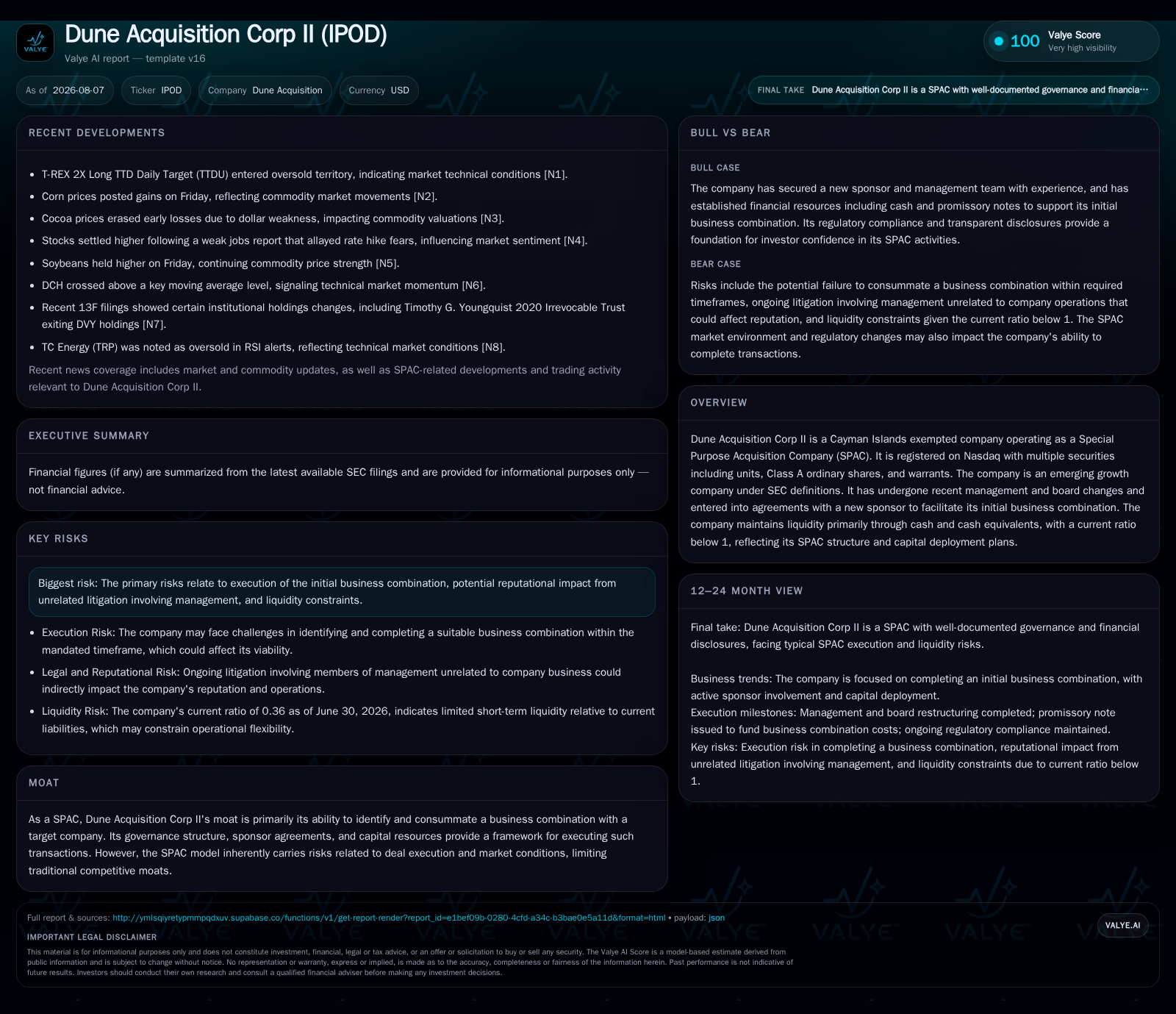
Dune Acquisition Corp II, a Cayman Islands-registered SPAC, reported no material changes in risk factors in its August 2026 10-Q but disclosed leadership shifts, including a new CFO appointment and a $500,000 unsecured note issued by the new sponsor to fund deal-related expenses. The company maintains approximately $43.6 million in cash against sizable current liabilities, reflecting a current ratio of 0.36, typical of pre-combination SPACs. As an emerging growth blank check company, Dune Acquisition's strategic challenge remains completing a timely business combination within the allowed period while navigating market and redemption risks. Its sponsor team’s capital markets experience and expanded network are key to sourcing proprietary deal flow and enhancing probability of transaction completion.
Recent Operating Update
Dune Acquisition Corp II's latest quarterly report filed August 7, 2026 ([S2]) reiterates no material changes in previously disclosed risk factors but includes meaningful governance developments pivotal to its SPAC lifecycle. Effective July 17, 2026, the company appointed Maximilian Staedtler as Chief Financial Officer ([S3],[S28]), replacing Elliot Richmond who remains CEO and Chairman; Staedtler brings substantial expertise from roles at CCM Capital Markets LP and Goldman Sachs investment banking. Importantly, on the same date, Dune issued an unsecured promissory note up to $500,000 payable to its new sponsor entity ([S3],[S29]) to finance reasonable costs related to its pursuit of an initial business combination. This short-term funding facility enhances liquidity flexibility ahead of securing a target without resorting to trust account capital early.
From a balance sheet perspective as of June 30, 2026 ([F1],[S2]), the company held approximately $43.6 million in cash and total current assets near $78.7 million against current liabilities exceeding $216 million. The sizeable trust account funded by IPO proceeds remains dedicated exclusively to consummating the business combination or returning capital upon failure.
Business Model Overview
Dune Acquisition Corp II operates as a classic Special Purpose Acquisition Company (SPAC), also referred to as a blank check company registered in the Cayman Islands ([S1],). It raised gross IPO proceeds totaling approximately $143.75 million by selling Units comprising Class A ordinary shares combined with warrants exercisable at $11.50 per share; together with Private Placement Warrants sold to the original sponsor for $2 million, total capital committed secured near $144.1 million placed into a trust account pending deployment toward acquisition ([S1],[S19]).
Revenue generation is nonexistent prior to the business combination because Dune holds no operating assets or operations ([S1]). Value creation hinges entirely on successfully identifying and closing an initial business combination within a mandated timeframe—currently around 15 months post-IPO—and taking the target public through merger or acquisition. Monetization derives from ensuing equity appreciation attributable to acquiring an enterprise with defensible competitive advantages consistent with management's thesis targeting companies with unique technology or intellectual property that can sustain pricing power ([S1]).
The firm's leadership emphasizes proprietary deal sourcing capabilities backed by an extensive network spanning market participants including private equity funds and investment banks ([S1]). Their approach focuses on disciplined valuations and operational prudence post-merger to enhance returns for shareholders.
Industry Structure & Competitive Positioning
The SPAC industry is characterized by intense competition among sponsors vying to secure attractive private company targets before expiration of the combination period. Sponsors’ track records in capital markets execution and domain-specific transaction expertise strongly influence investor confidence and deal completion probabilities. Notable peers like Pershing Square Tontine Holdings and Churchill Capital illustrate variations in scale, timing urgency, sponsor reputation, and post-merger performance that set benchmarks ().
Regulatory headwinds following recent SEC clarifications around investor protections have increased compliance costs and complexity across SPAC transactions industry-wide; Dune acknowledges these impacts but views strong governance reforms and updated agreements with new sponsors as mitigating factors ([S1],[S3]). Moreover, concerns about potential conflicts of interest are addressed through transparent founder agreements stipulating promote structures and warrant rights designed to align incentives between sponsors and public shareholders.
Dune's recent onboarding of Maximilian Staedtler as CFO signals an agenda toward strengthening financial stewardship during this critical phase of deal origination and transaction structuring given his background in strategic advisory and corporate development across tech-focused sectors where many SPAC targets reside ([S3],[S28]).
Growth Drivers
The primary growth driver remains progress toward completing an initial business combination within prescribed SEC-mandated timelines before the trust account must be liquidated back to investors—success here unlocks public-market access for private firms seeking efficient exits outside traditional IPO channels (). Favorable capital market conditions underpin increased investor appetite for alternative listing vehicles like SPACs owing to speed advantages and flexibility.
Strong sponsor networks augment proprietary access to quality pipeline assets less accessible via auction processes dominated by traditional private equity firms or underwriters ([S1]). The ability to source innovative technology companies or niche market leaders exhibiting sustainable competitive moats enhances negotiation leverage during deal terms.
Availability of PIPE financing commonly supplements transaction funding requirements post-announcement so long as market sentiment remains constructive around SPAC valuations overall—this contingent capital inflow is critical if public shareholder redemption rates erode escrow balances below minimum thresholds needed for closing ().
Risks & Watchpoints
Failure or delay in consummating a suitable business combination constitutes the primary existential risk; unsuccessful attempts result in liquidation at NAV minus expenses with loss of future growth optionality ([S1],[S2]). Redemption risk looms if public shareholders aggressively redeem shares ahead of deal approvals which reduces available cash interfering with deal financing plans.
Reputational challenges arise from pending litigation involving executive management unrelated directly to Dune's operations but potentially impairing stakeholder confidence ([S4],[S15]). Market volatility can depress post-deal share prices impairing perceived value creation thereby complicating sponsor economics through promote dilution or warrant repricing.
Finally regulatory uncertainties loom as evolving SEC positions on accounting treatment of warrants or enhanced disclosure requirements may raise transaction execution hurdles or increase cost structure for SPAC lifecycle management ().
What To Watch Next
Monitoring milestone event filings announcing selection or interim binding agreements regarding prospective targets will be crucial indicators of momentum toward de-SPAC completion given proximity implications for shareholder voting outcomes.
Subsequent quarterly updates will reveal any changes in trust account liquidity deployment especially further drawdowns under short-term notes issued by sponsors like that from July 2026 intended solely for combination-related expenses which signal advancing negotiations ([S3],[S29]). Tracking insider exercises of warrants versus public shareholder redemptions offers insight into alignment dynamics ahead of vote events.
Management guidance on expected timelines alongside regulatory filings clarifying amendments due to evolving SEC guidance could materially affect strategic paths pursued.
Financial Profile Discussion
Disclaimer: This is research-only, informational analysis and not investment advice. It may include AI-generated interpretation and general industry context. Always verify important details using primary sources.

Comments