
Cellyan Biotechnology Faces Revenue Pressure and Nasdaq Compliance Risks Amid Cross-Border OTC Pharma Market Challenges
Revenue declines from both supply chain services and procurement segments underscore competitive and regulatory headwinds for Cellyan Biotechnology.
Cellyan Biotechnology Co., Ltd, a Nasdaq-listed biotech supply chain and distribution service provider, reported a sharp 34% revenue decline in fiscal 2026 driven by weakening demand and intensified competition. The company’s core business—OTC pharmaceutical cross-border e-commerce supply chain services—contracted significantly alongside strategic pruning of low-margin customers in its procurement and distribution segment. Concurrently, Cellyan faces ongoing Nasdaq listing compliance challenges after failing to regain the minimum bid price, posing financial and reputational risks. Operating in the highly regulated Hong Kong-Mainland China OTC pharmaceutical niche, Cellyan’s growth will depend on navigating regulatory complexity, optimizing customer mix, and improving operational efficiencies amid volatile market dynamics.
Recent Operating Update
Meanwhile, Procurement and Distribution revenue decreased by a lesser but still significant 22%, to $5.87 million [S1][S14]. Notably, this segment’s share increased to 44% despite absolute decline as management strategically curtailed business with select customers characterized by protracted receivable aging and low gross margins—moves likely intended to improve profitability and reduce credit risk during intensifying competition
Gross profit margin contracted to approximately 10%, falling from around 12% in the prior year. Although costs carefully tracked lower revenues (down roughly 33%), management notes deliberate price concessions made to sustain competitiveness amongst emerging rivals in this crowded regulatory-sensitive space [S14]. This margin contraction reflects common structural challenges faced by supply chain providers competing on price while contending with fixed logistics infrastructure costs such as warehousing leases and employee compensation.
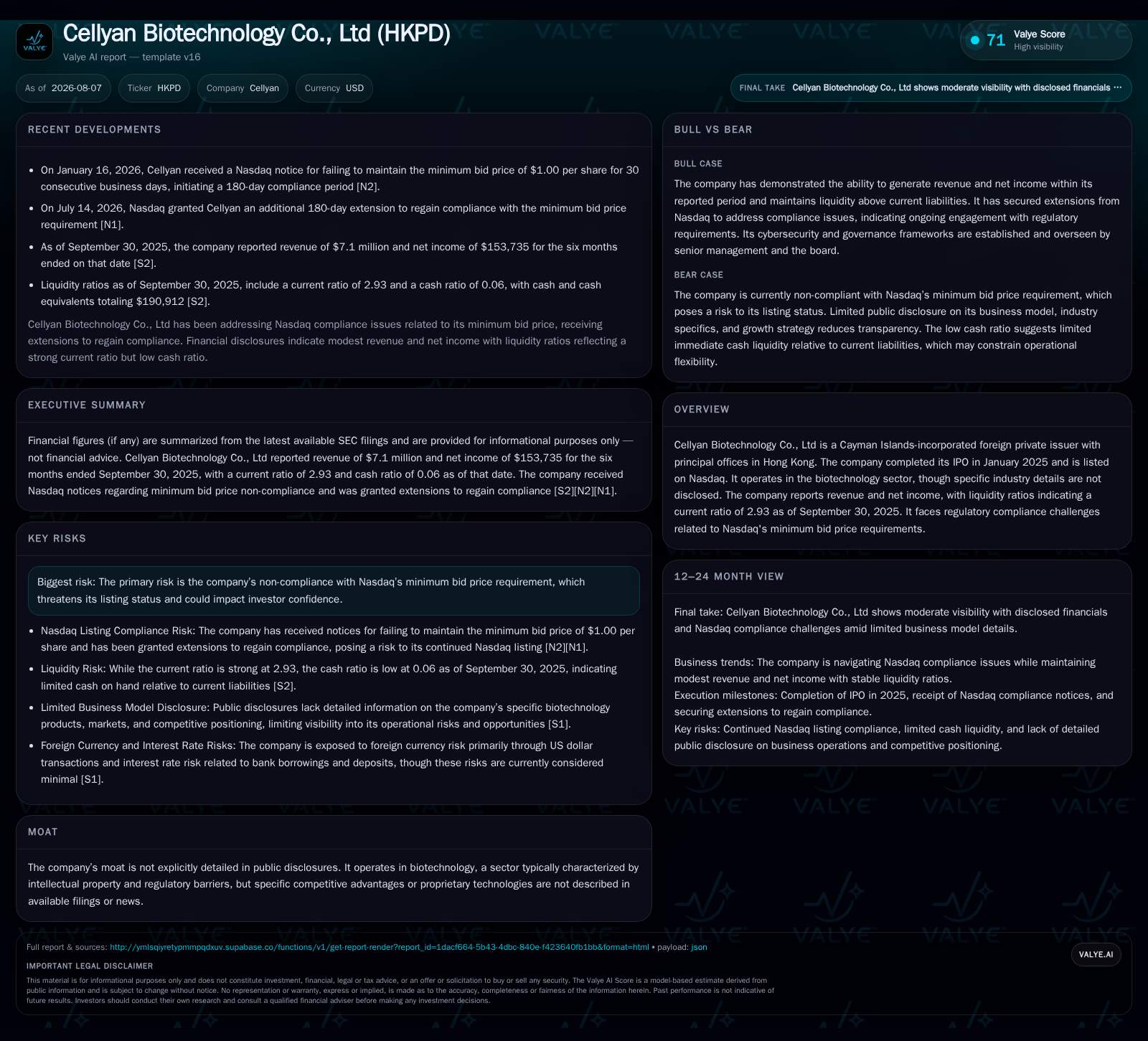
The company also grappled with significant Nasdaq exchange compliance issues due to its Class A Ordinary Shares closing below the $1 minimum bid price threshold for over thirty consecutive trading days. Originally notified early January 2026 with an initial cure period expiring mid-July, Cellyan secured an additional six-month extension until January 11, 2027 [S2], underscoring ongoing risks to its listing status that could undermine investor confidence and access to capital markets [N1].
Business Model Specifics
Cellyan operates primarily through two Hong Kong subsidiaries: Joint Cross Border focusing on third-party supply chain services tailored for Mainland Chinese OTC pharmaceutical e-commerce merchants; and V-Alliance managing procurement and direct sales to merchants via established e-commerce platforms [S1][S17]. Joint Cross Border positions itself as a "one-stop solution," handling everything from overseas product sourcing through import/export permit acquisition to logistics delivery across borders—a value proposition critical given China's complex pharmaceutical regulations governing foreign drug imports.
The Procurement segment leverages specialized knowledge of overseas OTC pharmaceutical products to source inventory directly and distribute them via online channels or through pharmaceutical distributors inside China. Revenue derives mainly from service fees embedded in logistics handling plus markups on procured products sold downstream.
Given inherent regulatory complexity—including mandatory licensure for warehousing pharmaceuticals per HK laws (Pharmacy & Poisons Ordinance), customs clearance formalities, and stringent product enlisting requirements—the company must sustain rigorous compliance programs demanding continuous review by regulators and customers alike [S11][S12]. Failure risks include fines, license suspensions or revocation impacting operational continuity.
Customer retention and engagement hinge on reliable logistics execution and ability to minimize order fulfillment cycle times amid volatile demand patterns typical for OTC pharmaceuticals purchased via cross-border e-commerce platforms. Importantly, the company's reported patient relationship management includes partnerships with major logistics providers integrated into platforms like Alibaba’s CaiNiao network—a critical element given such platforms' dominant ecosystem roles in China’s cross-border retail landscape [S5][S13]. However, concentration among top clients remains high; seven customers accounted for over half of total revenue in fiscal 2026 alone—a vulnerability should any contractual relationships be lost or renegotiated unfavorably.
Industry Positioning & Competitive Framework
Within the biotechnology supply chain service segment specializing in OTC pharmaceuticals for cross-border e-commerce, Cellyan sits at an important intermediary node connecting overseas manufacturers with Mainland Chinese end consumers or merchants. This value-chain role demands expertise spanning regulatory navigation (import/export licenses), product sourcing reliability amidst global trade uncertainties (tariffs, geopolitical tensions), warehousing capacity optimized for sensitive pharma goods requiring stringent storage conditions, wise inventory turnover management (29 days recently versus over mid-30 days historically), seamless customs clearance processes reducing cycle times, plus partnering effectively with e-commerce platform ecosystems.
Peer benchmarks might include regional pharma distributors like Zuellig Pharma or DKSH known for their extensive client base and integrated service suites across Asia; though such names tend towards broader healthcare sectors rather than focused OTC cross-border niches dominated here by smaller agile firms or third-party logistics specialists aligned closely with digital commerce platforms like JD Logistics or SF Express for last-mile delivery capabilities.
Across the competitive landscape are entrants attempting vertically integrated models merging procurement with platform-enabled retailing or establishing proprietary brands leveraging data analytics—a threat addressed partially by Cellyan through strategic customer selection pruning unprofitable contracts but necessitating continued innovation in service differentiation.
Growth Drivers
Future growth is strongly tethered to expanding consumer appetite within Mainland China for OTC pharmaceuticals sourced outside its borders via trusted e-commerce channels—driven by increasing health awareness post-pandemic coupled with governmental policies supportive of cross-border trade facilitation. Escalating regulatory complexity similarly raises barriers favoring experienced operators like Cellyan possessing proven compliance frameworks.
Technological advancements in logistics tracking systems enhance order fulfillment transparency—offering customer retention uplift opportunities if adopted rigorously. Strategic alliances reinforcing ties with major e-commerce platforms can yield scalable merchant access enabling volume growth without commensurate fixed cost increments.
Additionally, rising outsourcing trends among biotech manufacturers offloading their increasingly complicated supply chains open avenues for service providers offering bundled procurement-distribution solutions sensitive to fluctuating demand volatility characteristic of consumer-driven pharma products.[S17]
Risks & Constraints
Operational risks stem from dependence on limited major clients—Alibaba-associated parties notably—with potential revenue volatility if partnerships deteriorate amid competitive incursions or shifting platform policies altering merchant fee structures or logistics mandates [S5][S13]
Regulatory environment volatility remains a broad systemic risk owing to evolving PRC legal frameworks that may impose newly stringent controls over data security clauses affecting overseas offerings or foreign investment restrictions that could impact market access or increase compliance costs unexpectedly [S11][S12]. Furthermore, failure or delays in license renewals related to warehousing or import/export credentials could abruptly disrupt service continuity.
Foreign currency risk is minimal given HKD pegged currency regime mitigating transactional swings; however, geopolitical tensions impacting global trade flows could inflate procurement costs or impose tariffs adversely affecting margins.[S21]
Finally competitive pressures impose pricing compression labor market wage inflation threatens cost escalation requiring ongoing operational efficiency enhancement.
What To Watch Next
Key milestones include monitoring progress toward regaining Nasdaq minimum bid price compliance ahead of January 11 deadline—the absence thereof could lead toward delisting initiation processes which would materially affect rating agencies’ outlooks as well as investor sentiment.[N1]
Operational KPIs worth attention involve customer retention rates among top merchant clients especially those linked via CaiNiao network; changes here could foreshadow further revenue volatility [S5]
Tactical shifts in procurement strategy optimizing customer credit terms—manifested as improvements in average receivable days—and further pruning of low-margin accounts remain critical indicators of management discipline aimed at restoring profitability [S14]
Inventory turnover stability near FY26 level (~29 days) signals alignment between stock levels and reduced demand environment; deviations might suggest either excess inventory risk or shortages impairing order fulfillment.[S8]
Lastly any updates concerning regulatory licenses or material changes reported voluntarily due to evolving Hong Kong/China legal reporting requirements will be important early warnings of operational risks.[S11]
Financial Profile Discussion
Nevertheless, the fiscal year ended March 31, 2026 witnessed an operating cash outflow totaling approximately $752K contrasting with prior positive inflow over $569K the preceding year but highlighting stress environments where cash conversion is challenged by lower sales volumes paired with higher payables settlements [S10]. Capital expenditures were modest (~$43K) signaling restrained investment during downturn phases aiming to preserve cash flexibility.[S7]
The company benefits from supportive controlling shareholders providing contingency liquidity if required while recent private placement capital infusion adds approximately $6.5 million USD boosting runway beyond immediate funding needs albeit raising dilution concerns if repeated more frequently going forward [S15]
Overall financial health appears sufficient currently but hinging critically on restoring profitable growth trajectories along with Nasdaq listing status preservation.
This analysis synthesizes publicly filed company disclosures while applying industry context specific to biotechnology-related cross-border pharmaceuticals supply chains servicing Mainland China's dynamic e-commerce marketplace. It does not provide investment advice but aims to clarify operational trends, risks, sector positioning, and financial nuances integral for informed internal research deliberations.
Disclaimer: This is research-only, informational analysis and not investment advice. It may include AI-generated interpretation and general industry context. Always verify important details using primary sources.

Comments