
Astera Labs Advances AI Infrastructure Connectivity with Platform Integration and Design Wins
Astera Labs strengthens its position in semiconductor connectivity for cloud and AI systems by leveraging an integrated hardware-software platform and deep hyperscaler collaboration.
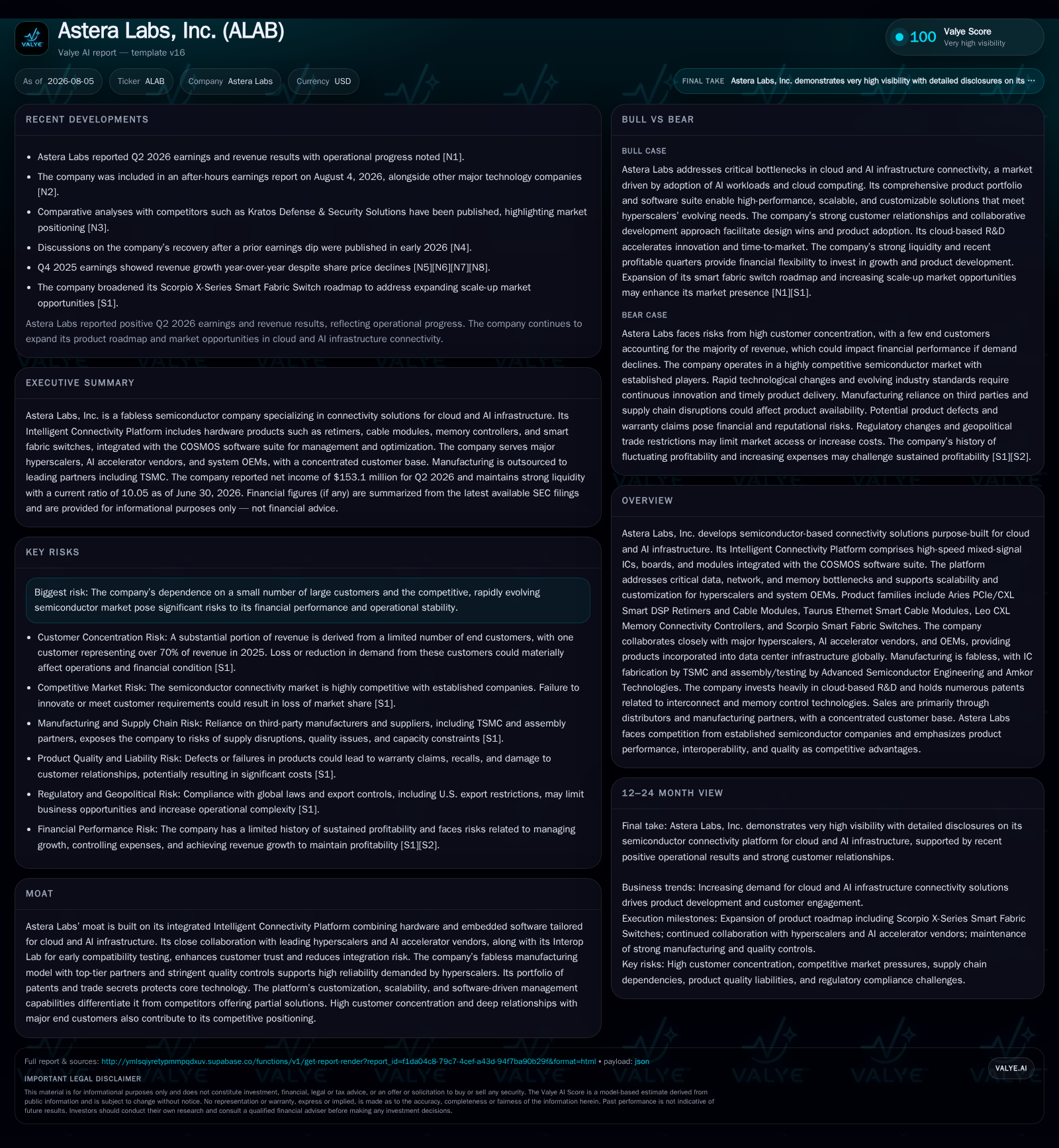
In its latest quarter, Astera Labs maintained steady operating performance supported by ongoing design wins with leading hyperscalers and AI OEMs, reinforcing its role in addressing data center connectivity bottlenecks. The company’s Intelligent Connectivity Platform—spanning mixed-signal ICs, modules, and a proprietary embedded software suite—targets critical cloud and AI infrastructure needs, distinguishing it within a concentrated and fast-evolving semiconductor segment. Key challenges include high customer concentration and the need to continuously innovate amid accelerating adoption of PCIe Gen5/6 and CXL standards. Financially, Astera Labs exhibits robust liquidity with a strong current ratio as of mid-2026, but growth depends on sustaining design wins and navigating lengthy qualification cycles.
Recent Operating Update
Astera Labs reported Q2 2026 results on August 4th that exceeded market expectations on both revenue and earnings metrics [S2][N1]. This performance reflects ongoing momentum from design wins at leading hyperscale cloud providers and system OEMs focused on AI workloads. The company's complex sales cycles benefit from deep engineering collaboration with these customers to tailor solutions addressing critical data path bottlenecks in emerging cloud architectures. Despite the capital-intensive nature of semiconductor R&D and manufacturing partnerships, Astera Labs continues to demonstrate operational discipline in controlling costs while scaling production [S3].
Business Model Overview
Astera Labs operates as a fabless semiconductor company concentrating on high-speed connectivity solutions purpose-built for cloud-scale and AI infrastructure applications [S1]. Its foundational offering is the Intelligent Connectivity Platform, consisting of multiple product formats: mixed-signal integrated circuits (ICs), cable modules, boards, and embedded software under the COSMOS suite. This platform targets key choke points in data transfer throughput, network latency reduction, memory expansion scalability, signal integrity enhancement, and fabric switching.
Revenue is primarily generated through direct sales of hardware products (ICs/modules/boards) mainly to distributors and manufacturing partners who integrate these into end-customer systems deployed globally in data centers [S7][S9]. Monetization also includes embedded software licensing as part of the platform’s configuration and management capabilities. Customer contracts are typically short-term purchase orders rather than long-term volume commitments; hence business depends heavily on design wins that convert into production deployments after multi-month qualification processes
The company’s fabless model outsources wafer fabrication to industry leader TSMC while relying on trusted subcontractors like Advanced Semiconductor Engineering (ASE) and Amkor Technologies for assembly/testing [S1]. Although this arrangement limits capital expenditure on facilities while providing manufacturing flexibility, it requires robust supply chain coordination to ensure timely volume deliveries without sacrificing quality.
Industry Structure and Competitive Position
Astera Labs operates within the niche semiconductor connectivity solutions segment tailored for cloud hyperscalers and burgeoning AI system developers. The industry is defined by rapidly evolving high-bandwidth standards such as PCIe Gen5/6 for peripheral interconnects and CXL (Compute Express Link) for coherent memory expansion — protocols essential to next-generation disaggregated data center architectures.
Peers include large integrated device manufacturers like Broadcom and Marvell Technology offering similar retimers and Ethernet switches; chip giants Intel supplying CXL controllers; NVIDIA collaborating as both customer and developer of AI accelerators; plus Cisco Systems competing on smart fabric networking equipment. However, Astera Labs differentiates itself by integrating embedded software tightly with hardware products into a unified platform — the COSMOS software suite facilitates real-time telemetry monitoring, predictive analytics for signal quality issues, remote firmware updates, customization per customer deployment scenarios — all features that go beyond commoditized chip offerings.
Industry KPIs revolve around securing design wins at hyperscalers/OEMs due to their outsized demand volumes; shortening product qualification cycle length essential for faster revenue recognition; managing customer concentration given top clients represent majority revenue; maintaining average selling price stability despite generational ASP declines typical in semiconductors; optimizing R&D spend ratio to sustain technological leadership; increasing unit shipments aligned with deployment ramps; ensuring low failure rates meeting hyperscale reliability demands; plus steadily improving time-to-market against evolving PCIe/CXL specifications.
Growth Drivers
The principal growth catalyst stems from the explosive adoption of AI workloads driving massive expansions in cloud data centers worldwide. These environments require specialized connectivity solutions to address persistent bottlenecks in data throughput between processors (CPUs/GPUs/accelerators), memory subsystems via coherent interconnects like CXL, high-availability fabric switching for distributed compute nodes, and optimized cabling modules reducing signal degradation over long distances.
The proliferation of disaggregated compute architectures emphasizes modularity where individual components (compute cores, memory pools) connect flexibly at scale — Astera’s platform supports these dynamics by offering customizable hardware/software stacks that align with each customer’s system topology.
Furthermore, increasing complexity of data center networks necessitates sophisticated monitoring tools embedded within silicon designs — the COSMOS suite provides this telemetry capability enabling preemptive maintenance reducing downtime risk which is paramount for hyperscale operators.
Expansion into new geographic markets where cloud adoption is accelerating also presents medium-term opportunities; however near-term demand remains concentrated among established hyperscalers in North America and Asia-Pacific regions. Integration projects with emerging AI accelerator vendors who require uniquely optimized connectivity further fuel design win momentum.
Risks and Watchpoints
High customer concentration poses a significant risk: one customer accounted for over 70% of revenue in 2025 while top three represented ~86% [S26]. A downturn or shift in purchasing patterns at any major client can materially affect financial results given absence of diversified revenue streams.
The company faces substantial pressure to continuously innovate in step with fast-changing PCIe/CXL standards—delays or misalignment risking lost design wins which can set back revenue ramps by quarters or years. Qualification processes are expensive with uncertain outcomes; failure or delay impairs ability to recoup development costs promptly.
Pricing pressures typical in semiconductor life cycles could compress gross margins if volume increases do not offset ASP erosion. Supply chain risks inherent in fabless operations—such as limited long-term contracts with third-party foundries or assembly testers—could lead to component shortages or delivery delays harming customer relationships.
Finally, integration complexity including interoperability testing must be tightly managed through initiatives like Astera’s Interop Lab collaboration hub. Defects or product recalls would negatively impact reputation given near-zero defect tolerance expected by hyperscalers [S10][S28].
What to Watch Next
Near-term milestones include announcements or confirmations of new design wins from hyperscaler customers or AI hardware partners that drive incremental unit shipments after protracted qualification phases.
Monitoring changes in product mix—introductions of newer generation Aries PCIe/CXL Smart Retimers or Scorpio Fabric switches supporting PCIe Gen6—would signal technology leadership sustaining competitive positioning.
Watch updates related to COSMOS software adoption rates across installed base since its incremental value adds stickiness beyond standard silicon components.
Observe supply chain status reports confirming no material disruptions with TSMC wafer supply or ASE/Amkor test capacity that could affect fulfillment schedules.
Financial guidance commentary given prior volatility would also serve as an indicator if procurement lead times normalize amid macroeconomic challenges or if backlog dynamics shift positively.
Financial Profile Discussion
As of June 30, 2026, Astera Labs held $111.5 million in cash and equivalents supported by $1.65 billion current assets against $164 million current liabilities yielding an extraordinarily strong current ratio above 10x—a sign of solid short-term liquidity positioning for operational flexibility [F1]. This cushion mitigates near-term liquidity risks common within capital-intensive fabless semiconductor firms during volatile demand cycles.
R&D spend remains a critical lever influencing both product pipeline robustness and time-to-market velocity though exact ratios are undisclosed here. Maintaining positive cash flow from operations will be key amid competing demands for investment versus shareholder returns over medium term.
This analysis synthesizes evidence from recent quarterly filings alongside longer-term structural insights into semiconductor connectivity solutions pivotal for accelerating cloud-scale AI infrastructure deployment. It highlights Astera Labs’ strategic strengths around its integrated platform approach combined with embedded software differentiation while weighing risks from concentrated customer exposure and technological competition in a rapidly evolving ecosystem. Continued progress depends heavily on execution discipline across product innovation cycles combined with maintaining deep customer relationships within a highly specialized market niche.
Disclaimer: This is research-only, informational analysis and not investment advice. It may include AI-generated interpretation and general industry context. Always verify important details using primary sources.

Comments