
VPG’s Latest Quarter Highlights Growth Potential Amid Cyclical Industry Headwinds
Vishay Precision Group’s Q2 2026 results reflect stable demand and innovation-driven positioning despite ongoing industrial cyclicality.
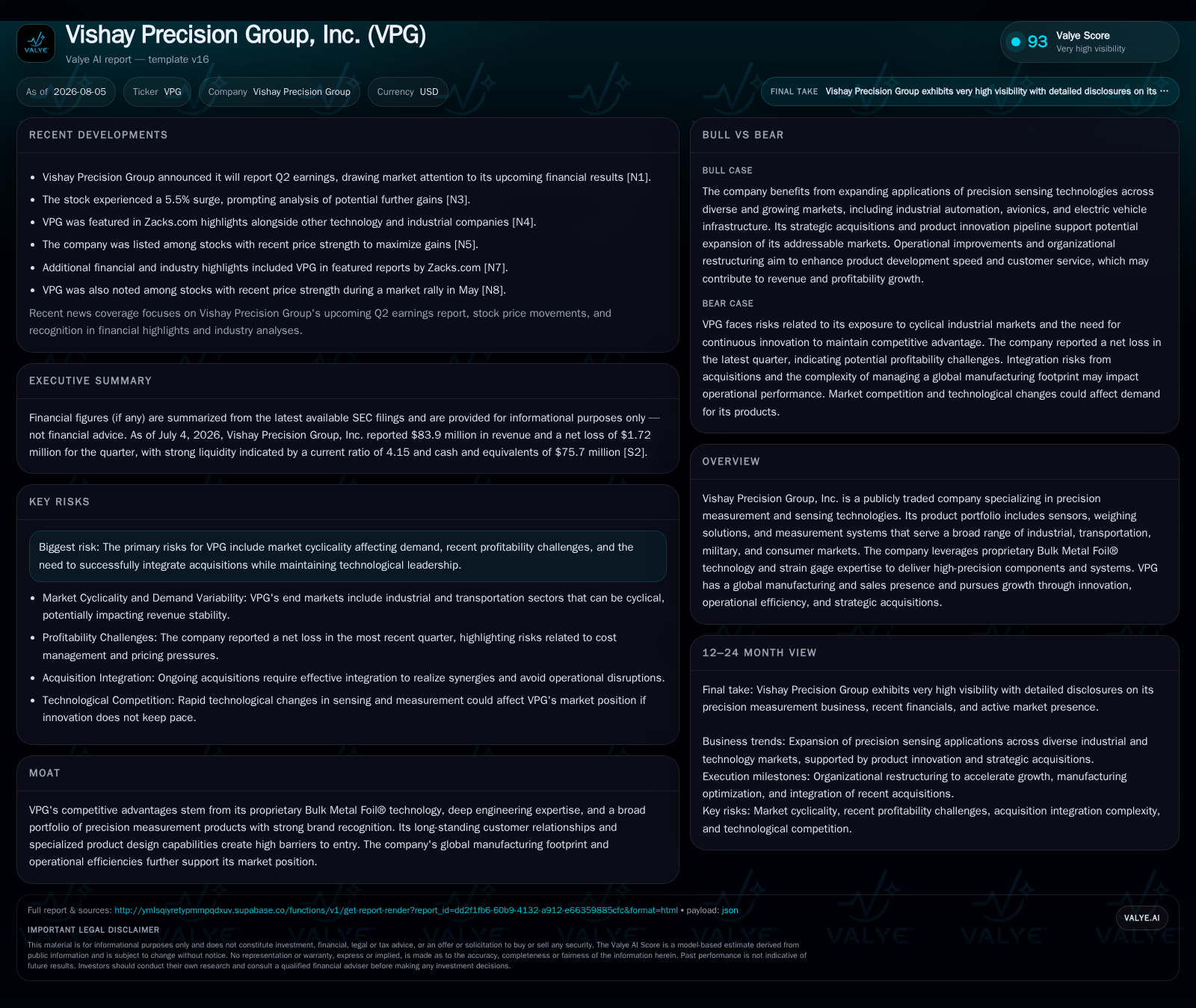
In its August 2026 quarterly filing, Vishay Precision Group (VPG) reported stable order trends and continued investments in R&D amidst a challenging macro environment that dampens near-term profitability. The company leverages its proprietary Bulk Metal Foil® technology to maintain pricing power and customer loyalty across diversified precision sensing markets. While cyclical end-market softness and competitive pressures persist, VPG’s strategic acquisitions and innovation pipeline underpin medium-term growth prospects. Key monitors include order backlog dynamics, new product qualifications, and margin improvement signals.
Robust Quarterly Results Against a Cyclical Industry Backdrop
Vishay Precision Group's second quarter of fiscal 2026 provided evidence of operational stability in the face of broad industrial cyclicality. The company reported no material deterioration in order intake or backlog relative to production volumes; the book-to-bill ratio remained near parity, signaling steady albeit cautious customer activity in precision sensors and weighing solutions [S2][S3]. This steadiness is notable given ongoing softness in transportation and industrial end markets that typically drive volumetric demand for load cells and transducers. Average selling prices were largely maintained, reflecting underlying pricing power attributed to proprietary technologies rather than commoditized products.
Margins faced pressure during the quarter due to inflationary input costs and higher R&D spending but operating income trends suggested incremental efficiency gains are mitigating these headwinds. Furthermore, geographic sales mix remains balanced enough to blunt localized downturns, although Asia's competitive intensity is a consistent challenge. Overall, the quarter reveals an underlying resilience in demand sensitive primarily to end-market capital expenditure cycles common in industrial hardware sectors.
Leveraging Proprietary Bulk Metal Foil® Technology Across Diversified End Markets
At the heart of VPG’s competitive advantage lies its proprietary Bulk Metal Foil® technology coupled with decades of engineering expertise in foil strain gages. This technology offers superior sensor stability, repeatability, and low drift compared to semiconductor or other strain gage alternatives prevalent among competitors. These characteristics are critical in mission-critical measurement applications across aerospace, military, medical, and industrial automation sectors where data accuracy directly correlates with downstream system performance.
The technology’s durability enables premium pricing and fosters long-term customer relationships by reducing qualification cycles—a major friction point when customers switch suppliers or adopt new designs [S1]. This moat extends beyond raw sensor production into custom engineering services where tailored sensor configurations meet exacting client requirements. As such, VPG’s revenue largely derives from differentiated product sales combined with engineering customization that supports higher average selling prices (ASP) relative to commodity load cell producers.
The application breadth—from precision weighing solutions in steel production to avionics instrumentation—also diversifies demand exposure across cyclical industries. This diversified portfolio reduces single-market dependence while leveraging the Bulk Metal Foil® advantage across multiple use cases.
Competitive Dynamics in Precision Sensors: Peer Comparisons Highlight Moat Characteristics
Within the precision measurement industry landscape, VPG’s specialization positions it distinctively between legacy foil strain gage producers such as its former parent Vishay Intertechnology, highly integrated sensing solution providers like Honeywell, and test & measurement equipment specialists including HBM. Unlike commodity load cell manufacturers dispersed globally, VPG combines proprietary materials science with engineering-intensive manufacturing which creates higher switching costs for customers reliant on precise calibration and reliability.
Competition varies by segment: foil resistors face pressure from lower-cost Asian producers yet maintain differentiation through quality; load cell modules compete on customization depth; integrated systems contend with vendors offering turnkey data acquisition hardware-software stacks. In this context, VPG’s global manufacturing footprint supports flexible capacity utilization responding to varied regional demand patterns—a crucial factor amid supply chain constraints impacting peers.
Moreover, VPG’s longstanding brand recognition related to its Bulk Metal Foil® heritage underpins its ability to sustain pricing power even as semiconductor strain gage technologies evolve. However, vigilance toward technological advancements by rivals remains vital given rapid pace of innovation in sensor miniaturization and integration.
Strategic Paths to Growth: Innovation Pipeline and Acquisition Integration Efforts
Recognizing the importance of sustaining industry leadership through technological advancement, VPG continues to allocate significant resources toward research and development. The latest disclosures emphasize maintaining or increasing R&D spend as a percentage of sales to fill the product pipeline with next-generation precision sensors targeting enhanced accuracy and miniaturization [S1]. Successful new product introductions shorten customer lead times—another competitive lever—and drive incremental margin expansion over legacy offerings.
Simultaneously, acquisition remains a key strategic lever aimed at expanding product breadth into complementary measurement domains such as torque, tilt, motion sensing, or pressure measurement. While these deals have historically accelerated market penetration and broadened technological capabilities, management acknowledges integration risks that could temporarily pressure operating results if synergies prove harder to realize [S1]. Effective post-merger integration impacting customer qualification cycles will be an important execution watchpoint going forward.
The combined approach of organic innovation plus selective acquisitions positions VPG favorably for medium-term growth amid evolving industry requirements shaped by automation trends and increased sensor deployment across transport and industrial end markets.
Risks from Market Cycles, Competitive Pressures, and Integration Execution Challenges
Despite these strengths, several risks temper the outlook for Vishay Precision Group. Foremost is the enduring cyclicality within major served markets such as transportation manufacturing and heavy industry where capital spending fluctuates with economic cycles impacting order visibility [S1][S2]. Furthermore, competition—especially from low-cost producers based in China—continues to exert downward pricing pressure on certain foil resistor components despite overall differentiation.
Technological obsolescence risk persists as semiconductor strain gages improve fidelity potentially encroaching on traditional Bulk Metal Foil® applications thus requiring vigilant innovation investment to retain leadership. Additionally, execution risks associated with integrating recent acquisitions are meaningful; failure here could erode customer satisfaction or delay realization of expected synergies reducing margin expansion opportunities.
Labor shortages affecting skilled personnel both internally in manufacturing roles and among suppliers further exacerbate capacity constraints potentially leading to extended lead times or elevated costs impacting customer delivery commitments.
Collectively these factors mean investors must monitor operational execution rigor closely alongside cyclical market developments.
What Investors Should Monitor Next: Order Trends, New Product Launches, Profitability Signals
Key milestones that would validate an improving growth profile include sustained book-to-bill ratios above one indicating growing backlog relative to shipped volumes confirming firm demand momentum [S2][S3]. Early signs of successful new instrumentation qualification wins shortening overall customer adoption cycles would signal strengthening commercial traction for recently developed products.
Capacity utilization metrics moving upward would reveal effective absorption of operational fixed costs enhancing margins alongside continued controlled inflation management. Incremental margin recovery premised on operational efficiencies paired with disciplined R&D expense management would underscore maturation of investments embarked upon during current periods.
Conversely growing order volatility or deteriorating price realization would warrant closer scrutiny about cyclicality severity or intensifying competitive assaults.
Financial Profile Discussion: Strong Liquidity with Profitability Still Evolving
From a financial standpoint measured at quarter-end July 2026, Vishay Precision Group exhibits robust liquidity supported by $75.7 million in cash and equivalents against $16 million total debt resulting in a net cash position approximately $59.7 million positive [F1]. The current ratio stands healthy at 4.15 reflecting ample short-term asset coverage relative to liabilities providing flexibility for working capital requirements amid potential upticks in raw material costs or inventory build for new product introductions [F1].
This financial posture supports VPG’s dual priorities of driving organic growth via innovation while selectively pursuing accretive acquisitions ensuring balanced capital allocation aligned with strategic objectives.
This analysis is prepared solely for informational purposes reflecting publicly available disclosures up to August 5, 2026. It does not constitute investment advice or research views.
Disclaimer: This is research-only, informational analysis and not investment advice. It may include AI-generated interpretation and general industry context. Always verify important details using primary sources.

Comments