
Gran Tierra Energy Streamlines with $1.3 Billion Asset Sale as Upstream Focus Sharpens
Gran Tierra’s divestiture of its Colombia and Ecuador oil business marks a strategic shift, concentrating operations in Canada and refining capital allocation amid ongoing commodity volatility.
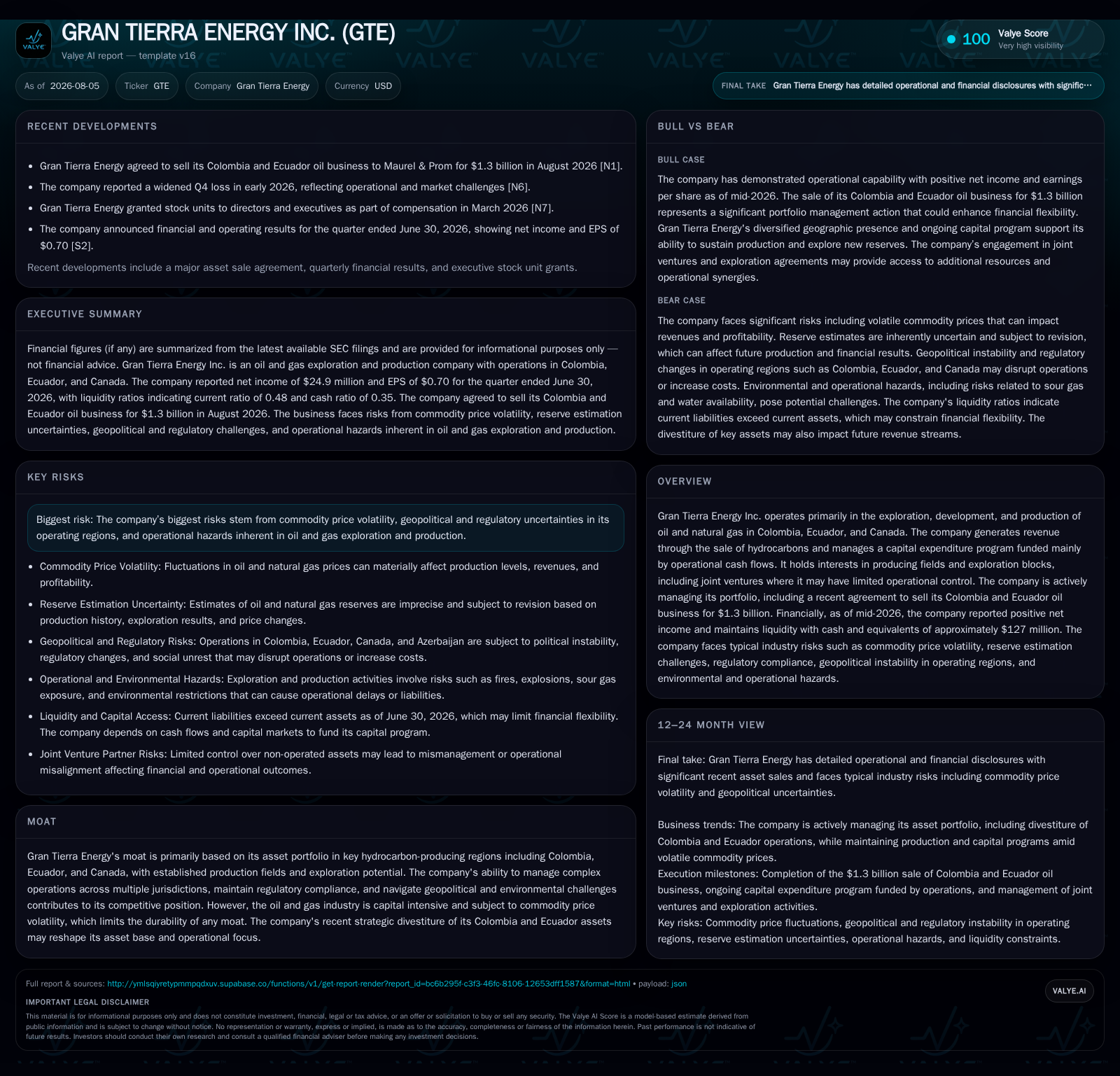
In Q2 2026, Gran Tierra Energy agreed to sell its Colombian and Ecuadorian assets for $1.3 billion to Maurel & Prom, significantly altering its geographic footprint and commodity exposure. This transaction reduces operational complexity by focusing on Canadian upstream assets, reshaping revenue streams and capital expenditure priorities. While lifting costs remain competitive within peer groups, the company faces concentrated commodity price and geopolitical risks post-sale. The asset sale strengthens liquidity but underscores the need for disciplined capital management in a capital-intensive environment.
Strategic Divestiture Narrows Geographic Exposure
Gran Tierra Energy’s August 2026 agreement to sell its Colombian and Ecuadorian oil assets for $1.3 billion to Maurel & Prom represents a decisive portfolio refocus away from geopolitically complex Latin American operations toward a concentrated Canadian upstream presence [N1][S3]. This move reduces exposure to mature fields managed often through joint ventures with limited operational control, simplifying management layers and regulatory complexities inherent in South American jurisdictions [S1][S2].
The Q2 2026 financial report captures the immediate impact of this transition through lower aggregate production volumes, reflecting the divestment process and signaling a shift in near-term revenue sources [S2]. The company is repositioning its asset base toward regions where it holds stronger operational influence and clearer regulatory oversight.
Impact on Revenue Structure and Capital Allocation
Gran Tierra’s upstream revenue historically derived from producing hydrocarbons under contracts subject to price differentials related to quality and transport logistics, varying significantly between Colombian/Ecuadorian light crude streams and Canadian heavier blends [S1]. The exit from South America shifts revenue recognition predominantly to Canadian output, where pricing dynamics are influenced by global benchmarks adjusted for pipeline tariffs.
Capital expenditure priorities have pivoted accordingly. Funds previously allocated to exploration and development abroad are now redirected primarily toward sustaining production and growth initiatives within Canadian assets, relying heavily on internally generated cash flow rather than external financing sources [S1][S2]. This reallocation reflects a strategic emphasis on operational control and political stability while balancing the need for reserve replacement amid natural field declines.
Operational Efficiency Amid Transition
Despite production volume adjustments linked to the divestiture, Gran Tierra maintains lifting costs per barrel comparable with peers operating in similar upstream environments across Canada and Latin America [S2][S3]. Cost discipline remains pivotal as commodity price fluctuations continue to pressure margins.
Streamlined joint venture structures post-sale enhance decision-making efficiency by consolidating operating control, reducing overhead redundancies, and mitigating downtime during ownership transitions. These factors contribute to stable production uptime metrics essential for securing operational cash flow during this restructuring phase [S1]
Competitive Positioning Post-Divestiture
Compared with other mid-tier upstream producers active across Colombia, Ecuador, and Canada, Gran Tierra’s sharpened focus aligns with a broader industry trend favoring geographic concentration over diversification. This approach enables deeper basin expertise and more targeted capital deployment but heightens exposure to localized risks.
Selective divestitures are increasingly common among peers seeking improved free cash flow profiles by reducing geopolitical risk and regulatory burdens. Gran Tierra’s strategy mirrors this pattern by prioritizing reserve replacement efficiency through focused exploration efforts that aim to lower finding and development costs relative to legacy assets experiencing natural decline curves.
Growth Prospects Driven by Technological Advancements
Post-sale growth depends heavily on exploiting Canadian assets through enhanced recovery techniques such as horizontal drilling innovations detailed in prior disclosures [S1][S2]. These technical advancements can improve reserve replacement ratios—a key indicator of production sustainability—and reduce lifting costs by optimizing extraction methods.
This focused investment strategy leverages operational cash flow to support well development schedules and infrastructure improvements designed to expand margins despite reduced geographic diversification.
Risk Considerations: Commodity Prices and Geopolitical Exposure
While shedding South American operations diminishes exposure to volatile government policies characteristic of Colombia and Ecuador, Gran Tierra remains vulnerable to commodity price fluctuations tied primarily to Brent-based indices affecting realized prices after transportation deductions [S1][S2].
Geopolitical risk persists within Canadian operations due to environmental regulations and indigenous stakeholder negotiations that may intermittently delay projects or increase capital requirements. These factors necessitate vigilant risk management integrated into corporate governance frameworks.
Near-Term Milestones: Transaction Completion and Capital Deployment
Key upcoming events include securing final regulatory approvals necessary for closing the $1.3 billion asset sale, which will formally remove Colombian/Ecuadorian operations from Gran Tierra’s balance sheet [N1][S3]. How the company allocates proceeds—whether toward debt reduction or increased capital expenditures in Canada—will reveal management’s strategic priorities.
Subsequent quarterly reports will provide critical data on post-transition production volumes and realized pricing trends, serving as metrics for evaluating cash flow stabilization or growth within the refocused portfolio.
Financial Profile Discussion: Liquidity Position Supports Strategic Shift
As of June 30, 2026, Gran Tierra held approximately $127 million in cash against roughly $552 million in total debt, resulting in net debt near $425 million [F1]. Current assets of $239 million and current liabilities of $493 million imply a current ratio near 0.48x for 2026-06-30 [F1].
This analysis integrates Gran Tierra Energy’s latest filings with sector-specific insights framing its strategic repositioning following a major asset sale that recalibrates its operational footprint. Monitoring execution risks tied to transaction closure alongside effectiveness of targeted investments will be critical amid ongoing commodity market volatility.
Disclaimer: This report is informational only; it does not constitute investment advice or an offer to buy or sell securities.
Disclaimer: This is research-only, informational analysis and not investment advice. It may include AI-generated interpretation and general industry context. Always verify important details using primary sources.

Comments