
RICHTECH ROBOTICS Advances AI-Driven Commercial Service Robot Development Amid Compliance Challenges
The company expands operational capacity with a new U.S. facility and strategic partnerships while addressing financial reporting compliance.
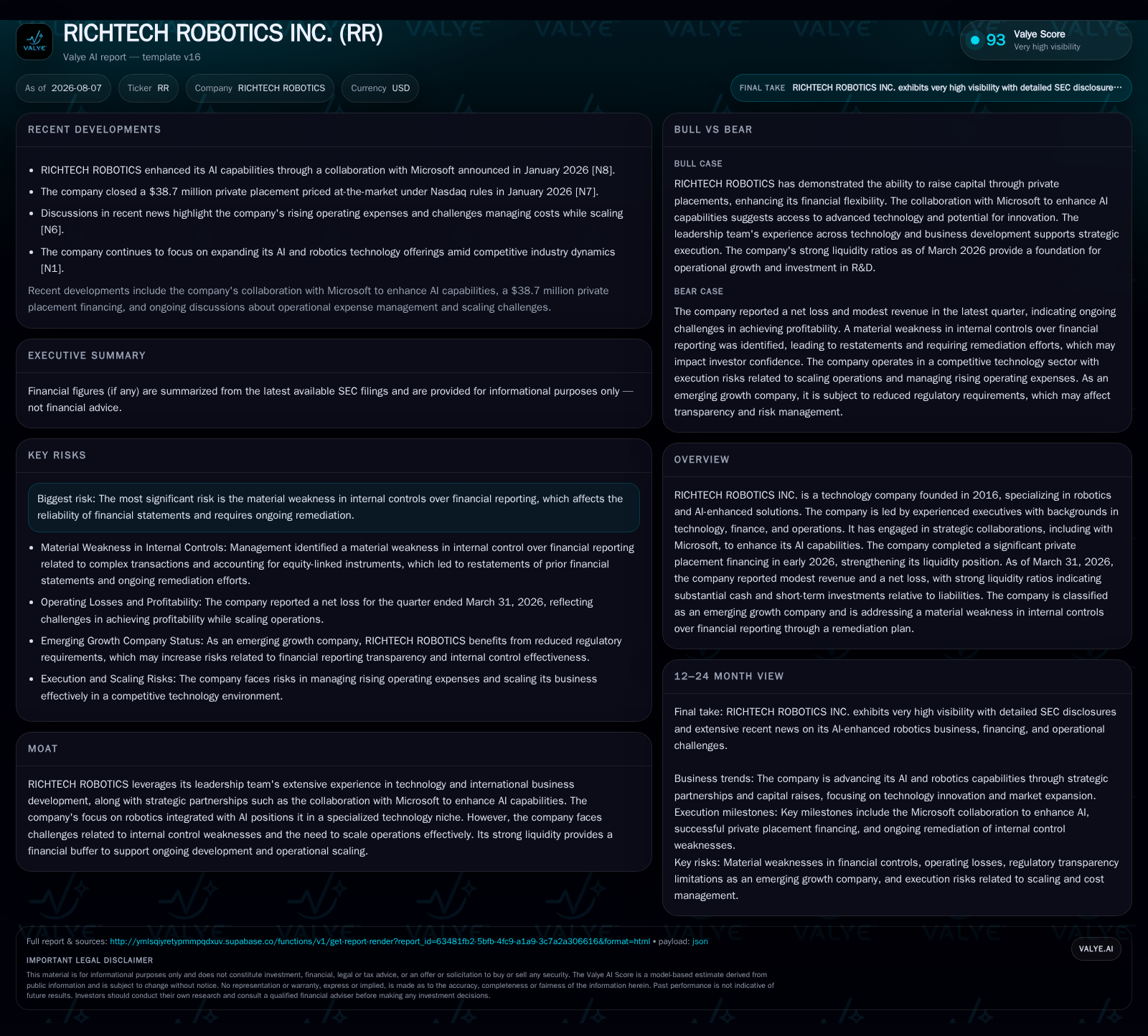
RICHTECH ROBOTICS is enhancing its commercial service robotics capabilities through a significant U.S.-based facility acquisition and deepening AI collaborations, notably with Microsoft. The latest quarterly filing shows the firm navigating material internal control weaknesses affecting timely SEC reporting, leading to a Nasdaq compliance plan submission. While near-term operating losses persist, substantial liquidity supports ongoing R&D and scaling efforts in an evolving service robotics industry. Market acceptance and regulatory compliance remain critical watchpoints as Richtech aims to translate AI-driven innovation into broader customer adoption.
Quarterly Operating Update Signals Strategic Capacity Expansion with New U.S. Facility Acquisition
The August 2026 Form 10-Q filing highlights Richtech Robotics’ strategic acquisition of a substantial property in Las Vegas—a nearly 79,325 square foot building secured at $21.18 million fully paid from cash reserves [S2][S3][S6]. This marks a pivotal progression from prior periods where operational scale was limited to support growing deployment demands across its service robotics portfolio. The facility is designated as a multifunctional hub for warehousing, assembly lines for robotic hardware manufacturing, light manufacturing processes, as well as advanced research and development activities including robotic testing and data collection to train proprietary AI models [S6]. Given the industry's evolving requirements for continuous AI model improvement and high robot uptime reliability, this investment signals efforts to vertically integrate more of the value chain in-house, potentially accelerating responsiveness to customer feedback and innovation iteration cycles.
Business Model Nuances: Integrating Robotic Hardware Sales with Software and Support Revenue Streams in Emerging Service Robotics Market
The annual filing further reveals Richtech's commitment to intensive robotics R&D expenditures aimed at improving automation breadth across sectors including food service, industrial manufacturing, healthcare, and retail deployment scenarios [S1]. Maintaining robust R&D intensity relative to revenues is crucial given the rapid pace of innovation required to sustain customer adoption rates amid competitive pressure.
Competitive Positioning Within Service Robotics: Lessons from Peer Innovation Intensity and Market Adoption Barriers
RICHTECH’s positioning within the burgeoning service robotics landscape intersects with well-known players like iRobot (noted for consumer/commercial cleaning robots), Boston Dynamics (advanced robotics leveraging cutting-edge AI), and Fetch Robotics (specializing in indoor delivery automation). These peers set benchmarks on product deployment scale, customer adoption velocity, technological innovation cadence, and depth of AI integration within practical operations.
Operating in this sector inherently demands continual investment in technology refresh cycles against risks of obsolescence or being undercut by lower-cost competitors. Moreover, the market for commercial service robots remains emergent; broader acceptance hinges on end-user workplace integration willingness alongside demonstrated productivity gains [S1]. Given these dynamics, Richtech’s ability to effectively translate R&D outputs into reliable robot units sold and retain customers through software/service contracts will be defining metrics moving forward.
Growth Potential Anchored in AI Enhancement and Geographic Expansion Plans Supported by Strategic Partnerships
Several structural tailwinds underpin Richtech’s growth outlook. First is the acceleration in demand for automation solutions driven by rising labor costs across several industries where manual repetitive tasks are prime candidates for robotics substitution. Second is ongoing advancement in embodied AI enabling robots to operate autonomously with improved reliability—enabling expansion beyond controlled industrial settings into more variable commercial environments [S1][S3][S6].
Richtech’s new Las Vegas facility plays a dual role by serving as a domestic logistics hub facilitating quicker market penetration within the United States while also anchoring R&D efforts supporting the continuous improvement cycle of their robots’ AI capabilities through enhanced data collection and model training workflows [S6]. Strategic partnerships like that with Microsoft further extend these capabilities by providing scalable cloud infrastructure for complex AI workloads.
Growth levers include scaling robot units sold (subject to successful commercialization), licensing revenue progression tied to software upgrades/AI improvements embedded in deployed units, expanding recurring maintenance contract base supporting stable aftermarket income streams, plus geographic footprint expansion enabled by operational capacity enhancements.
Risks from Internal Controls Weaknesses Amid Rapid Technological Change and Regulatory Listing Pressure
Operational advancement notwithstanding, Richtech remains challenged by significant material weaknesses in internal controls over financial reporting disclosed repeatedly since fiscal year-end September 2025 [S3][S15][S20]. These deficiencies led to delayed SEC filings—including late Form 10-Q submissions triggering a Nasdaq notice under Listing Rule 5250(c)(1) requiring timely periodic filings [S3][S16]. The company has since submitted a remediation plan seeking up to 180 calendar days extension until November 2026; however, approval is not guaranteed [S3].
These issues stem from complex accounting around warrant liabilities and equity instruments requiring significant judgment on fair value measurements—highlighted during their restatement process covering multiple prior fiscal periods [S15][S21][S27]. The material weakness undermines investor confidence regarding financial statement reliability until fully remediated. It also represents a significant administrative overhead potentially diverting management attention away from core operational scaling efforts.
Aside from financial controls risk, the company faces typical sectoral hazards: evolving safety regulations concerning autonomous robot operation indoors alongside humans; rapid competitive technology innovation putting pressure on product lifecycles; uncertainties over speed of broad commercial adoption of robots coexisting safely with personnel; capital intensity inherent in scaling manufacturing/testing infrastructure; plus potential reputational risks if any deployed units exhibit operational failures [S1][S24].
Forward-Looking Monitoring: Upcoming Milestones for Nasdaq Compliance and Operational Scaling Execution
Investor focus should coalesce around several concrete near-term milestones: the outcome of Nasdaq's review regarding acceptance or rejection of Richtech’s compliance restoration plan by November 2026 deadline [S3]; shipment volume trends signaling improved commercialization traction post-facility ramp; ongoing progress indicators toward remediation of internal control weaknesses documented via auditor communications or subsequent SEC disclosure updates; stabilization or improvement trends in operating cash burn reflecting advancing economies of scale versus continued R&D spending intensities [S2].
Financial Profile Discussion: Liquidity Strength Balances Near-Term Operating Losses And R&D Investment Burden
While short-term profitability remains out of reach presently due primarily to upfront capital allocation toward innovation cycles rather than immediate monetization efficiency gains typical for early-stage robotics innovators like iRobot or Fetch Robotics at comparable developmental junctions (primarily due to differing scale), maintaining disciplined cost management alongside gradual volume increases will be necessary to preserve long-term viability.
This analysis summarizes publicly disclosed data from Richtech Robotics’ most recent SEC filings through August 7th, 2026 along with industry context relevant to the service robotics sector specialization integrating embodied AI systems. No investment research views are offered herein. Readers should consult independent sources before forming views regarding this company or its sector positioning.
Disclaimer: This is research-only, informational analysis and not investment advice. It may include AI-generated interpretation and general industry context. Always verify important details using primary sources.

Comments