
CoastalSouth Bancshares Strengthens Loan Growth and Interest Rate Risk Management Amid Margin Pressures
The latest quarterly results reveal CoastalSouth’s operational focus on expanding its loan portfolio while actively managing interest rate risk through derivatives.
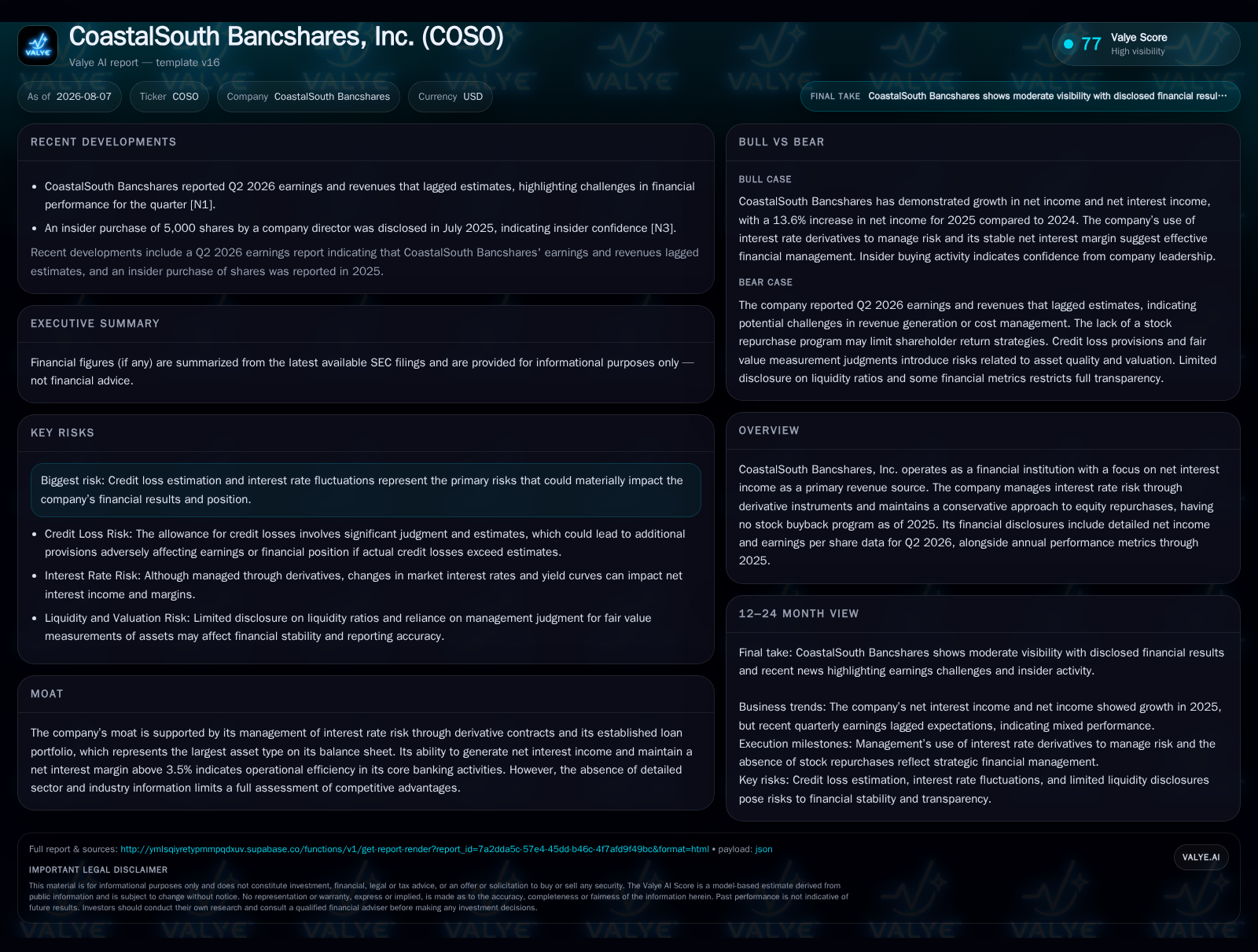
CoastalSouth Bancshares, Inc. reported second-quarter 2026 results evidencing continued loan portfolio expansion, which remains the primary driver of net interest income. The company sustains a net interest margin above 3.5%, supported by hedging strategies employing interest rate derivatives to mitigate volatility. Despite no current stock repurchase program, CoastalSouth maintains conservative capital management and regulatory compliance. Key risks persist around credit loss allowances and potential interest rate fluctuations affecting margins.
Recent Operating Update
CoastalSouth Bancshares’ latest quarterly filing dated August 7, 2026, underscores continued execution of its growth strategy centered on loan portfolio expansion. Net interest income—the core revenue engine—benefits from strong demand in both commercial and consumer lending segments. Though Q2 earnings and revenues slightly lagged estimates reported July 20, 2026, the underlying asset composition shows durable momentum [S2][N1]. This sets the tone for assessing the firm’s strengths and vulnerabilities within a regional banking context.
Business Model Analysis
Interest expense management is equally pivotal; CoastalSouth achieved a reduction driven partially by lower deposit costs and the strategic redemption of subordinated debt totaling $15 million in 2025 [S24][S8]. The company also leverages derivative instruments—including interest rate swaps designated as cash flow hedges on brokered deposits—to smooth volatility in funding costs tied to market rates [S17]. These derivative contracts are essential in mitigating mismatch risk between fixed-rate liabilities and variable-rate assets.
Notably, CoastalSouth explicitly does not maintain or anticipate resuming a stock repurchase program in the near term, indicating a prudent stance on equity capital preservation [S1]. Capital adequacy is managed conservatively through regulatory compliance and payoff of higher-cost instruments rather than returning cash to shareholders.
Industry Structure and Competitive Position
Within regional banking—dominated by institutions like Regions Financial Corporation (RF) that serve SME clients through relationship-driven banking—CoastalSouth's model aligns with typical value-chain roles: intermediating between depositors supplying funds and borrowers demanding credit for business operations or personal finance needs. The firm's reliance on Federal Home Loan Bank advances alongside deposits balances liquidity provisioning against operating needs [S4][S5]
Peer comparison frameworks generally note that maintaining net interest margins north of 3.5% signals effective asset-liability management during volatile rates; CoastalSouth meets this threshold consistently as shown for fiscal year-end 2025 [S24]. This margin performance situates it competitively with small- to mid-cap regional banks that actively use derivative hedging structures.
Concentration risks remain prominent given over 16% exposure to senior housing loans—a segment susceptible to sector-specific economic cycles—and commercial/industrial credit lines that form a major portion of the investment loan book [S1]. The internal grading system for commercial loans further indicates rigorous credit monitoring practices prized among regional competitors.
Growth Drivers
The principal growth impetus stems from sustained demand for commercial credit among local SMEs driven by favorable regional economic conditions. Rising balance sheets reflect active loan origination pipelines closing deals successfully, indicating strong franchise engagement [S13].
Deposit base accretion complements this trend by providing stable low-cost funding critical to margin preservation amidst fluctuating short-term rates. The bank’s absence of share buybacks redirects capital toward organic growth rather than shareholder distributions, supporting balance sheet durability.
Derivative-based hedging strategies provide another layer of stability by capping earnings volatility linked to interest rate swings, thereby preserving net interest margin even during uncertain rate cycles [S17][S24]. Enhanced cybersecurity governance overseen by seasoned executives reduces operational risk exposure, enabling focus on growth initiatives with moderate confidence [S1].
Risks and Constraints
Credit risk estimation remains paramount due to concentrations in specialized loan segments such as senior housing. Imprecise provisioning could materially affect earnings if economic headwinds impair borrower repayment capacity. Furthermore, net interest margin sensitivity to rate movements introduces ongoing margin pressure risk despite derivative safeguards.
Regulatory capital requirements impose ongoing constraints mandating robust tier 1 capital levels; failure to meet thresholds could trigger supervisory actions impacting strategic flexibility [S9]. Cybersecurity threats represent an evolving operational hazard but are mitigated through dedicated oversight committees with substantial IT security expertise [S1].
Monitoring loan-to-deposit ratios will reveal whether deposit growth keeps pace with lofty loan demand sustainably.
Earnings metrics such as return on average tangible equity (noted at ~11% in FY25) should signal if revenue mix shifts or margin compression emerge as concerns under tightening monetary conditions [S16]. Additionally, scrutiny over hedge accounting effectiveness—particularly the treatment of derivatives against brokered deposits—will illuminate the firm’s ability to shield income from rate gyrations.
Management commentary on capital deployment priorities or policy shifts regarding equity returns versus organic reinvestment may alter investor perception given the current no-repurchase stance [S1][N1]. The bank’s elimination of subordinated debt further strengthens leverage ratios providing room for continued balance sheet growth.
Overall capital adequacy complies comfortably with regulatory minimums evidenced by Tier 1 leverage ratios supported through retained earnings incrementally offsetting limited goodwill and intangible assets deductions characteristic of mortgage servicing rights holdings typical in regional banking institutions [S9][S15]. No share repurchases during fiscal year reinforce a conservative financial stewardship philosophy prioritizing capital preservation amid macroeconomic uncertainties.
-- This analysis synthesizes material from CoastalSouth Bancshares’ recent SEC filings including Q2 2026 Form 10-Q and annual Form 10-K reports along with pertinent investor communications without providing investment research views.
Disclaimer: This is research-only, informational analysis and not investment advice. It may include AI-generated interpretation and general industry context. Always verify important details using primary sources.

Comments