
Stride’s Multi-Year Virtual School Contracts Anchor Growth Amid EdTech Platform Innovation
Stride, Inc. leverages its integrated school-as-a-service platform and long-term contracts to sustain growth and competitiveness in the evolving education technology sector.
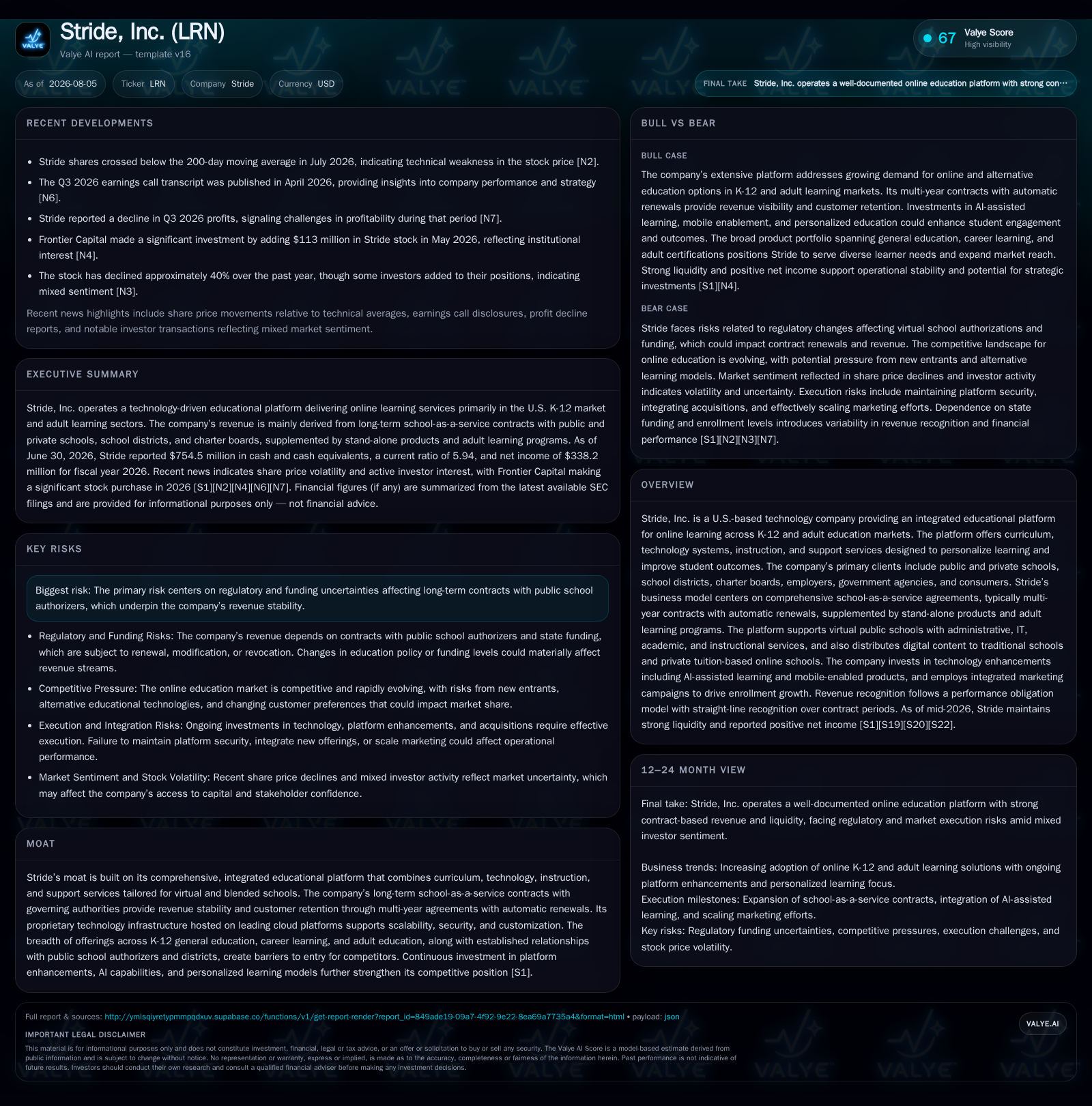
Stride’s latest quarterly filings confirm stable revenue from its General Education and Career Learning segments, underpinned by multi-year agreements with automatic renewal provisions that provide notable revenue visibility [S2]. The company’s platform combines curriculum, LMS, SIS, instructional services, and support on a cloud-hosted infrastructure designed for scalability and personalized learning — a core competitive advantage against peers such as K12 Inc. and Chegg [S1],[S23]. Regulatory and funding changes remain key risks given public school contract dependencies, while expanding adult education and AI-driven personalization present growth avenues [S1],[S26]. Stride maintains a strong liquidity position with over $750 million in cash and negligible debt, supporting ongoing investments in technology and curriculum development [F1],[S2].
Recent Operating Update
The latest quarterly report ending March 31, 2026 confirms that Stride’s revenues continue to derive largely from its General Education and Career Learning business lines delivered through an integrated online educational platform operating across the United States [S2]. The company emphasizes its cohesive technology fabric enabling centralized management of educational delivery alongside operational support functions forming the backbone of its school-as-a-service agreements. These contracts average over five years with automatic renewal clauses that underpin recurring top-line revenue visibility — a critical factor for sustainable cash-flow modeling in the education technology SaaS sector [S1],[S2]. The CEO also acts as the chief decision maker who evaluates performance primarily based on consolidated net income metrics highlighting a unified financial lens across its segments.
The quarter showcased ongoing capital expenditure focused on several strategic axes: portfolio enhancement through curriculum development; software development for improved platform functionality; AI-assisted learning capabilities; plus operational support improvements. Payment terms reflect typical SaaS-like subscription models augmented by fee elements tied to instructional service delivery across virtual public schools. Stride uses the time elapsed method for recognizing revenue since its full product-service integration contributes evenly throughout the academic year—a common approach aligning contract performance obligations to service delivery schedules in education SaaS contracts [S2]
Business Model
Stride operates at the nexus of educational content creation, technology infrastructure provisioning (learning management system + student information system), instructional service delivery (teacher training and support), and administration for virtual/blended K-12 schools under long-term client contracts typically exceeding five years with automatic renewals barring explicit non-renewal notices. This "school-as-a-service" model locks in institutional clients — public school districts, charter authorizers — who outsource their virtual school operations comprehensively to Stride. Additionally, stand-alone products such as digital curricula or instructional modules serve traditional schools or private tuition-based online education markets.
Further anchoring its steady cash flow profile are career learning pathways addressing middle/high school students targeting job-ready skills in fast-growing sectors like IT and healthcare. These programs may culminate in industry certifications or college credits. Beyond K-12 verticals, Stride also operates an adult learning segment serving consumers directly as well as employers/government agencies seeking workforce upskilling through certification programs pioneered by Stride's proprietary content [S1],[S23].
Revenue stems predominantly from multi-year contracts encompassing bundled offerings—curriculum licensing fees combined with delivery platform subscriptions plus instructional support service fees. Volume drivers include enrolled student counts in virtual schools managed by Stride alongside new program rollouts especially within career learning sectors. Pricing power is supported by the comprehensive nature of Stride's integrated offering which competitors struggle to replicate end-to-end. Margins largely depend on efficient cost management within teaching staff deployment for instructional services paired with scalable cloud infrastructure reducing incremental delivery costs.
Industry Structure and Competitive Position
The education technology SaaS space where Stride competes is characterized by durable contracts with public authorities coupled with continuous innovation investment required to maintain differentiated platforms amid intensifying competition from multiple fronts including established textbook publishers turned digital content providers (e.g., Pearson), specialized LMS vendors (e.g., Instructure), pure-play online education platforms (e.g., Coursera), virtual school operators (e.g., K12 Inc.), and adult career education companies (e.g., 2U).
Stride's moat emerges from its ability to integrate curriculum development tightly with cloud-hosted LMS/SIS platforms enhanced by analytics reporting systems. Its know-how navigating complex government regulations affecting funding for virtual schools creates an important barrier relative to new entrants. Scale also enables significant leverage in talent acquisition for qualified online instructional personnel while broad service bundles increase switching costs for clients.
Nevertheless, risks remain pronounced around regulatory shifts impacting state-level funding formulas or authorization requirements for virtual/public charter schools served by Stride. Rising competition includes entrants deploying cutting-edge AI technologies potentially threatening legacy pedagogy models if Stride fails to iterate continuously [S13],[S26].
Growth Drivers
Structural tailwinds include accelerating adoption of virtual and blended learning modalities post-pandemic alongside growing demand for competency-based personalized education models assisted by AI integration — areas where Stride actively invests through platform upgrades focusing on user experience enhancements like mobile accessibility, oral reading fluency scoring powered by AI algorithms, state alignment tools for curricula compliance, tutoring support innovations, etc. Expansion in career learning offerings tailored toward high-growth labor market needs coupled with scaled adult education drives additional diversification beyond core K-12 general education.
Government initiatives supporting digital expansion of schooling models lend macro support while increased employer emphasis on workforce reskilling synergizes with Stride’s adult learner programs sold directly or via partnerships with agencies/employers. Key adoption metrics indicating traction will be contract renewal rates exceeding historical baselines (>80% expected), growth in enrolled student populations per contract footprint, rising average revenue per user through upselling new content/services modules, strong net retention within subscription revenue pools reflecting lower churn against price hikes or contractual escalations.
Risks and Watchpoints
A principal vulnerability lies in funding uncertainties arising from public sector budgetary constraints impacting authorizers’ willingness or ability to renew large multi-year contracts at existing price points or volumes. Competitive pricing pressures may force margin compression if competing providers offer partial service packages leveraging superior AI tools or lower cost structures leaving Stride's bundled school-as-a-service agreements challenged.
Technology risks encompass maintaining platform security standards amid expanding cyber threats alongside ensuring seamless scalability as user bases grow. Content relevance must keep pace with constantly evolving curriculum standards—failure here erodes customer satisfaction leading to higher churn rates.
Long sales cycles typical of public education contracting necessitate pipeline visibility on contract wins/renewals tightly monitored alongside legislation changes at state/federal levels that could significantly impact eligibility criteria or tuition reimbursement models.
What To Watch Next
Upcoming milestones include quarterly updates on contract renewal success rates confirming momentum behind multi-year locked-in revenues; enrollment statistics measuring traction within both General Education & Career Learning; incremental revenue contributions from newly launched AI-enhanced personalized learning features; expansion progress across adult education verticals particularly corporate/government segments; cost efficiency improvements demonstrated via operating margin stabilization after ramped R&D investments; regulatory developments influencing virtual charter operations funding mechanisms.
Investor attention might also be warranted around guidance provided during earnings calls following Form 8-K release dated August 4th, 2026 which may shed further light on organic growth expectations or partnership deals signaling market expansion opportunities [S3],[S28].
Financial Profile Discussion
As of June 30, 2026, Stride holds approximately $755 million in cash and equivalents with current assets totaling about $1.72 billion against current liabilities near $289 million, implying a strong current ratio of approximately 5.94x [F1]. Total debt remains modest relative to liquidity, supporting a conservative leverage profile without immediate refinancing pressure [F1].
Operating income reached approximately $451 million with net income close to $338 million illustrating healthy profitability margins supported by recurring revenue quality intrinsic to long-term contracted services [F1]. Cash flows from operations have been substantial enough not only to comfortably cover ongoing capitalized software/curriculum development spend ($50+ million quarterly) but also permit active share repurchase programs implemented over recent quarters balancing returns with reinvestment strategy [S2],[S25]. This conservative leverage profile supports continued product innovation investments without immediate refinancing pressure or dilution risk.
In sum, Stride’s financial discipline complements its strategic positioning within a sector increasingly embracing digital transformation yet facing execution complexity tied to regulatory dynamics and competitive evolution.
This analysis synthesizes publicly available SEC filings through August 2026 together with reliable industry perspectives pertinent to the education technology SaaS landscape. It does not constitute investment advice but aims to illuminate fundamental operational drivers, structural market context, competitive challenges, financial health markers, and directional cues essential for an informed understanding of Stride's evolving business profile.
Disclaimer: This is research-only, informational analysis and not investment advice. It may include AI-generated interpretation and general industry context. Always verify important details using primary sources.

Comments