
Cricut Navigates Supply Chain Pressures and Sustains Brand-Driven Growth in DIY Electronics
Cricut’s latest quarterly results highlight the challenges of managing global supply risks while leveraging proprietary hardware and consumables to sustain consumer engagement.
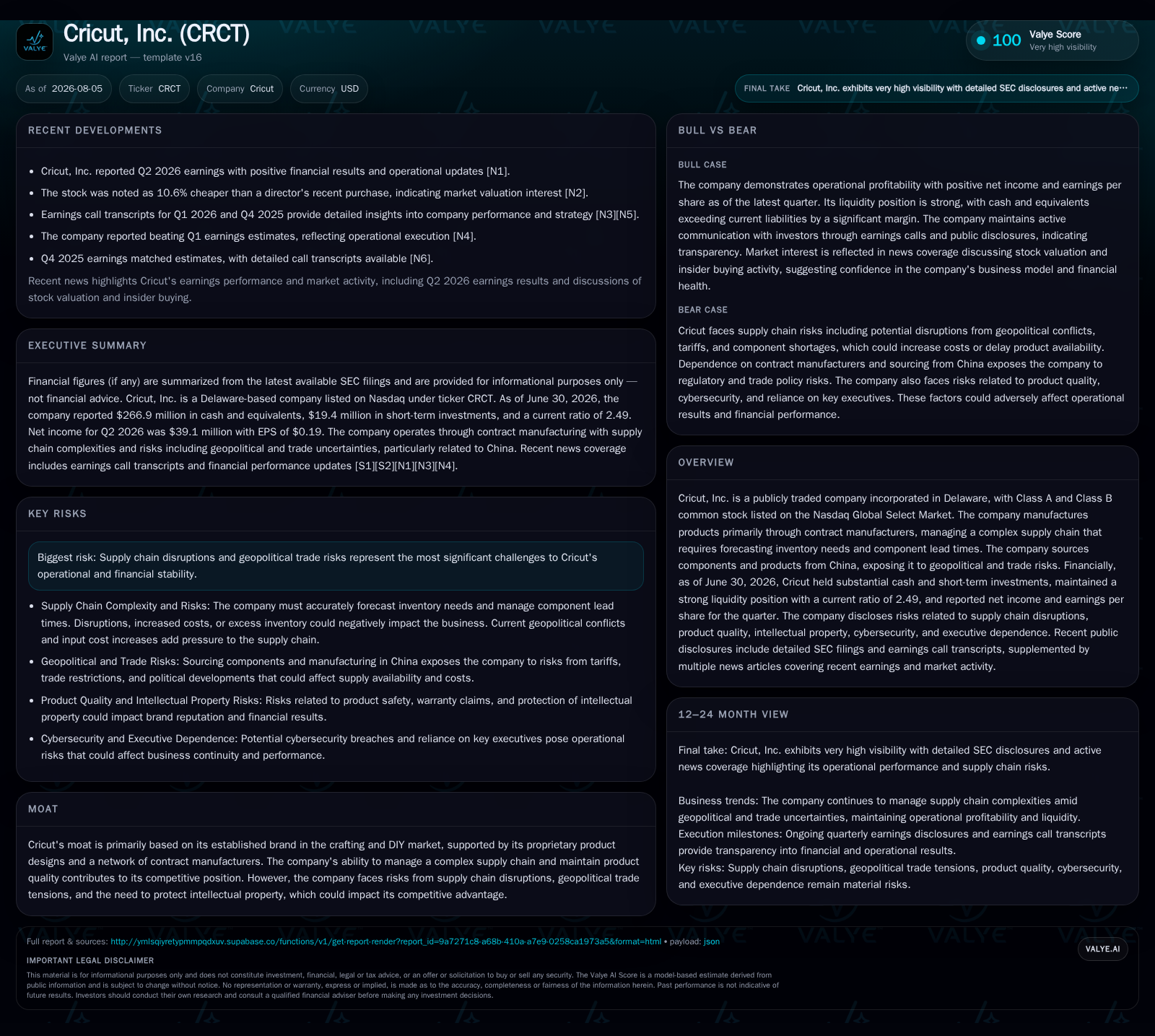
In its Q2 2026 filing, Cricut, Inc. reported solid operating performance supported by strong brand equity in the crafting electronics market, despite rising supply chain pressures stemming from geopolitical tensions and commodity inflation. The company's reliance on contract manufacturing and component sourcing from China exposes it to risks that require precise inventory forecasting and supply chain agility. Cricut’s business model blends hardware sales with consumables and digital content to drive recurring revenue, anchored by a loyal customer base attracted to DIY personalization. Key near-term challenges include managing increased input costs and potential disruptions related to geopolitical trade tensions. Financially, Cricut maintains strong liquidity with a current ratio of 2.49 and substantial cash reserves as of June 2026.
Recent Operating Update: Navigating Supply Chain Challenges Amid Solid Earnings
Cricut's Q2 2026 filing underscores resilience in operational execution despite intensifying supply chain pressures. The company reported continued net income generation bolstered by sustained demand for its hardware devices alongside consumable supplies integral to its product ecosystem [S2][N1]. However, management acknowledges emerging complexity due to elevated fuel prices and petrochemical cost inflation linked to geopolitical events in the Middle East, which strain transportation expenses and raw material pricing [S2][S24]. These cost dynamics feed into longer lead times and raise risks around inventory forecasting accuracy — a critical lever given Cricut's dependence on third-party contract manufacturers primarily located in China [S24][S29].
The firm's update reiterates efforts to calibrate inventory orders tightly against consumer demand forecasts to mitigate adverse impacts such as excess stock or production shortfalls. Notably, Cricut must balance responding swiftly to supply volatility against maintaining consumer price sensitivity within its largely discretionary crafting segment [S2][S24]. The company also flags ongoing vigilance around currency fluctuations and labor availability influences as components of its broader risk management framework.
Business Model: Crafting Recurring Revenue Through Proprietary Hardware Ecosystem
Operating within the consumer electronics hardware space tailored for crafting and DIY personalization, Cricut designs, markets, and sells precision cutting machines complemented by proprietary consumables like specialized cutting mats, blades, vinyls, papers, and inks. This integrated model fosters recurring revenue streams beyond one-time device purchases through consumables replenishment — a typical monetization archetype in hardware ecosystems.
Revenue is primarily generated via direct-to-consumer e-commerce channels alongside retail partnerships that provide broad market reach. The direct channel enables richer customer engagement data capture and facilitates targeted marketing for accessories and software services accompanying device functionality enhancements [S1]. Such multichannel distribution balances volume scale advantages with client intimacy required for upselling digital content access or subscription-based design libraries.
Contract manufacturing enables scalable production without heavy capital outlay but introduces dependency risks on external suppliers’ capacity and geopolitical stability. The sourcing concentration in Asia—specifically China—exposes Cricut to tariffs, export restrictions, or logistical bottlenecks affecting both device assembly and semiconductor procurement embedded in their products [S24][S29]. This necessitates superior inventory forecasting competencies driving key KPIs such as unit sales volume alignment with component purchase timing.
Industry Structure and Competitive Position: Brand Equity Anchored with Proprietary Designs Amid Supply Risk
Within consumer electronics hardware focused on creative arts applications, Cricut competes through its established brand reputation combined with differentiated proprietary technology. Its competitive set includes companies offering related maker tools but generally lacks an equivalent ecosystem combining hardware precision cutting technology with extensive consumable offerings and integrated digital content platforms.
Peers like GoPro or Sonos illustrate parallel dynamics where outsourced manufacturing paired with coherent brand ecosystems enable pricing power despite input cost volatility. However, unlike pure consumer electronics firms more diversified across geographies or end markets, Cricut's niche orientation heightens sensitivity to shifts in hobbyist spending patterns.
The company's success depends on sustained innovation cycles for new device features matched with effective brand-building efforts fostering repeat consumption of accessories — crucial for defending against both new entrants offering low-cost alternatives and substitutes such as non-digital crafting methods [S1]. Intellectual property protection thus represents a strategic need given potential counterfeiting risks undermining product integrity.
Growth Drivers: Innovation Ecosystem Expansion Meets Rising DIY Enthusiasm
Growth opportunities are anchored in continuous product innovation extending device capabilities while simplifying user experience enhancements via software updates or cloud-based design tools integrated into the customer journey. Expanding digital content offerings—including subscription access to design libraries—serves as a lever for deeper customer lifetime value enhancement.
Additionally, geographic expansion into underpenetrated international markets combined with partnerships broadening retail footprint could unlock incremental volumes if matched with adept supply chain adjustments mitigating regional logistics complexities.
Demographic trends reflecting growing consumer interest in personalization crafts bolster structural demand prospects for Cricut’s portfolio. Also significant is the development of complementary accessories and consumables designed specifically to extend hardware utility — a classic margin-enhancing approach employed across consumer electronics hardware sectors.
Risks / Watchpoints / Growth Constraints: Supply Volatility Amid Cost Inflation Pressures
Supply chain disruptions remain the foremost risk category; rising geopolitical tensions risk exacerbating tariffs or regulatory hurdles impacting shipments from China-based contract manufacturers [S21][S24][S29]. Fuel price inflation contributes upward pricing pressure on logistics costs that may compress gross margins absent offsetting price increases or efficiency gains.
Inventories potentially becoming obsolete due to shifting consumer preferences or new model launches pose another operational hazard requiring precise demand planning. Cybersecurity vulnerabilities inherent in connected devices pose a reputational risk if exploited.
Moreover, intense competition from other hardware makers using alternative technologies or lower prices could exert pressure on average selling prices (ASP). Dependency on few large third-party manufacturers also concentrates execution risk if any partner faces capacity constraints or quality control issues.
What to Watch Next: Inventory Management Execution & Demand Stability Indicators
Subsequent quarters should clarify how effectively Cricut manages inventory levels amid the volatile cost environment by tracking inventory turnover rates relative to unit sales volumes reported quarterly. Monitoring warranty claim rates can also serve as a proxy for product quality consistency amid scaling production through contract partners.
Market response evident through repeat purchase rates for consumables alongside new subscriber additions for digital content platforms will provide signals about engagement depth beyond initial device adoption.
Management commentary regarding modulation of contract manufacturer relationships or diversification efforts away from China will be critical indicators reflecting strategic moves to mitigate identified supply risks.
Financial Profile Discussion
As of June 30, 2026, Cricut maintained a strong liquidity profile highlighted by cash and short-term investments totaling approximately $267 million alongside current assets of $500 million versus current liabilities near $201 million—yielding a comfortable current ratio of 2.49 that supports operational flexibility amidst marketplace uncertainties [F1]
While detailed quarterly operating income figures were not explicitly disclosed for Q2 2026 within available sources, trailing twelve-month data through December 2025 showed operating income at approximately $96 million with net income around $77 million underscoring ongoing profitability capability [F1]. The capital-light nature of the business model driven by contract manufacturings helps preserve positive cash flow conversion even during periods requiring elevated working capital investment for inventory buffers.
Capital allocation seems currently oriented toward sustaining innovation investments within research & development spending balanced against marketing expenditures aimed at reinforcing brand awareness metrics supportive of long-term revenue mix improvement through higher-margin recurring services.
Disclaimer: This analysis is provided solely for informational purposes based on publicly available regulatory filings and industry knowledge layers. It does not constitute investment advice or research views regarding any securities.
Disclaimer: This is research-only, informational analysis and not investment advice. It may include AI-generated interpretation and general industry context. Always verify important details using primary sources.

Comments