
LeMaitre Vascular Faces Regulatory Hurdles While Leveraging Targeted Product Expansion
LeMaitre Vascular’s latest quarter highlights regulatory compliance risks amid ongoing product innovation and steady operational execution.
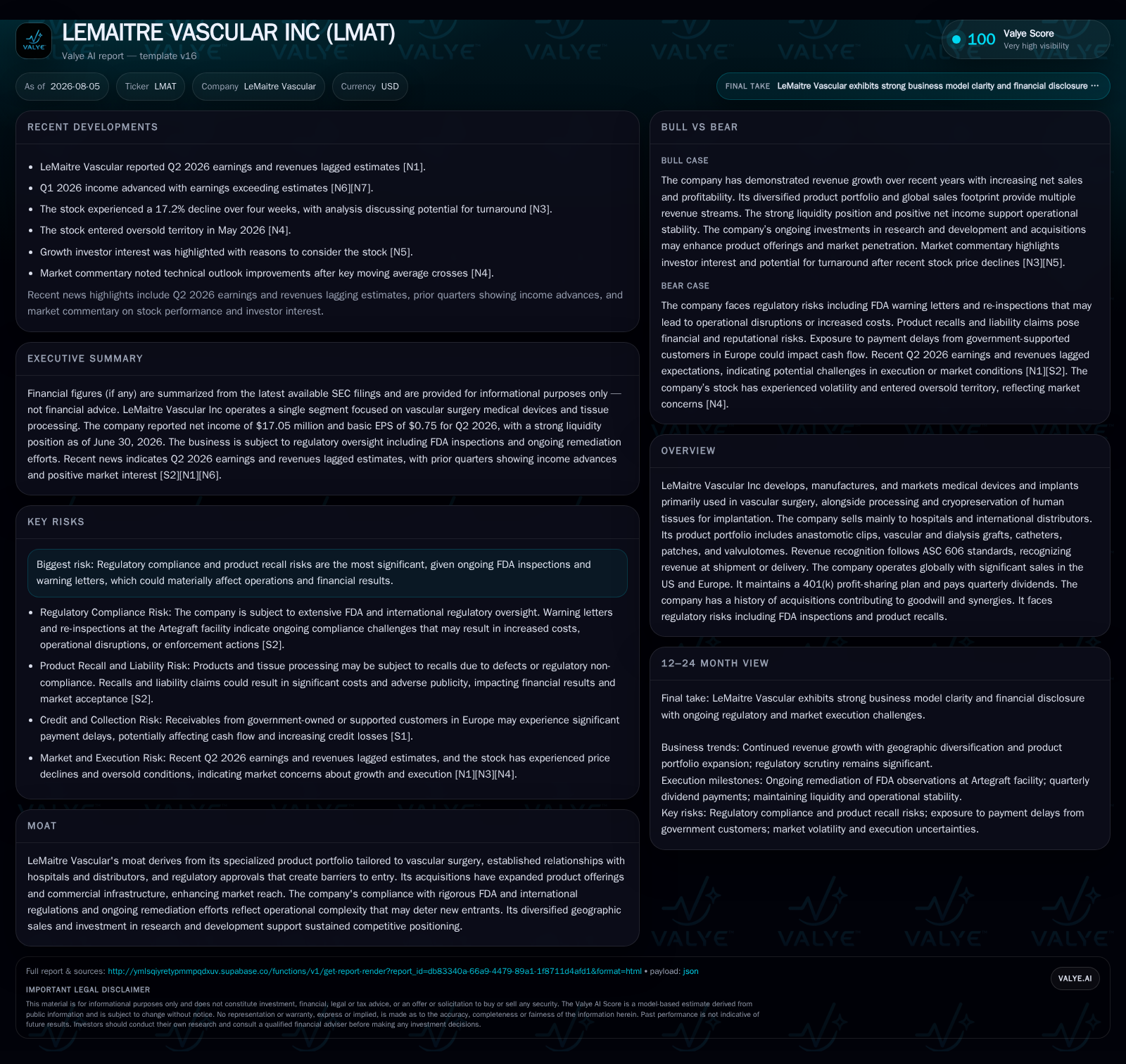
LeMaitre Vascular reported Q2 2026 results with operational performance reflecting persistent regulatory challenges including FDA inspections and product recall risks, particularly following prior warning letters. The company’s specialized medical device portfolio, focused on vascular surgery products like anastomotic clips and grafts, relies heavily on established hospital and distributor relationships for revenue. While acquisitions have broadened their offerings and geographic reach, the firm faces significant compliance costs and market uncertainties. Growth drivers include demographic trends boosting vascular procedures and ongoing R&D investments, though near-term risks from post-market surveillance remain elevated. Financially, LeMaitre maintains a robust current ratio exceeding 16x with healthy cash reserves, supporting dividend payments and capital allocation priorities.
Recent Operating Update
LeMaitre Vascular's Q2 2026 earnings disappointed relative to market expectations as reported in its August press release filed via Form 8-K on August 4. This shortfall coincides with ongoing challenges tied to regulatory compliance complexities revealed in recent FDA inspections resulting in warning letters issued earlier in 2025 [N1], [S2], [S3]. These findings amplify operational headwinds around product quality assurance and post-market surveillance obligations. Notably, the company disclosed prior voluntary recalls — including those related to compromised sterile barrier seals on certain catheter lines such as TufTex Over-the-Wire — underscoring the potential financial impact of such events despite management's assertion that these were not materially damaging to overall business performance [S2], [S27].
Business Model Analysis
LeMaitre generates revenue predominantly from the development, manufacturing, marketing, and sale of highly specialized medical devices intended for vascular surgery applications along with human tissue processing services for implantation [S1]. Its core products include vascular grafts used to replace or bypass diseased arteries, anastomotic clips facilitating vascular reconnection during surgery, valvulotomes that enable valve leaflet modification inside veins, catheters for various intravascular uses, plus patches serving tissue repair functions. These offerings are sold mainly through hospital procurement channels and a global network of distributors enabling international reach across regions including the U.S. and Europe where regulatory registration exists.
Revenue recognition follows ASC 606 principles; LeMaitre recognizes revenue typically upon shipment or delivery of products to customers or distributors. Volume growth depends on surgical procedure rates amplified by demographic factors such as increasing prevalence of peripheral artery disease among aging populations. Pricing power reflects specialized product efficacy alongside rigorous FDA approval which erects a formidable barrier against new entrants. Margins benefit from scale economies but are sensitive to cost pressures arising from quality control enhancements mandated post-inspection [S1], [S2].
The company's acquisition strategy has incrementally expanded its portfolio breadth and distribution capabilities by capturing synergistic opportunities to leverage existing commercial platforms across acquired businesses. Goodwill recorded from such deals reflects expectations of cross-selling efficiencies, streamlined manufacturing consolidation, and rationalization of overlapping administrative functions which collectively aim to lower unit costs over time while boosting market penetration [S5].
Industry Structure and Competitive Position
Operating within the vascular medical devices segment places LeMaitre in direct competition with entities ranging from large diversified firms like Boston Scientific or Medtronic — both possessing broad cardiovascular portfolios with significant R&D budgets — to smaller specialized niche vendors targeting specific surgical instrumentation sectors. Regulatory compliance acts as a de facto moat; LeMaitre’s established FDA clearances coupled with international certifications support sustained market access but require continuous investment.
The industry value chain positions the company primarily at the finished goods manufacturing stage supplying hospitals directly or via distributors who cater to regional medical centers. This channel dependency underscores importance of strong relationship management with hospital purchasing groups whose procurement timing can be lumpy due to budget cycles or reimbursement policies tying device usage rates to insurance frameworks.
Regulatory oversight from FDA alongside counterparts like EMA enforces stringent quality standards that have heightened enforcement actions recently industry-wide after a series of safety-related recalls broadly affecting implantable devices category. Such scrutiny results in increased costs for post-market surveillance programs yet bolsters patient safety outcomes—a dual-edged dynamic affecting operating margins across the sector.
Growth Drivers
Fundamental demand increases stem from demographic shifts including aging populations prone to atherosclerosis requiring vascular interventions. Technological progress enhancing minimally invasive vascular surgery methods drives preference for innovative devices such as improved valvulotomes or advanced graft materials reducing operative complications.
Additionally, geographic expansion into emerging markets with rising healthcare infrastructure investments presents avenues for incremental sales growth through augmented distributor penetration.
Strategic acquisitions enable faster entry into complementary product lines or underpenetrated regions while reducing go-to-market expenses.
Investments in R&D are critical as continuous product improvement supports differentiation—keeping pace with clinical adoption trends ensures sustained relevance given advancing peer innovation cycles.
Risks and Constraints
Regulatory compliance risk stands out as paramount given history of FDA warning letters linked to facility inspections (e.g., Artegraft plant), active product recall exposures like catheter packaging integrity issues, with implications extending beyond direct remediation costs towards reputational damage that may dampen customer confidence or limit future approvals across jurisdictions [S2], [S27].
Operational complexity involved in managing multi-product manufacturing plus human tissue processing increases chances for inadvertent lapses requiring costly corrective actions.
Hospital reliance introduces vulnerability tied to healthcare spending cycles often influenced by economic downturns or policy-driven reimbursement changes potentially delaying elective surgeries impacting device volumes.
Competition intensifies pricing pressure especially against larger diversified manufacturers who leverage broader portfolios creating bundled sales incentives.
Integration risks inherent in prior acquisitions necessitate vigilant management attention lest synergy objectives fall short impacting cost structures.
Supply chain disruptions remain a sector-wide challenge exacerbated by geopolitical tensions influencing component availability or shipment timelines internationally.
Currency fluctuations also introduce variability given international sales exposure across regions with differing economic stability profiles.
What To Watch Next
Key milestones involve successful resolution of outstanding FDA inspection observations which may dictate normalization pace for production capacities or licensing status.
Monitoring quarterly revenue trajectories relative to backlog changes will indicate whether sales recovery post-regulatory challenges is gaining traction.
Development releases or regulatory clearances of new vascular surgery devices could serve as catalysts helping diversify revenue streams away from recalled product lines.
Acquisition integration progress reports will indicate realization extent of projected goodwill-driven synergies influencing longer-term margin expansion capabilities.
R&D expenditure trends provide insight into efforts sustaining pipeline vitality necessary for competitive survival amidst peer innovation intensity.
Dividend declarations remain relevant as signals of financial robustness amid operational uncertainty; similarly key credit metrics warrant attention for capital structure resilience.
Financial Profile Discussion
LeMaitre Vascular reported $26.6 million in cash and equivalents at June 30, 2026 alongside a staggering current ratio exceeding 16x due primarily to $488 million in current assets versus only $29.9 million in current liabilities—a liquidity profile indicating sound short-term financial health capable of cushioning operational volatility or regulatory remediation spending demands [F1]
Capital expenditures remain moderate aligned with ongoing manufacturing upgrades rather than major capacity expansions likely constrained by regulatory focus on existing facilities compliance rather than scale growth currently [S28]
Collectively, the financial picture suggests sufficient liquidity paired with cash flow strength enabling coping with regulatory investment needs without immediate capital raises though monitoring remains prudent given elevated risk exposure areas.
This analysis synthesizes recent SEC filings alongside industry context without providing investment guidance. Readers should consider additional sources when forming views about LeMaitre Vascular’s strategic prospects under evolving market conditions.
Disclaimer: This is research-only, informational analysis and not investment advice. It may include AI-generated interpretation and general industry context. Always verify important details using primary sources.

Comments