
Heritage Financial Surpasses Q2 Expectations While Integrating Olympic Bancorp Merger
Heritage Financial reports strong Q2 2026 earnings with steady profitability and capital, highlights key merger integration progress.
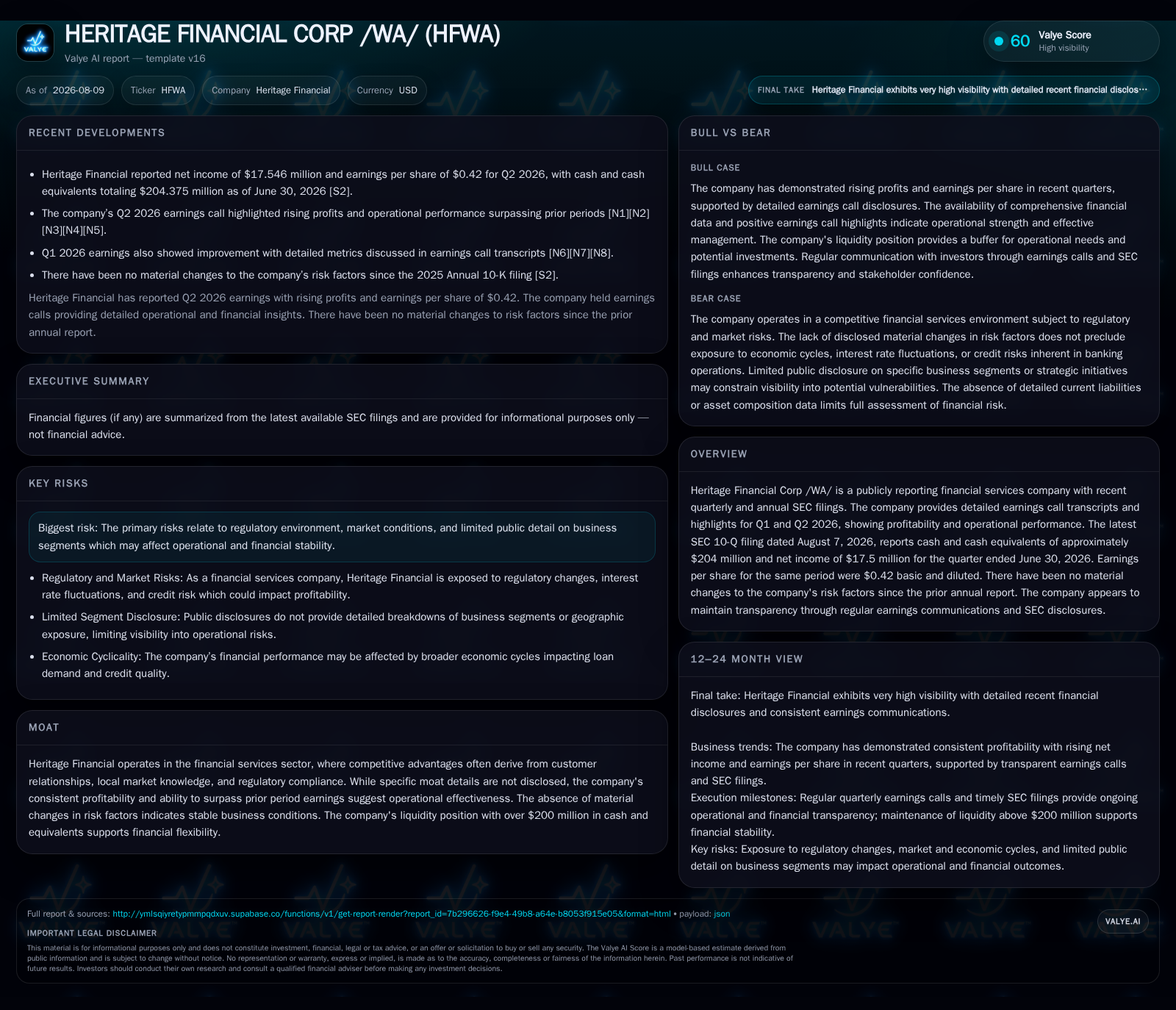
In its latest quarterly filing, Heritage Financial Corp demonstrated operational resilience and profitability, reporting $17.5 million net income and solid cash reserves of over $200 million as of June 30, 2026. The recent completion of the Olympic Bancorp merger early in 2026 expands Heritage's regional footprint, drives loan portfolio diversification, and enhances deposit base strength. The bank's focus on relationship-driven commercial lending and non-maturity deposits supports stable funding and asset quality amid interest rate variability. Looking ahead, Heritage faces typical regional banking risks including credit quality vigilance, regulatory capital maintenance, and competitive pressures while seeking to leverage cross-selling and market expansion opportunities.
Recent Operating Update
A major near-term catalyst has been the completed acquisition of Olympic Bancorp effective January 31, 2026, including the merger of Olympic’s subsidiary Kitsap Bank into Heritage Bank [S19]. This transaction adds approximately $1.56 billion in assets [S1], extending Heritage’s geographic presence within Washington State's commercial banking landscape. The merger contributes scale benefits and diversifies both the loan book and deposit base.
Business Model
Heritage operates primarily as a state-chartered commercial bank delivering retail and commercial banking services mainly across Washington State’s regional markets [S1]. The company generates revenue chiefly through net interest income derived from lending activities funded by customer deposits. It manages a diversified loan portfolio heavily weighted toward commercial business loans encompassing commercial & industrial (C&I), owner-occupied commercial real estate (CRE), and non-owner occupied CRE lending [S1]. Approximately $3.9 billion is invested in commercial business loans out of a total $4.8 billion loan portfolio as of year-end 2025, demonstrating the strategic emphasis on this segment [S1].
The bank’s product suite extends across online personal financial management tools, business remote deposit capture, and cash management services designed to foster customer adhesion via technology-enabled convenience.
Relationship banking remains a core strategic pillar; seasoned retail and commercial teams cultivate connections in local communities aiming to deepen customer loyalty through advisory roles beyond transactional banking. Compensation structures reportedly align employee incentives tightly with balanced growth targets combined with asset quality maintenance [S1].
Industry Structure and Competitive Position
Operating within the regional banking sector characterized by intense competition from national banks, fintech innovators, credit unions, and other financial service providers [S1], Heritage leverages its local market knowledge and community focus to differentiate. It competes particularly on quality customer experience combined with diversified lending expertise.
The recent acquisition integrates Olympic Bancorp’s footprint enhancing scale against peer regional banks such as Umpqua Holdings Corporation or Zions Bancorporation generally known for similar Western U.S. market exposures. This merger enriches Heritage’s asset mix notably in commercial real estate while expanding branch network penetration geographically.
Regulatory capital ratios remain robust with common equity tier 1 ratio at 12.7% exceeding “well-capitalized” thresholds ensuring regulatory compliance and providing buffers against unforeseen stress scenarios [S1].
Growth Drivers
Consistent local economic activity within Washington supporting small-to-medium businesses aligns positively with Heritage’s targeted sectors.
Cross-selling opportunities arising from expanded digital platforms augment fee income streams while also reinforcing client stickiness which can reduce attrition risks common among community-centric lenders. Additionally, branch expansion targeted strategically to high-growth locales deepens market penetration facilitating new relationship development.
Successful integration of Olympic Bancorp unlocks synergies related to cost rationalization and enhanced service offerings that could accelerate pace of profitable loan growth without corresponding increases in risk exposure.
Risks and Watchpoints
Though no material changes were reported in risk disclosures through Q2 2026 filings [S2], ongoing vigilance is warranted around several typical regional banking vulnerabilities:
- Credit Quality: Maintaining low levels of nonperforming loans amid economic cyclicality requires continuous underwriting discipline especially given concentration in CRE segments.
- Interest Rate Risk: Fluctuating rates can compress net interest margins; effectiveness in managing repricing mismatches remains pivotal.
- Regulatory Compliance: Adherence to capital requirements plus evolving supervisory guidance imposes administrative burdens.
- Competition Pressure: Larger national banks and fintech entrants pose challenges on pricing power particularly for retail deposit products.
- Merger Integration Risks: Realizing full synergy potential demands careful cultural assimilation plus system harmonization.
- Cybersecurity: Past incident disclosures affirm the importance placed on robust cyber defense protocols due to operational risk concerns [S16][S28]
Monitoring loan loss reserves relative to total loans will provide timely insight into asset quality trends given underlying portfolio composition now augmented by Olympic assets.
What to Watch Next
Key upcoming milestones include continued post-merger operational rollout metrics such as branch network consolidation progress, realized cost savings versus plan benchmarks, and cross-sell revenue lift indications during subsequent quarters. Loan portfolio growth rates coupled with shifts in deposit mix will serve as barometers measuring funding strategy execution efficacy.
Dividend policy trajectory following recent payout increase to $0.25 per share signals board confidence but warrants observation under variable earnings pressures [S7]. Intense focus on efficiency ratios responding to integration overheads versus incremental revenue gains will be another focal point for assessing operating leverage realization.
Executing technology enhancements maintaining competitive parity against evolving fintech capabilities will also bear watching given digital adoption trends increasingly influential in customer retention dynamics.
Financial Profile Discussion
As supported by recent SEC filings through Q2 2026, Heritage Financial maintains a strong liquidity position evidenced by cash and cash equivalents totaling approximately $204 million at quarter-end June 30, 2026 [F1]. Capital ratios reported at the end of year 2025 exceeded regulatory well-capitalized standards comfortably—common equity tier one at 12.7%, Tier 1 capital ratio at 13.1%, providing solvency assurance while enabling room for controlled balance sheet expansion [S1].
Profitability has been consistent sequentially with second-quarter net income reported at $17.5 million reinforcing operational momentum enabled partly through merger synergies yet without any alarming deterioration in asset quality markers or credit provisions highlighted thus far internally or externally.
Dividend payout increases accepted reflect stable earnings underpinning shareholder returns without compromising reinvestment potential necessary for organic growth initiatives.
This analysis draws solely on publicly available information from SEC filings, quarterly reports, earnings call transcripts, and validated financial data current as of August 7, 2026. It refrains from speculative forward-looking statements or investment research views.
Disclaimer: This is research-only, informational analysis and not investment advice. It may include AI-generated interpretation and general industry context. Always verify important details using primary sources.

Comments