
Peapack-Gladstone Financial's Private Banking Focus Drives Stable Revenue Amid Interest Rate Challenges
PGC’s boutique wealth and private banking model sustains diversified revenue streams despite margin headwinds in a competitive regional banking landscape.
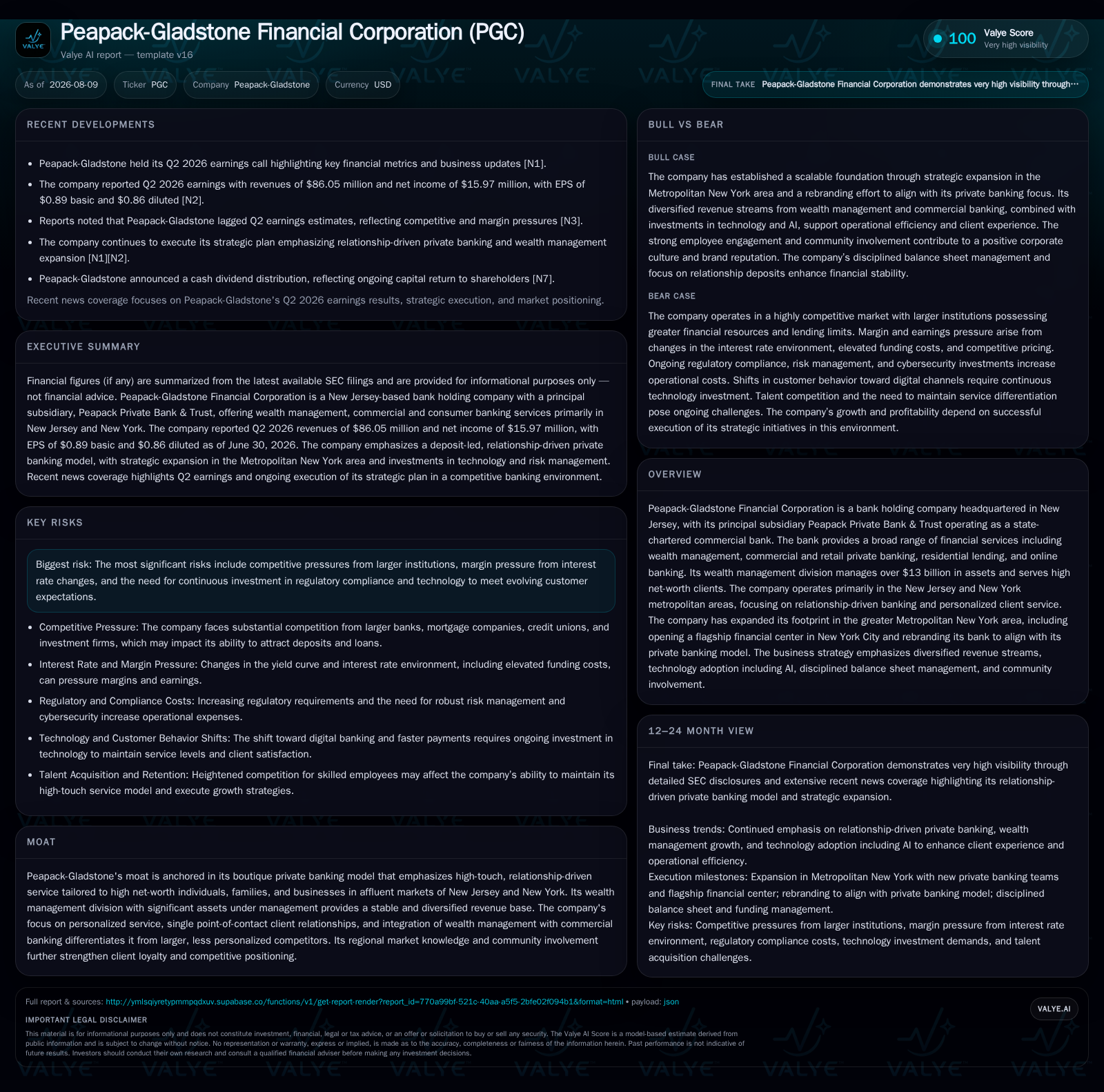
Peapack-Gladstone Financial Corporation reported a mixed Q2 2026 operating update reflecting pressure on net interest margins but resilience in wealth management fee income. The company’s business model centers on personalized private banking and wealth management for affluent clients primarily in New Jersey and New York, leveraging strong local relationships and AUM growth to diversify non-interest income. While rising interest rates challenge lending margins, PGC mitigates this with selective loan growth and continued technology investments to enhance high-touch client service. Key risks include increased regulatory costs, competitive pressures from larger banks, and credit quality sensitivity within its commercial portfolio. Monitoring net interest margin trends and AUM expansion provide critical near-term performance signals.
Recent Operating Update and Why It Matters
Peapack-Gladstone Financial Corporation (PGC) filed its latest quarterly report dated August 7, 2026, which highlights nuanced operational dynamics reflecting both pressure points and strategic progress. Capital markets revenue was modestly down to $799 thousand in Q2 2026 versus $925 thousand in the prior quarter yet remains an ancillary contributor relative to core lending and wealth fees [S2]. More notably, total interest expense declined significantly from $41.4 million in the prior quarter to $36.3 million, indicating an improvement in funding cost efficiency or liability mix optimization amidst a volatile rate environment [S2]. This reduction helps partially offset narrower net interest margins caused by rising benchmark rates competing against deposit pricing.
This weighted dynamic frames PGC’s near-term operating challenge: managing margin compression while maintaining balance sheet growth [S3]. The August event filing further confirmed first half financials but did not materially alter the company's ongoing strategy or risk profile communicated earlier in the year
Business Model Analysis
PGC functions principally through its subsidiary Peapack Private Bank & Trust, a New Jersey state-chartered commercial bank that fuses traditional community bank activities with boutique private banking services tailored toward affluent individuals, families, foundations, trusts, and local enterprises primarily located in New Jersey and the New York metropolitan area [S1]. This geographical focus supports deep local market knowledge that underpins personalized relationship banking.
Revenue streams flow primarily through three channels: net interest income earned from a diversified loan portfolio including commercial loans (working capital lines, term loans), owner-occupied commercial real estate mortgages, multifamily property loans, residential mortgages including home equity lines of credit; fee income derived from wealth management advisory services based on assets under management (AUM); and various retail banking fees [S1][S6]. PGC’s wealth management unit currently oversees over $13 billion in client assets—a substantial scale providing recurring fee income that cushions against cyclical swings in lending profitability [S1].
The firm’s business model leverages cross-selling opportunities between private banking deposit accounts (often low-cost funding sources) and tailored wealth solutions offering trust administration, tax advisory, investment management, and estate planning. These integrated services elevate switching costs for clients while enabling sticky deposit bases fundamental for funding loans.
Notably, PGC recently rebranded its bank operations to align more closely with its private banking identity and inaugurated flagship branches in New York City, signaling a strategic push into premium urban markets within its regional footprint aimed at expanding the affluent client base without diluting its high-touch service essence [S1].
Industry Structure and Competitive Positioning
Regional banks like PGC inhabit an intermediary role bridging retail/commercial depositors with borrowers while managing investment portfolios for affluent clients. Their value proposition hinges on specialized relationship banking within constrained geographic footprints versus large national banks whose scale often comes at the cost of personalization.
Peers such as Signature Bank (private banking-centric regional player), Eastern Bankshares (regional bank with wealth integration), Camden National Corporation (community focus), First Republic Bank (luxury private banking scale), and SVB Financial Group (commercial/private banking niche) illustrate spectrum approaches within this sector. Compared to these peers, PGC’s strength lies in its boutique service model combined with significant AUM-derived fees providing revenue diversification beyond volatile net interest income—a common vulnerability among pure-play lenders. However, PGC’s scale remains smaller than First Republic or Signature Bank, potentially limiting economies of scale benefits.
The sector faces persistent pressures: sustained higher interest rates elevate funding costs impacting net interest margins; competition from fintech disruptors introduces alternative non-lending financial solutions; heightened regulatory compliance requirements inflate operational expenses; evolving technology expectations require ongoing capital investment; credit risk exposure demands vigilant monitoring especially within commercial real estate portfolios impacted by local economic cycles.
Continuous close monitoring of these risk vectors supported by quarterly updates on non-performing loans ratios, ACL levels relative to total loans, efficiency ratio movements, and capital adequacy ratios will be critical indicators of resilience or emerging stress.
What to Watch Next
Upcoming quarters will reveal how effectively PGC manages:
- Net Interest Margin Trends: Stabilization or improvement signs post recent funding cost reductions will validate pricing power or balance sheet restructuring effectiveness.
- Assets Under Management Growth: Sequential AUM increases indicate successful client acquisition/retention reflecting strength of distribution capabilities within expanded geographies.
- Loan Portfolio Quality Metrics: Changes in delinquency rates or charge-offs provide early warning signals on credit environment deterioration requiring provisioning adjustments.
- Revenue Mix Shift: Increasing proportion of fee-based income suggests growing revenue diversification reducing dependence on variable lending spreads.
- Regulatory Expense Trajectory: Plateauing or accelerating compliance costs informs operational leverage assumptions critical for medium-term profitability guidance.
- Execution on Branch Expansion Strategy: Market reception in NYC centers impacts overall scalability prospects beyond legacy New Jersey footprint.
Investor briefings post upcoming earnings releases should shed light on these key execution milestones alongside any revised outlook commentary responding to macroeconomic developments or industry shifts.
Financial Profile Discussion
As of the latest quarter ended June 30, 2026, Peapack-Gladstone reported total debt approximating $74.9 million with net debt estimated near $40.1 million after considering liquid assets including cash equivalents [F1][S2]. Interest expense trends improved quarter-over-quarter reflecting optimized borrowing costs totaling approximately $36.3 million down from prior periods with subordinated debt costs fully redeemed recently easing fixed obligations [S2].
Liquidity stands sound with ample unused borrowing capacity at the Federal Home Loan Bank exceeding $1.7 billion alongside contingency funding plans designed for stressed environments further cushioning deposit volatility risks common among uninsured deposits prevalent in private banking contexts [S4][S23]. Overall capital adequacy ratios remain compliant with regulatory minimums underpinning dividend payout capacity balanced against reinvestment needs for technology upgrades cited as strategic priorities going forward [S1].
This analysis synthesizes the latest public disclosures including quarterly filings, annual reports, event updates, and sector context relevant for Peapack-Gladstone Financial Corp as of mid-2026 without offering investment advice or price targets.
Disclaimer: This is research-only, informational analysis and not investment advice. It may include AI-generated interpretation and general industry context. Always verify important details using primary sources.

Comments