
Timberland Bancorp’s Stable Regional Banking Model Supported by Loan Growth and Strong Capital
TSBK’s latest quarter shows modest earnings growth underpinned by a diversified loan portfolio, solid net interest margin, and prudent capital management.
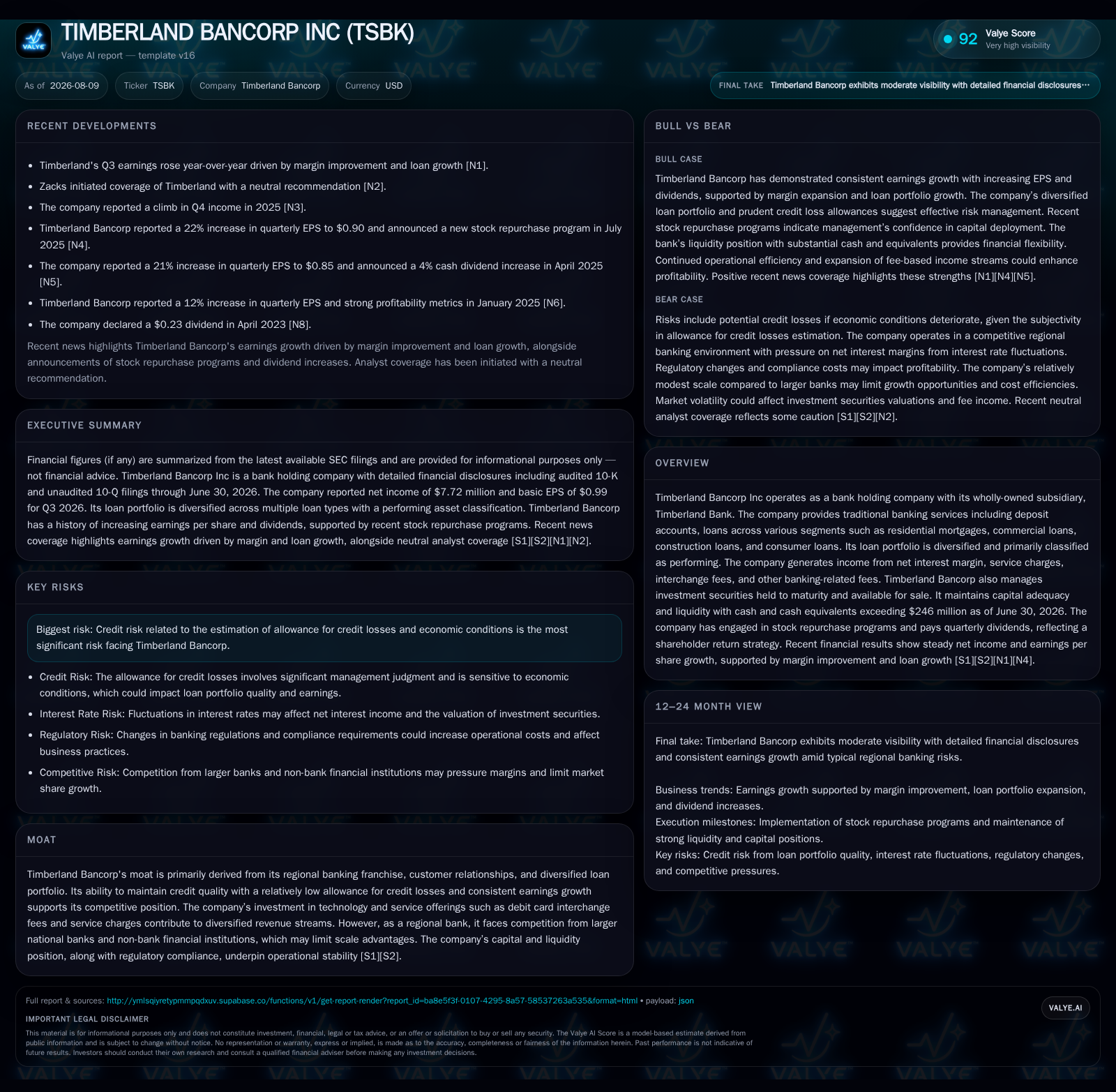
Timberland Bancorp Inc continues to leverage its position as a regional bank focused on Washington state markets with a diversified loan book including residential mortgages, commercial and construction loans. Its recent quarterly results highlight steady net income growth driven by rising net interest margin and deposit growth, while maintaining conservative credit risk management and strong liquidity. The bank balances shareholder returns via dividends and stock repurchases amidst regulatory oversight and competitive pressures pertinent to regional banks. Key near-term metrics to monitor include loan quality, net interest margin trends relative to interest rate movements, and deposit pricing dynamics.
Recent Operating Update
d [S3][S2].
Asset quality metrics remain stable with the loan portfolio predominantly classified as performing across residential mortgage, commercial loans, construction financing, and consumer segments [S1]. The allowance for credit losses (ACL) has been incrementally increased in line with CECL accounting standards but remains conservative relative to total loans, reflecting management’s prudent credit risk assessment given local economic sensitivities [S2][S1]. Investment securities designated held-to-maturity carry unrealized losses primarily due to interest rate increases but remain sound in credit quality thus limiting near-term impairment risk [S2].
Business Model Overview
Timberland Bancorp operates as a regional bank holding company headquartered in Washington state with its wholly-owned subsidiary Timberland Bank servicing localized markets comprising Grays Harbor, Pierce, Thurston, King, Kitsap, and Lewis counties. The bank’s business model centers on traditional banking services: taking deposits and extending diversified loans—residential mortgage lending being a significant component along with commercial lending including small-business credits and construction loans.
Revenue streams derive mainly from net interest income—the spread between interest earned on loans and securities versus interest paid on deposits—and are supplemented by non-interest income sources such as service charges on deposit accounts and debit card interchange fees. This dual revenue model provides partial insulation against fluctuations in either lending or fee income individually but makes the franchise sensitive to interest rate cycles impacting NIM volatility.
Loan origination volumes influence revenue volume directly; meanwhile deposit growth sustains funding capacity at competitive costs preventing margin compression due to reliance on expensive wholesale borrowings.
The regional banking sector broadly competes on relationship-centric service delivery versus national banks’ product breadth or fintech lenders’ agility in niche lending areas or digital platforms. Timberland’s relatively low allowance for credit losses compared with peers signals effective underwriting discipline amidst economic volatility concentrated in its localized footprint [S1]. However, persistent threats stem from competitive deposit pricing pressures pushing funding costs higher as well as growing fintech competition challenging traditional fee income sources like interchange fees.
Peers in the region such as Zions Bancorporation or KeyCorp typically operate at larger scale enabling broader diversification across geographies or business lines; Timberland’s narrower but focused market positioning requires balanced growth initiatives leveraging technology upgrades to sustain fee income expansion.
Growth Drivers
Timberland Bancorp’s main growth catalysts reflect both macroeconomic improvements localized within its Washington state markets and strategic enhancements in product offerings:
- Local Economic Expansion: Employment growth and business formation in core counties stimulate demand for residential mortgages—both purchase money and refinancing—and commercial credit needs including construction financing.[S1]
- Loan Growth Across Segments: Balanced pipeline development especially in commercial real estate projects supports incremental yield pickup amid rising rates.[N1]
- Deposit Base Expansion: Customer retention strategies combined with community banking trust underpin steady deposit inflows safeguarding low-cost funding sources essential for margin preservation.[S2]
- Fee Income Diversification: Enhanced debit card interchange fee revenues alongside service charge upticks on account maintenance contribute stable non-interest income complementing lending revenues.[N1]
- Capital Return Discipline: Regular dividends plus targeted share repurchases bolster investor confidence while optimizing equity usage.[S3][S2]
Technology adoption aimed at improving digital customer engagement also plays a secondary role enhancing operational efficiency and potentially opening new fee revenue channels without materially increasing fixed costs.
Risks and Watchpoints
Key risks facing Timberland Bancorp are largely concentrated around credit quality management within a geographically focused loan book sensitive to Washington state economic conditions. Downturns linked to inflationary cost pressures or labor shortages could impair borrowers’ repayment ability notably within construction or manufacturing sectors prevalent locally [S1].
Interest rate volatility remains a significant risk factor: while rising rates have so far improved NIM positively, adverse shifts could compress margins through mismatch effects or slow demand for variable-rate lending products.
Liquidity risk is mitigated by strong cash reserves ($246 million as of June 2026) yet deposit flight triggered by market disruptions could pressure funding stability [F1][S2]. Regulatory compliance complexity around capital requirements demands continuous monitoring particularly if strategic expansion necessitates balance sheet reinvestment.
Furthermore, competitive encroachment from larger banks offering scale-driven pricing discounts or fintech firms providing streamlined digital alternatives risks eroding Timberland’s customer base or non-interest fees over time.
Allowance for credit losses adequacy warrants vigilance given CECL accounting adoption; rising delinquencies would mandate higher provisions impacting earnings promptly.
What to Watch Next
Investors should track subsequent quarters for:
- Trends in net interest margin reflecting ongoing Fed policy moves or local loan repricing actions;
- Loan portfolio performance focusing on delinquency ratios or net charge-offs particularly in commercial real estate segments;
- Deposit cost evolution amid rising competitor funding costs;
- Non-interest income trends stemming from interchange fee growth or service charge initiatives;
- Capital ratio changes supporting dividend sustainability or adjustments in share repurchase cadence;
- Regulatory updates affecting community banking operational flexibility;
- Investment securities unrealized loss trajectories indicating potential impairment risks.
Monitoring these KPIs will illuminate how well Timberland adapts its regional-centric banking model amidst macroeconomic uncertainties and intensifying competition.
Financial Profile Discussion
As of June 30, 2026, Timberland Bancorp reported cash and cash equivalents totaling approximately $246 million providing strong liquidity coverage consistent with regulatory expectations for a regional bank relying principally on retail deposits as primary funding sources [F1][S2]. Capital return policies blend quarterly cash dividends ($0.30 per share declared recently) alongside opportunistic stock buybacks executed regularly but at measured pace preserving capital adequacy buffers vital under evolving regulatory regimes [S3][S2]. These actions demonstrate balanced capital stewardship aiming for shareholder value enhancement without undermining financial prudence.
Overall Timberland operates with tight cost control enabling efficiency alongside sustainable profitability that can withstand typical regional banking headwinds tied to localized economic cycles or monetary policy shifts.
This analysis synthesizes publicly available SEC filings through August 7, 2026 [S1][S2][S3], supplemented by recent market commentary [N1], contextualizing Timberland Bancorp Inc's operational standing within the regional banking environment. It highlights durable aspects of the firm’s business model alongside critical considerations pivotal to monitoring near-term performance without conveying investment advice.
Disclaimer: This is research-only, informational analysis and not investment advice. It may include AI-generated interpretation and general industry context. Always verify important details using primary sources.

Comments