
Beacon Financial's Multi-State Expansion Boosts Diversification and Fee Income Potential
Recent quarterly filings reveal steady execution of merger integration alongside growing wealth management contributions, underpinning Beacon Financial’s regional banking resilience.
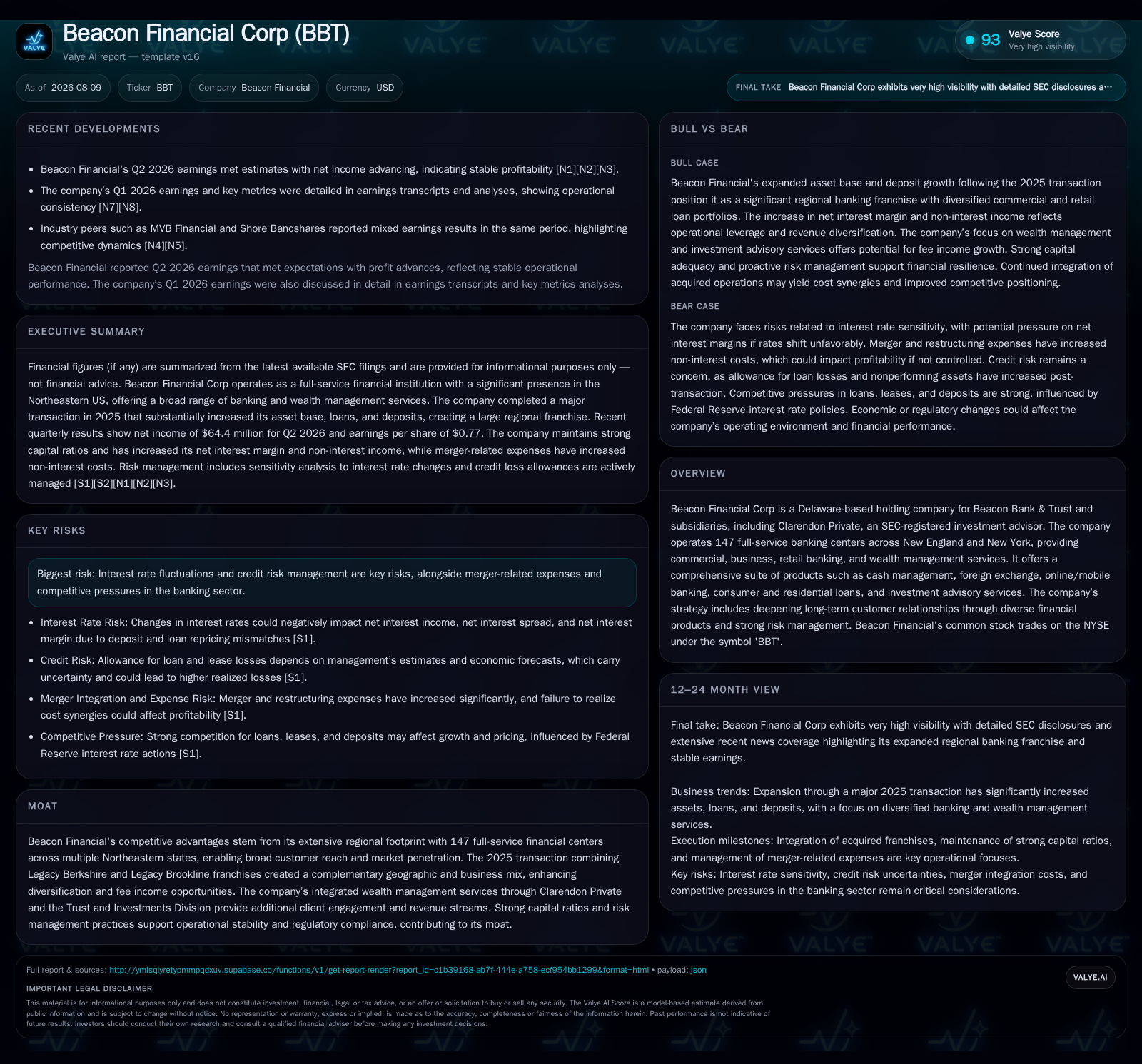
Beacon Financial Corp advanced its post-merger integration in Q2 2026, maintaining stable operating performance amid evolving governance with the adoption of a Good Leaver policy enhancing talent retention. The bank’s multi-state branch network continues to underpin its core deposit and loan growth, while fee income from its SEC-registered investment advisory subsidiary, Clarendon Private, adds diversification to revenue. Capital adequacy and liquidity remain solid, supporting strategic flexibility against interest rate and credit risk challenges common in regional banking.
Q2 Operating Update: Integration Execution and Policy Changes Reflect Stability
Beacon Financial's latest quarterly filing for Q2 2026 reports continued stable operational performance in the wake of its franchise combination completed in 2025. The absence of material disruption or elevated credit loss provisions suggests effective integration of Legacy Berkshire and Legacy Brookline franchises, now operating cohesively across New England and New York [S2]. Notably, the Board adopted a new Good Leaver policy governing equity award treatment upon retirement for senior management on July 29, 2026. This policy aims to support structured succession planning and talent retention, signaling corporate governance evolution commensurate with the company’s growth stage [S3]. These governance advances often reduce turnover risks among key executives during post-merger transitions.
Revenue Model: Lending Core Coupled with Growing Wealth Advisory Streams
Beacon Financial operates a classic regional bank revenue model anchored by net interest income derived from lending activities funded by a diversified deposit base. Its loan portfolio spans commercial lending to businesses alongside consumer and residential mortgages broadly servicing the Northeast corridor. This geographic concentration leverages broad branch network density but also exposes the bank to regional economic cycles [S1]. Offsetting some cyclical sensitivity, Beacon benefits from fee income generated by Clarendon Private, its SEC-registered investment advisory arm. Wealth management services through this subsidiary as well as trust offerings enhance client relationships with higher-margin products that are less interest rate dependent. Such diversification is critical for sustaining earnings stability given prevailing interest rate volatility.
Competitive Footprint: Branch Density and Complementary Regional Reach Enhance Moat
With 147 full-service financial centers dispersed across Massachusetts, New York, Connecticut, Rhode Island, and Vermont, Beacon commands a substantial presence relative to peers like Regions Financial Corporation or M&T Bank Corporation within overlapping Northeastern markets [S1]. This scale underpins robust deposit gathering capabilities—a vital moat element enabling competitive commercial lending products at attractive funding costs. The integrated wealth management offering adds another dimension uncommon among some regional bank peers narrowly focused on deposit-lending spreads. As foot traffic trends shift industry-wide due to digital banking adoption, Beacon’s challenge remains optimizing branch usage while leveraging physical locations for deeper cross-selling opportunities.
Growth Engines: Branch Network Expansion, Cross-Selling Wealth Services, Loan Momentum
Beacon’s recent growth drivers include organic loan portfolio expansion supported by positive regional economic indicators and selective commercial lending initiatives targeting middle-market businesses [S2]. Concurrently, wealth advisory services have reported incremental fee income gains as clients increasingly seek integrated financial solutions bridging banking with investment needs [S1]. Merger-related scale efficiencies bolster earnings capacity by reducing overlapping costs while expanding service offerings geographically. Loan-to-deposit ratio metrics remain balanced reflecting prudent funding discipline crucial amid rising rates potentially compressing margins if deposit costs escalate faster than asset yields.
Risks on Watch: Interest Rate Sensitivity, Credit Quality Vigilance, Integration Costs
Interest rate fluctuations pose a persistent challenge affecting Beacon’s net interest margin dynamics given the typical lag between repricing liabilities versus assets. While rising rates can initially boost margin spreads via higher yielding loans funded by stable cost deposits, prolonged volatility risks loan demand softening or increased credit risk if borrower stress emerges in sensitive sectors [S2]. Asset quality metrics continue to be closely monitored; stable non-performing loan ratios indicate conservative underwriting practices remain effective so far despite merger-related portfolio consolidation. Additionally, ongoing transaction expenses tied to franchise combination activities weigh modestly on expense efficiency ratios but appear within manageable bounds thus far.
Looking Ahead: Regulatory Climate, Milestones in Succession Planning, Demand Signals from Regional Economy
The regulatory landscape continues evolving with potential impacts on capital requirements and compliance expenditures for regional banks like Beacon. Their solid capital buffers mitigate immediate regulatory headwinds but may influence strategic capital allocation decisions going forward. The cultivation of governance frameworks such as the Good Leaver policy reflects preparedness for orderly leadership transition critical to maintaining operational continuity post-merger. Economically, Beacon’s positioning across multiple Northeastern states exposes it to diverse growth prospects—regional economic expansions tend to drive loan growth while downturns test credit resilience and deposit stability.
Financial Profile Discussion: Solid Capital Position Supports Strategy Execution
As of June 30, 2026, Beacon holds approximately $1.22 billion in cash and equivalents against about $889 million in total debt illustrating net liquidity strength supportive of operational flexibility [F1]. This liquidity buffer enables comfortable absorption of merger-related expenses accrued during prior quarters without encumbering day-to-day lending or funding needs. The available funds combined with disciplined credit oversight create resilience against cyclical shocks common in regional banking sectors.
Beacon Financial's ability to integrate complementary franchises while leveraging wealth management services elevates its profile beyond a pure community bank archetype into a more diversified regional institution well-aligned with Northeastern market dynamics. Continued monitoring of net interest margin trends in response to changing rate environments alongside asset quality vigilance will be essential validators of durable profitability going forward. Governance enhancements signal a maturing organization sensitive to leadership continuity—a crucial factor for investor confidence amid sector consolidation waves. Overall operational steadiness coupled with strategic diversification initiatives positions Beacon cautiously optimistic against the backdrop of competitive pressures from larger banks and fintech disruptors targeting similar customer bases.
DISCLAIMER: This report is for informational purposes only and does not constitute investment advice or research views. It incorporates publicly available filings and industry context without speculation beyond cited evidence.
Disclaimer: This is research-only, informational analysis and not investment advice. It may include AI-generated interpretation and general industry context. Always verify important details using primary sources.

Comments