
Encompass Health Expands Inpatient Rehabilitation Capacity Amid Reimbursement and Regulatory Pressure
The company’s Q2 2026 results reflect growth in hospital network and patient volume balanced against ongoing Medicare reimbursement challenges and rising labor costs.
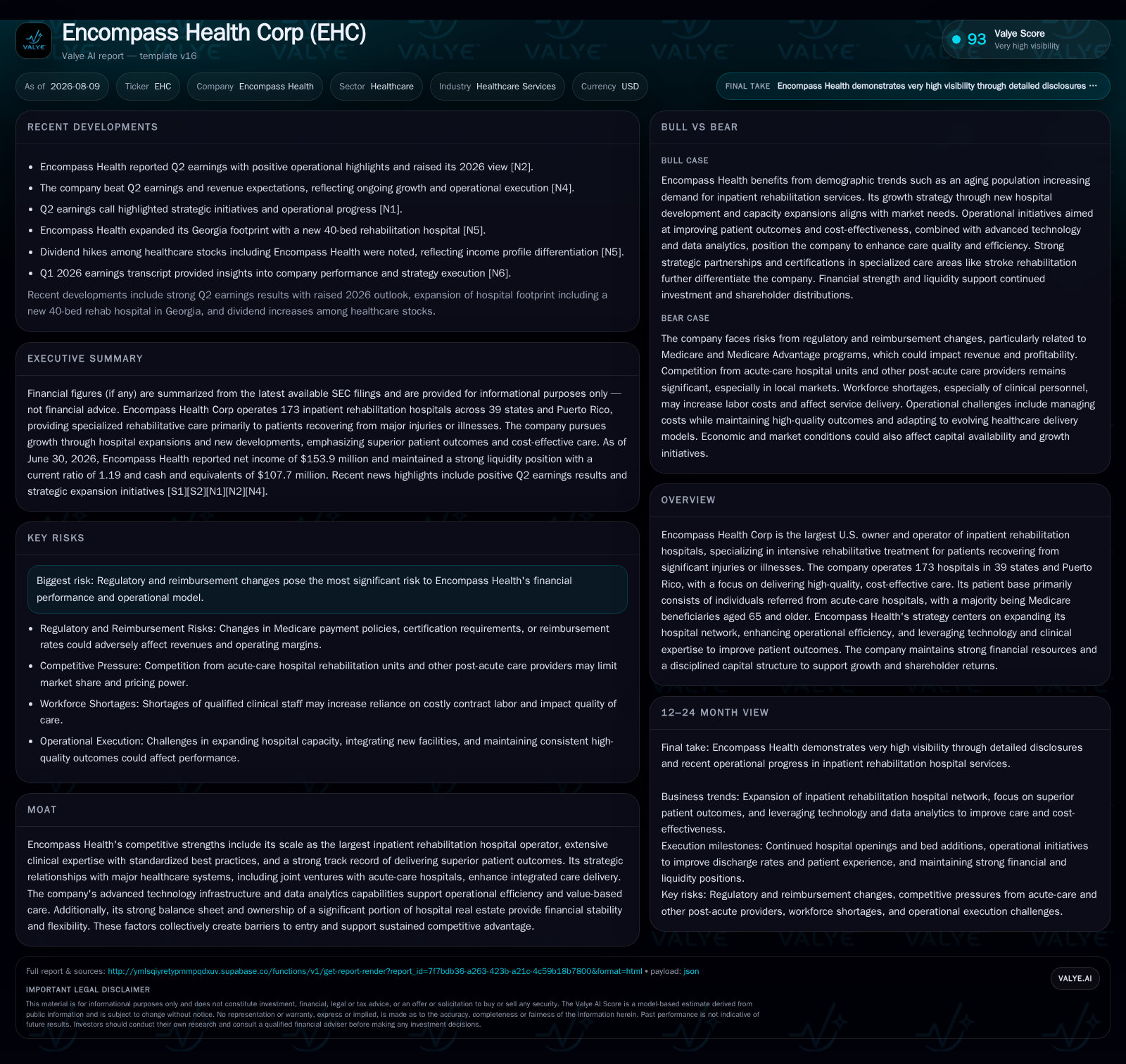
Encompass Health, the largest U.S. operator of inpatient rehabilitation hospitals, reported solid operational expansion in Q2 2026 with growth in hospital count and patient discharges, leveraging its scale and clinical protocols to sustain quality outcomes. However, persistent downward pressure on Medicare reimbursement rates due to regulatory productivity adjustments and sequestration represents a key margin headwind. Encompass Health’s focus on operational efficiency, capital discipline, and technology adoption supports its strategic growth agenda amid an aging population driving demand for post-acute care. Key risks remain around future reimbursement changes and labor cost inflation. Monitoring occupancy trends and payer mix shifts will be critical near-term.
Recent Operating Update
Encompass Health Corp’s latest quarterly filing for Q2 ended June 30, 2026 underscores continued operational growth during external reimbursement pressures. The company expanded its inpatient rehabilitation hospital network to 173 locations across 39 states plus Puerto Rico [S1], building on steady additions over the past few years. This growth includes both greenfield developments and capacity increases within existing hospitals. Patient discharges rose correspondingly, reflecting stronger referral volumes from acute-care hospitals catering largely to Medicare-eligible patients recovering from strokes, orthopedic injuries, neurological events, and other disabling conditions [S2],[N2].
On August 5, the company released a detailed earnings press release confirming these trends alongside financial performance metrics showing robust Adjusted EBITDA generation underpinning liquidity [S3]. Importantly, Encompass Health highlighted no material changes in risk factors but acknowledged intensifying challenges from labor cost escalations and regulatory adjustments influencing operating margins [S2]. These factors frame the near-term operating landscape.
Business Model Specifics
Encompass Health’s business model centers on providing specialized inpatient rehabilitative services designed to restore patient function after major health events requiring intensive therapy. Monetization is primarily through government reimbursements—Medicare accounts for approximately 92% of patients served—with supplemental revenue from Medicaid and private payors contributing a smaller share [S1]. This reliance places the company firmly within the post-acute care sector’s regulated reimbursement framework.
Revenue is driven by volume (patient discharges), average length of stay (LOS), therapy intensity measured in minutes per patient day, and payer mix quality (with Medicare generally yielding higher reimbursement rates than Medicaid). The company owns around 79% of its hospital real estate assets enhancing balance sheet strength but also bears substantial fixed costs tied to capital investments in facilities and equipment [S1],[F1].
Clinical protocols emphasize evidence-based care delivered by multidisciplinary teams comprising physical therapists, occupational therapists, speech therapists, nursing staff, case managers, and physicians overseeing rehabilitation plans. Technology adoption—such as enterprise electronic medical records integrated with data analytics—supports enhanced operational efficiencies through standardized best practices and outcome measurement enabling value-based care collaborations with acute hospitals via joint ventures and partnerships [S1].
Industry Context and Competitive Positioning
Operating in the inpatient rehabilitation healthcare services industry positions Encompass Health squarely in the post-acute care value chain segment that interfaces directly after acute hospital stays. Competition includes other large inpatient rehabilitation operators (publicly traded or private), skilled nursing facilities offering rehab bundles, home health agencies expanding service breadth, as well as acute-care hospitals retaining or growing onsite rehab units.
Scale distinguishes Encompass Health as the largest U.S. operator by hospital count and revenues. Its geographic footprint provides diversification benefits with concentration in high-population states like Florida and Texas that align with older demographics driving rehab demand [S1]. Peers often lack comparable nationwide coverage or integrated care capabilities leveraging advanced data systems—creating moat elements tied to clinical outcomes reputation and referral relationships.
Growth Drivers
Several structural trends underpin sustained demand for Encompass Health's services. The aging U.S. population fuels higher incidence rates of chronic conditions necessitating rehabilitative care. Secular shifts favor inpatient rehabilitation settings over alternatives due to superior functional recovery potential supported by intense therapy regimens.
Expansion of hospital network through new constructions or acquisitions fuels beds availability responding to localized needs. Same-store growth originates from higher occupancy rates driven by greater referrals from partner acute-care hospitals aiming for streamlined care transitions.
Clinically, continuous enhancements to protocols support improved rehabilitative outcomes which can translate into stronger payer contracts under value-based care arrangements incentivizing efficiency gains and readmission reduction efforts.
Finally, ongoing adoption of digital tools including predictive analytics allows more precise case management optimizing LOS without compromising recovery quality while controlling staffing costs—a critical margin lever amidst wage inflation pressure.
Risks and Constraints
The most significant vulnerability lies in dependence on government program reimbursements—particularly Medicare—which face annual payment adjustments frequently tempered by productivity offset requirements mandated since ACA enactment alongside sequestration reductions set through early 2030s legislation [S1]. This dynamic caps revenue growth relative to rising operating cost bases including wages.
Labor shortages especially among specialized therapists heighten operational risk amid competitive healthcare employment markets inflating wage expenses beyond historic norms [S2]. Regulatory scrutiny intensifies legal risk exposure encompassing compliance audits and False Claims Act litigation typical at scale in healthcare providers [S1].
Capital intensity requires balancing growth ambitions against debt-finance constraints governed by credit agreement covenants stipulating leverage ratios tied to trailing Adjusted EBITDA performance metrics; failure here could restrict funding options or dividend payments [S13],[S16],[S21].
Geographic concentration in certain states exposes the company to region-specific Medicaid policy changes—as illustrated by provisions in recent state-focused legislation like the One Big Beautiful Bill Act impacting reimbursement frameworks though proportionally less critical than federal Medicare policies currently [S1].
What to Watch Next
Key near-term markers include monitoring occupancy rate trends across existing hospitals as a proxy for referral strength amid changing post-acute care landscapes. Tracking payer mix shifts remains important given potential Medicaid program redesigns or private payor contracting evolutions.
Updates on labor cost inflation trajectories versus operational efficiency initiatives will reveal margin sustainability pathways especially if wage pressures accelerate unexpectedly.
Capital deployment progress through announced expansions or acquisitions will provide clarity on growth pipeline execution efficiency.
Regulatory developments from CMS regarding upcoming Medicare payment rules—including market basket updates subject to productivity adjustment—and any moves altering sequestration policies warrant close attention as they materially drive revenue per discharge potential.
Finally, progress in integrating technology platforms across care settings indicating enhanced coordinated care capabilities may influence future competitive positioning.
Financial Profile Discussion
As of June 30, 2026, Encompass Health held approximately $108 million in cash and equivalents against total debt of about $2.6 billion, resulting in net debt near $2.5 billion [F1]. Current assets stood at $1.04 billion with current liabilities of $873 million, implying a current ratio of approximately 1.19 [F1].
Adjusted EBITDA remains a key liquidity measure supporting debt servicing and capital investments aligned with hospital expansions and refurbishments, as confirmed in the latest earnings release [S3]
The company’s leverage ratios are maintained within covenant limits under its credit agreements, with no immediate refinancing concerns reported [S3]. Nonetheless, management continues to monitor sensitivity to EBITDA fluctuations given ongoing economic uncertainties impacting patient volumes and reimbursement rates.
Capital allocation balances disciplined leverage management with selective growth investments and shareholder return policies aimed at sustaining investment-grade credit perceptions [S16,S27].
Disclaimer: This analysis is for informational purposes only based on public filings dated through August 7, 2026, without any investment advice or research view regarding Encompass Health Corp securities.
Disclaimer: This is research-only, informational analysis and not investment advice. It may include AI-generated interpretation and general industry context. Always verify important details using primary sources.

Comments