
Ingredion’s Volume-Driven Recovery Undermined by Rising Costs and Acquisition Headwinds
Strong segment volume growth contrasts with margin pressure from manufacturing cost inflation and Tate & Lyle acquisition-related expenses.
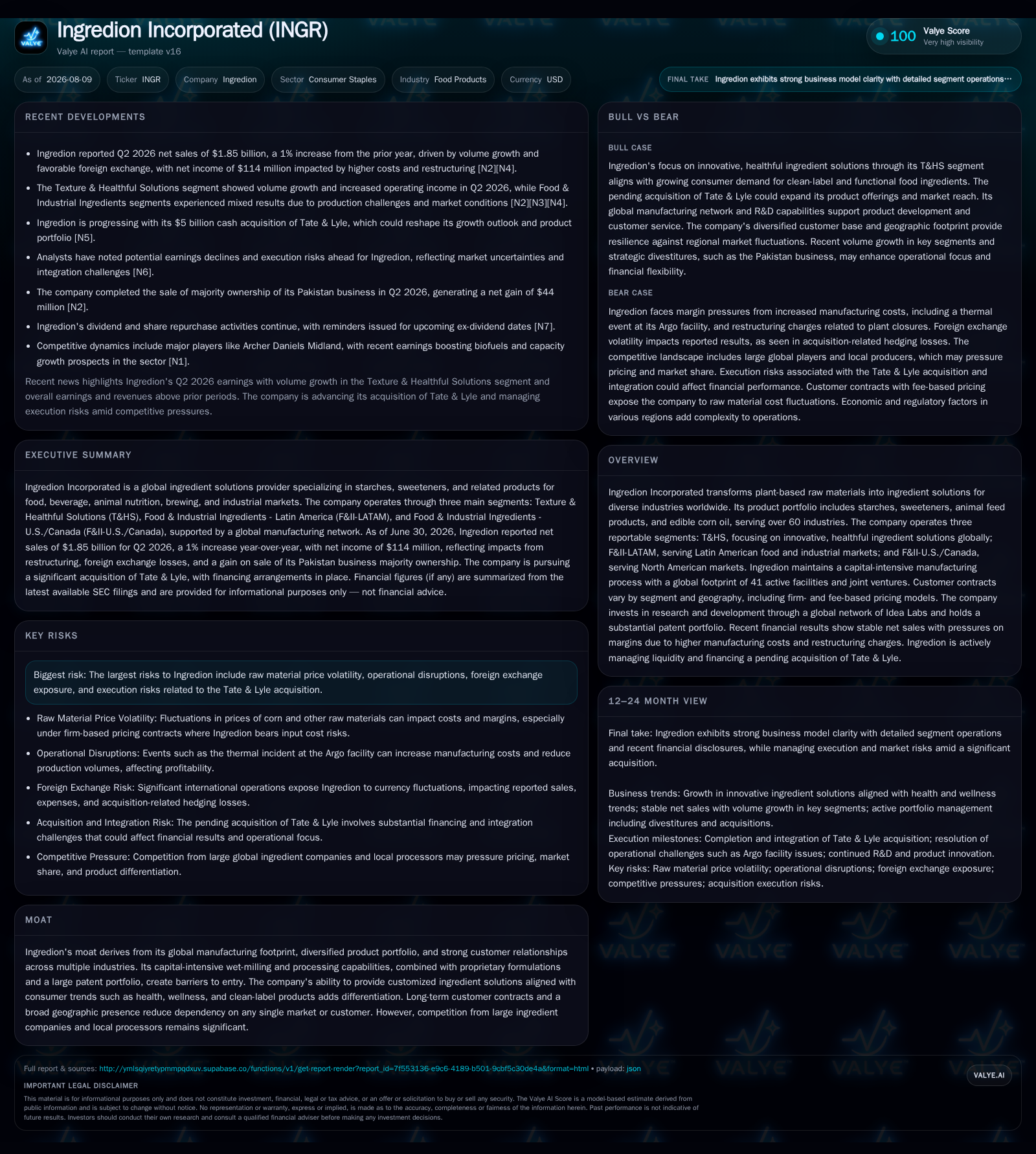
Ingredion's Q2 2026 results revealed a modest net sales increase primarily driven by volume growth in its Texture & Healthful Solutions segment, offset by rising manufacturing costs and lower price mix. Operating income contracted notably due to costs associated with plant closures in Brazil and acquisition-related foreign exchange hedging losses linked to the pending Tate & Lyle deal. The company’s capital-intensive global manufacturing platform underpins its product portfolio but remains vulnerable to input cost swings and integration risks. Continued innovation targeting healthful, clean-label ingredient trends supports its market positioning, yet margin recovery depends on effective cost management and seamless Tate & Lyle acquisition execution.
Q2 Operating Dynamics: Volume Strength Clashes with Cost Inflation and Acquisition Charges
Operating expenses remained fairly stable at $207 million but restructuring and impairment charges jumped sharply from $3 million in Q2 2025 to $45 million in Q2 2026—primarily attributed to the shutdown of their Cabo facility in Brazil [S2]. Moreover, financing costs soared from $12 million to $55 million largely because of $47 million of foreign exchange hedging losses tied directly to the pending acquisition of Tate & Lyle, which materially pressured bottom-line profitability. Net income attributable to Ingredion declined substantially from $196 million in the prior-year quarter to $114 million in Q2 2026
Complex Business Model Layers: From Raw Material Sourcing to Customized Ingredient Solutions
Ingredion’s core competency lies in transforming plant-based raw materials—primarily corn through wet milling—into differentiated starches, sweeteners, edible oils, and biomaterials that serve more than 60 industries worldwide. Its business is organized into three reportable segments: T&HS focuses on global markets innovating healthful texturizing ingredients aligned with wellness trends; Food & Industrial Ingredients Latin America (F&II–LATAM) caters mainly to South American food and industrial customers using locally sourced agricultural inputs; Food & Industrial Ingredients U.S./Canada (F&II–U.S./Canada) provides similar regional coverage in North America [S1][S17].
Revenue streams derive from contracts combining firm-price arrangements that lock-in pricing risk on manufacturer side with multi-year fee-based contracts that pass raw material cost fluctuations largely onto customers—a common industry practice reflecting volatility in agricultural commodity pricing. Fee-based pricing dominates longer-term agreements such as those with beverage producers who require stable supply but expect price adjustments linked to corn or tapioca feedstock market prices [S21]. This pricing mix creates revenue stability yet exposes margins cyclically depending on input cost volatility.
Capital intensity is a defining feature of Ingredion’s operations—with a global portfolio of 41 active manufacturing plants utilizing wet milling technology requiring significant fixed asset investment for capacity maintenance and efficiency enhancements. Operational leverage depends on optimal capacity utilization across these sites which also face regulatory compliance requirements including environmental controls targeting emissions from natural gas-fired boilers typical in high-volume industrial processing [S1][S17]. The recent closure of the Cabo facility marks a consolidation move aiming at improving overall efficiency but simultaneously entailing restructuring costs that press near-term earnings.
The company's innovation capability is underscored by substantial R&D investments managed via global Idea Labs network focused on developing proprietary formulations customized for evolving consumer demands like non-GMO certification, clean-label transparency, functional health benefits, and reduced sugar content. This innovation pipeline differentiates Ingredion relative to peers by offering specialized ingredient solutions beyond commodity starches or sweeteners—crucial for maintaining customer loyalty in food formulation industries increasingly driven by regulatory compliance and sensory quality requirements [S1].
Competitive Moats Tested: Global Capacity Scale Versus Raw Materials Volatility and Regulatory Pressure
Ingredion’s moat arises from its expansive geographic footprint spanning multiple continents paired with high capital barriers embedded in wet milling infrastructure rivaling global peers such as Archer Daniels Midland (ADM) and Tate & Lyle prior to their pending merger. With diverse product applications covering food-texture enhancers, industrial adhesives, brewing fermentables, animal nutrition aids, and biomaterial precursors, Ingredion spreads risk across end markets while achieving scale economies necessary for competitive cost positioning.
Long-term customer relationships largely governed by multi-year contracts provide some protection against commoditization; however, volatile raw material prices inject uncertainty into gross margins reflecting either lagging cost pass-throughs or firm-price risk absorption depending on contract features. Foreign exchange fluctuations particularly affect international subsidiaries’ reported results impacting U.S.-dollar denominated consolidated earnings—the company experienced such dynamics via sizable FX hedging losses during Tate & Lyle acquisition preparations [S2][S9]. Regulatory compliance costs related to environmental standards (e.g., air emissions permits) impose ongoing capital expenditure requirements estimated at over $50 million annually affecting operating cost structures modestly but materially over time [S13].
Innovation's Role in Responding to Consumer Trends and Market Differentiation
A critical competitive lever for Ingredion is its emphasis on R&D-led product development adapting ingredient functionality toward burgeoning clean-label and plant-based trends important across foodservice and consumer packaged goods sectors. Their patent portfolio supports unique starch modifications enhancing texture profiles or shelf-life extension while enabling non-GMO certification meets growing retailer mandates.
These innovations help the company capture incremental value beyond commodity starch or HFCS sales through specialized products like high maltose syrups accelerating brewing fermentations or protein fortification ingredients expanding into nutrition markets outside traditional sweetener/starch segments [S1][N11]. Continuous investment here aims at insulating margins as basic starch/sweetener prices fluctuate freely with global commodity cycles
Acquisition Execution Risks and Integration Challenges Amid Tate & Lyle Deal Progression
The planned acquisition of Tate & Lyle valued at approximately £2.7 billion (~$3.5 billion USD) represents a transformative yet risky growth step for Ingredion. The anticipated strategic synergy involves combining complementary product lines and expanding geographic reach particularly in Europe.
However, early signs show tangible acquisition headwinds including significant foreign exchange hedging losses booked as financing costs ($47 million just this quarter), elevating reported interest expense beyond normal running levels [S2][S23]. Additional restructuring charges linked partly to integration activities add near-term earnings volatility as systems rationalization unfolds.
Given sector peers’ experiences executing large-scale consolidations under commodity price fluctuations—such as ADM’s biofuels expansion challenges—the integration demands close monitoring through upcoming quarters for potential margin squeeze or operational disruption risks extending beyond initial estimates [N7][N8]
Growth Outlook: Demand Drivers Versus Margin Headwinds from Supply Chain Realignments
Growth opportunities center on rising global demand for clean-label ingredient solutions tailored for emerging health-conscious consumer segments combined with expansion into fast-growing emerging-market processed foods. Additionally, leveraging proprietary specialty ingredients for industrial biomaterials offers potential diversification beyond food/beverage channels.
Yet these drivers conflict with considerable margin pressure arising from recent operational disruptions like plant closures (e.g., Cabo) plus intensified supply chain complexity post-acquisition requiring scaled integration investments amid inflationary input costs not fully transferable via pricing mechanisms given prevalent contract types.
Monitoring net sales volumes segmented quarterly alongside gross margin trends remains critical KPIs signaling recovery prospects. Also vital will be ramping capacity utilization back toward normalized ranges post-disturbances at key sites such as Argo alongside successful contract renewals preserving overall fee-based revenue balance stability.
What to Watch Next: Integration Milestones, Contract Renewals, Capacity Utilization Metrics
Investors should watch for sequential quarterly updates quantifying progress against stated restructuring schedules—including any further impairment charges—as well as incremental evidence of margin stabilization reflecting managed input-cost offsets or improved pricing power.
Additional focus should dwell on updates relating specifically to Tate & Lyle deal integration such as transition expense run rates versus projected synergies alongside any regulatory approval timelines or hurdles potentially affecting closing dates.
Operational KPIs like capacity utilization rates across major plants (especially Argo), net sales volume growth per segment (particularly Texture & Healthful Solutions), renewal rates on multiyear fee-based contracts under shifting raw material price regimes will illuminate underlying demand durability versus transient inflation-induced margin erosion.
Financial Profile Discussion
As of June 30, 2026, Ingredion reported robust liquidity with cash and equivalents totaling approximately $948 million alongside current assets of roughly $3.52 billion versus current liabilities near $1.26 billion yielding a healthy current ratio around 2.8 [F1]. Financing costs increased notably due to foreign exchange hedging losses related to the pending Tate & Lyle acquisition, adding short-term pressure on credit metrics [S2].
In summation, Ingredion faces a distinct operating inflection point balancing volume-driven recovery efforts against notable margin headwinds emanating from both supply chain disruptions and transactional integration burdens associated with Tate & Lyle acquisition ambitions. Their ability to sustain innovation-led premium ingredient offerings amid evolving consumer preferences while controlling capital deployment efficiency will shape medium-term performance trajectories inside a structurally competitive global food ingredients industry.
Disclaimer: This is research-only, informational analysis and not investment advice. It may include AI-generated interpretation and general industry context. Always verify important details using primary sources.

Comments