
New England Realty Associates' Portfolio Diversification Anchors Unit Value Amid Cost Pressures
Stable property operations in Massachusetts and New Hampshire underpin revenue, but rising interest costs and expenses weigh on net income for the partnership.
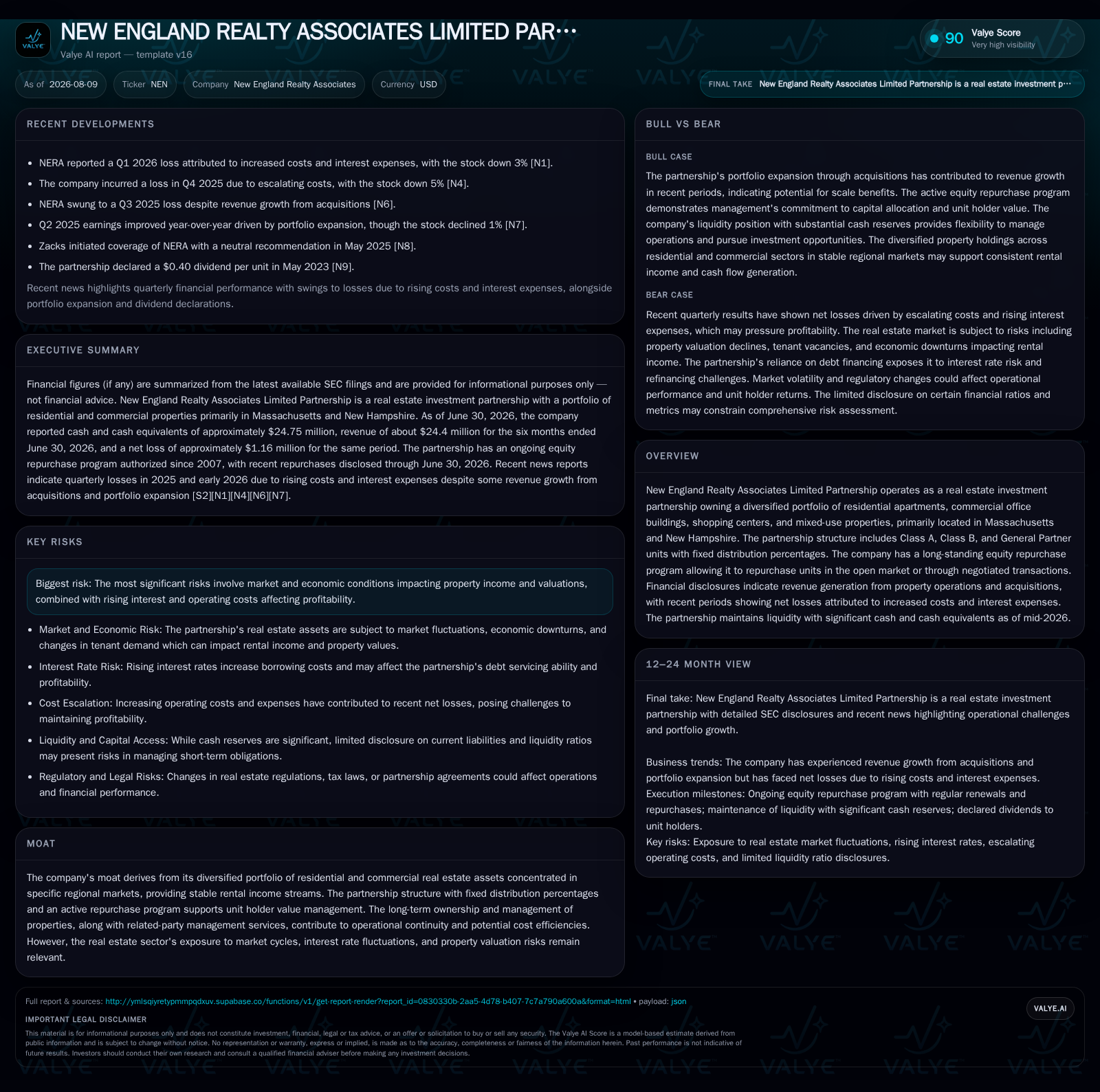
New England Realty Associates Limited Partnership reported steady operational performance through its diversified portfolio of residential apartments, commercial office buildings, and shopping centers primarily located in Massachusetts and New Hampshire. Despite stable rental income and net operating income, the partnership’s net losses have widened due to increasing interest expenses reflecting its substantial leverage. The company’s partnership unit structure with fixed distribution percentages and an established equity repurchase program aim to balance unit holder returns and liquidity amidst market volatility. Key risks remain tied to refinancing exposures and regional economic sensitivity, making upcoming lease renewal outcomes, cost trends, and repurchase activity critical near-term indicators.
Quarterly Operating Update Reveals Stability in Property Performance but Growing Expense Pressure
This scenario exemplifies the sensitivity of real estate partnerships’ profitability to finance costs given ongoing market cycles. The observed stability in net operating income (NOI), a key sector metric reflecting property-level profitability excluding financing effects, confirms that tenancy levels and lease renewals have held firm recently. Nonetheless, margin sustainability is challenged by escalating debt servicing burdens that could pressure distributable cash flows if trends continue unmitigated.
Partnership Structure and Distribution Mechanism Foster Unit Holder Alignment during Market Volatility
The partnership operates under a multi-class unit structure consisting of Class A units (majority share), Class B units, and General Partner (GP) units with pro-rated fixed distribution percentages assigned at 80%, 19%, and 1%, respectively [S1][S2]. This arrangement ensures alignment among stakeholders by defining stable income distributions anchored to available operational cash flows minus expenses.
Such fixed percentage allocations provide predictability for unit holders accustomed to steady income streams common within real estate investment partnerships. It also places implicit pressure on management to maintain portfolio occupancy and control operating expenses to support consistent distributions. Given this backdrop, the partnership’s strategy includes using an equity repurchase program as a tactical tool to manage unit liquidity and stabilize trading values during periods when external economic forces create valuation pressure.
Diversified Portfolio Mix as a Buffer Against Regional Market Fluctuations
The partnership’s asset base spans residential apartments, commercial office buildings, shopping centers, and mixed-use properties predominantly located in Massachusetts and New Hampshire [S1]. This geographic concentration provides a degree of exposure homogeneity that benefits from localized economic fundamentals but also introduces risks tied to regional market volatility.
Diversification across property types helps mitigate segment-specific demand shocks; multifamily residential rents typically exhibit defensive characteristics whereas commercial offices can be more cyclical depending on employment trends. Shopping center assets add retail exposure with distinct lease dynamics. The combined effect is generally reduced rent volatility relative to more concentrated portfolios but does not eliminate localized cyclical swings or regulatory impacts related to real estate markets in these states.
Equity Repurchase Program: A Tactical Lever to Manage Unit Liquidity and Price Support
Dating back to August 2007 with multiple subsequent authorizations extending capacity beyond initial limits, the equity repurchase program empowers management to buy back Depositary Receipts (each representing one-tenth of a Class A unit) alongside proportionate Class B and GP units based on fixed ownership distribution ratios [S2][S1]. Recent quarterly activity saw the repurchase of over 14,500 Depositary Receipts during Q2 2026 at average prices around $60 per receipt [S2].
This program represents an active capital allocation mechanism allowing the partnership to opportunistically support unit prices in the face of market fluctuations or when internal valuations suggest undervaluation relative to net asset value. The related pro-rata repurchases across unit classes preserve structural equity relationships while enhancing overall market liquidity — a critical feature given limited secondary market depth commonly observed in real estate partnerships compared with publicly listed REITs.
Capital Structure Headwinds: Rising Interest Costs Challenge Profit Margins
With total debt standing near $529 million offset by roughly $24.7 million cash as of June 30, 2026 — yielding net debt approximating $505 million — leverage remains substantial for New England Realty Associates [F1]. Such indebtedness inherently exposes the partnership to refinancing risk amid maturing liabilities and interest rate fluctuations.
The notable increase in interest expense driving net losses this period illustrates how fixed asset portfolios can still suffer earnings pressure when financing conditions tighten despite operational stability.
Within its peer group comprising other regional real estate limited partnerships focused on mixed residential-commercial portfolios with similar financing profiles, rigorous capital structure management becomes paramount especially given ongoing macroeconomic uncertainty impacting credit markets.
Growth Drivers Centered on Regional Demand and Active Portfolio Management
Long-term growth levers for New England Realty Associates tie closely to favorable regional economic conditions that sustain demand for rental housing and commercial space within its primary markets [S1]. Structural demographic trends such as urbanization in Massachusetts combined with corporate expansions contribute positively toward occupancy rates and potential lease renewal upside measured through spread gains over expiring terms.
Strategic acquisitions or selective redevelopment within existing holdings present further avenues for NOI growth alongside efforts to actively manage tenant mix aimed at reducing concentration risks. Efficient property management under related-party arrangements may also enhance cost control thereby improving margins incrementally.
Risks Around Refinancing, Tenant Concentration, and Economic Sensitivity Require Monitoring
Key risks persisting for New England Realty Associates echo broader industry themes yet hold specific relevance given its capital structure and regional focus. Refinancing risk remains salient as looming debt maturities coincide with heightened borrowing costs limiting flexibility or increasing financial burden if capital markets tighten unexpectedly [S1][S2]
Tenant credit quality impacts must be considered carefully since defaults or non-renewals affect occupancy rates — a vital driver of NOI given reliance on stable rental streams. Geographic concentration restricts diversification benefits at a macro level; adverse shifts in Massachusetts or New Hampshire economies could disproportionately disturb portfolio performance compared with more nationally diversified peers.
Tracking these factors will provide greater clarity into whether operational stability can eventually translate into improved distributable earnings despite headwinds seen from elevated financing charges.
Financial Profile Discussion
As of mid-2026, New England Realty Associates’ financial position shows roughly $24.7 million cash reserves against $529 million gross debt resulting in net leverage slightly above $500 million scale reflecting typical capital intensity for a regionally concentrated real estate partnership [F1]. While this level supports active investment capability backed by recurring rental revenues, it simultaneously creates exposures around refinancing risk should credit conditions deteriorate or if cash flow generation weakens unexpectedly.
No indications arise from current disclosures about covenant breaches or liquidity constraints suggesting immediate solvency concerns; however prudence dictates continual monitoring especially considering elevated interest expense trends impacting reported net income negatively this quarter [S2][F1]. Readers should consider all relevant factors holistically as part of ongoing sector evaluation.
Disclaimer: This is research-only, informational analysis and not investment advice. It may include AI-generated interpretation and general industry context. Always verify important details using primary sources.

Comments