
NB Bancorp Expands Regional Footprint and Scale through Provident Acquisition While Managing Credit Risk and Capital Distribution
NB Bancorp extended its asset base and geographic reach following its 2025 Provident acquisition, emphasizing net interest income growth and credit loss discipline amid regulatory capital considerations.
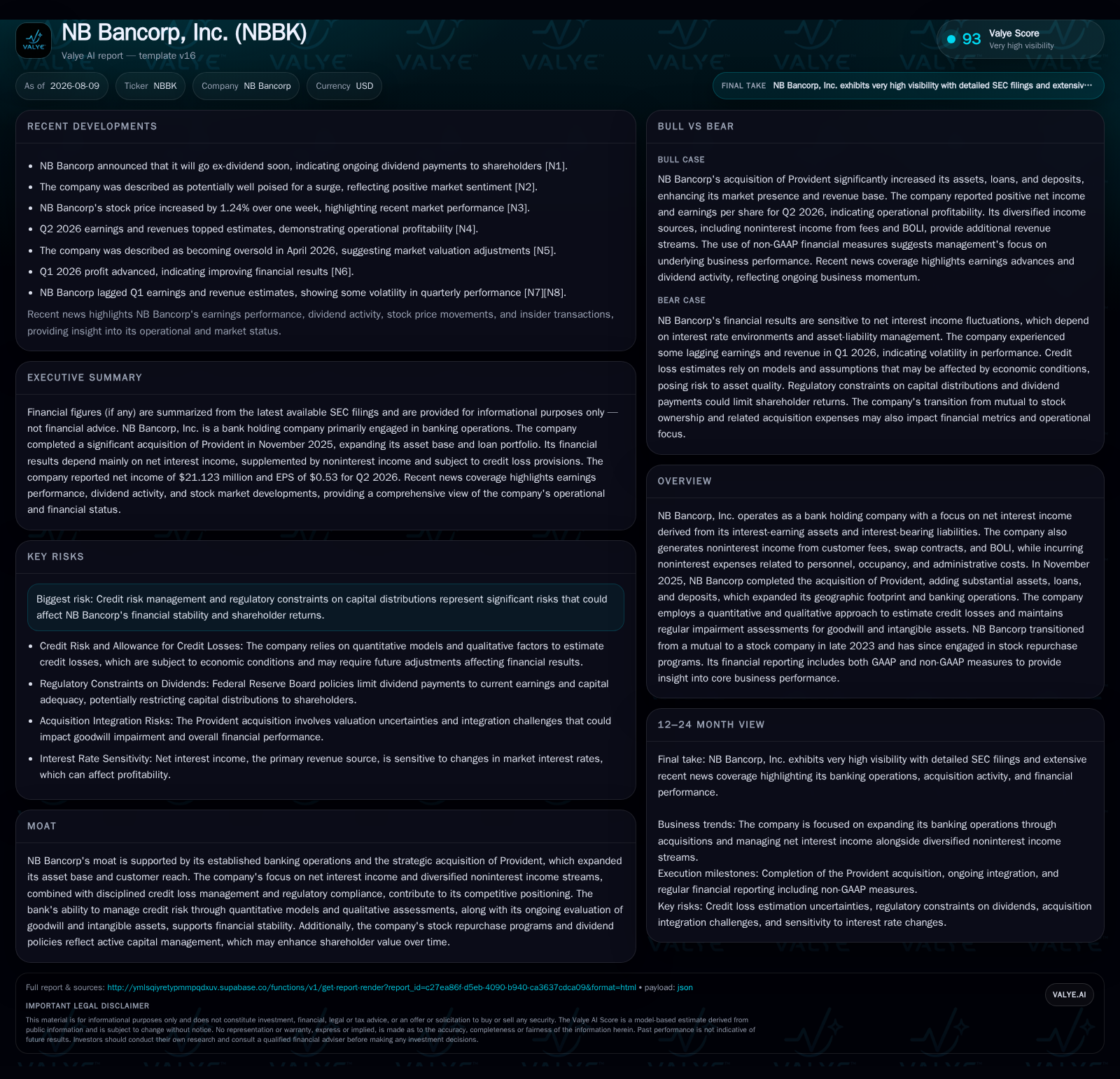
NB Bancorp, Inc. recently reported operating results that incorporate significant portfolio expansion from its November 2025 Provident acquisition, adding over $1 billion in loans and deposits [S1]. The company remains focused on net interest income as the core revenue driver while diversifying noninterest income streams. It continues to manage credit risk through systematic allowance assessments and complies with Federal Reserve dividend guidelines emphasizing capital adequacy [S6]. Stock repurchase activity was completed prior to year-end 2025 as NB Bancorp transitions from mutual to stock ownership. Going forward, loan growth, deposit retention, and maintaining regulatory capital buffers will be key operational markers to watch [S2, S3].
Recent Operating Update
NB Bancorp's latest quarterly report for Q2 2026 reaffirms the operational impact of its recent Provident acquisition completed in November 2025. This transaction contributed approximately $1.4 billion in total assets, including $1.18 billion in net loans and $1.14 billion in deposits at closing [S1]. The acquisition notably expanded NB Bancorp's geographic coverage into northeastern Massachusetts and southern New Hampshire through Provident’s network of branches. The company’s focus remains on enhancing net interest income as the central profit engine while integrating noninterest revenue sources such as fees from customer accounts, swap contract income, and returns from BOLI investments [S2], [S3].
On July 22, 2026, NB Bancorp declared a $0.07 per share cash dividend payable in August, indicating the company’s capacity to return earnings to shareholders while still adhering to regulatory capital distribution requirements [S3], [N2]. This payout underscores the balance the bank maintains between growth investment and shareholder returns within Federal Reserve dividend guidelines emphasizing payment out of current earnings with prospective retention aligned with capital needs [S6].
Business Model
NB Bancorp operates as a classic regional bank holding company whose revenue largely stems from net interest income — the margin between yields earned on loans and securities against costs paid on deposits and other borrowings [S1], [S13]. This spread is sensitive to changes in market interest rates but has been bolstered by loan portfolio expansion driven by organic originations augmented by strategic acquisitions like Provident. In 2025, net interest income grew by over $36 million or 22.5%, supported by a 16.3% increase in average loan balances combined with a slight upward movement in portfolio yields to 6.67% [S26]. This suggests management’s successful deployment of excess liquidity into higher-yielding commercial loans.
The company's noninterest income sources diversify earnings away from pure interest spread dependency. Customer service fees from deposit accounts provide recurring cash flow stability, swaps contribute mark-to-market gains or losses related to interest rate risk management, and BOLI serves both as an asset cushion and a tax-advantaged income stream [S13], [S20]. Noninterest expenses are primarily associated with personnel (salary/benefits), occupancy costs for branch networks (including new geographic footprints post-acquisition), professional fees relating to compliance and integration efforts, marketing expenditures, FDIC insurance assessments, and general administration.
Credit risk management is a critical facet of NB Bancorp’s model given its concentrated regional lending approach predominantly targeting commercial real estate (CRE), small businesses, construction loans, and land development portfolios—all categories inherently sensitive to economic fluctuations. The company employs quantitative models supplemented by qualitative assessments across segmented loan portfolios to set an allowance for credit losses (ACL) that reflects expected future impairments under prevailing economic assumptions [S15], [S16]. Purchased credit deteriorated (PCD) loans acquired from Provident are measured distinctly under ASC Topic 326 standards ensuring transparency between fair value adjustments at acquisition versus ongoing credit loss provisions.
Capital allocation is guided by regulatory frameworks mandating dividends be sustained only out of current earnings with due consideration for capital conservation buffers required under Basel III-like rules enforced by the Federal Reserve Board. These buffers constrain leverage expansion or aggressive distribution policies—thereby securing the bank's long-term financial health while allowing for stock repurchases when feasible [S6]. NB Bancorp completed two repurchase programs totaling about 10% of outstanding shares during the year ending December 2025 before halting activity toward year-end; this indicates measured capital returns balanced with maintaining adequate reserves following the significant merger-induced asset expansion [S7].
Industry Structure and Competitive Position
NB Bancorp competes within the regional banking sector focusing primarily on deposit-taking and commercial lending activities within Massachusetts and southern New Hampshire markets. Regional banks like NB Bancorp act as intermediaries funneling local deposits into community commercial investments—a business fundamentally reliant on stable deposit bases at low costs (deposit beta) and maintaining prudent credit underwriting standards.
The Provident acquisition materially enhanced NB Bancorp’s scale relative to typical community banks but keeps it below the size tier of larger regional competitors headquartered nationally yet operating similarly at a state/regional level. NB Bancorp's peer group includes regional banks with asset bases around several billion dollars that also pursue M&A-driven growth strategies alongside organic loan pipeline development.
Key competitive factors include:
- Deposit retention: Maintaining term deposit renewal rates helps keep funding costs stable amid rising rate environments where alternatives could lure away funds.
- Net interest margin sustainability: The ability to expand or hold spreads despite fluctuations in short-term rates.
- Efficiency ratio: Reflects operating expense control against revenues; integration costs from mergers can press this temporarily higher.
- Credit quality: Loan portfolio composition aligned with local economic growth drivers reduces nonperforming assets risk.
- Regulatory capital compliance: Sufficient CET1 ratios facilitate strategic flexibility including dividends or buybacks.
NB Bancorp’s demonstrated credit discipline through consistent ACL evaluations squares well with peer trends where cautious underwriting dominates post-pandemic recovery phases. Its geographical diversification via Provident affords incremental insulation against localized economic shocks common among smaller community banks.
Growth Drivers
Loan portfolio expansion remains essential as organic loan originations rebuild post-acquisition plus incremental growth prospectively from deeper market penetration across northern Massachusetts and southern New Hampshire regions formerly served exclusively by Provident customers. Improving economic conditions alongside stable commercial real estate demand act as tailwinds supporting this loan growth trajectory.
Deposit volume growth is equally critical given deposits fund majority lending activity; NB Bancorp expects high retention on sizable time deposits maturing within one year based on observed customer loyalty but remains alert to heightened competition impacting deposit beta especially as alternative instruments compete for customer cash holdings [S8], [S21].
Fee-based products such as treasury services, swap contracts, and BOLI add recurring non-interest revenue streams that stabilize earnings through rate cycles or softening credit spreads.
Interest rate volatility poses risk to NIM contraction should deposit betas rise sharply or asset repricing lag liabilities; close tracking of market curves and hedge positions will be needed.
Deposit outflows could force increases in funding costs if elevated levels of brokered deposits are utilized beyond conservative internal limits set currently at not more than 25% of total assets.
Regulatory constraints impacting capital distributions can limit shareholder returns particularly if earnings volatility threatens mandatory capital buffers saturate available retained earnings levels.
Integration risks following Provident acquisition include cultural alignment challenges, IT system consolidations, branch optimization strategies plus potential unforeseen operational expenses.
What To Watch Next
Investors should monitor:
- Quarterly net interest margin trends versus peer regional banks amidst evolving rate conditions.
- Loan growth data points signaling either organic momentum or dependency on further acquisitions.
- Provision for credit losses changes reflecting evolving loan portfolio risk profiles.
- Deposit retention rates at time deposit maturities indicating funding cost stability prospects.
- Capital ratios including CET1 levels dictating dividend policy flexibility.
- Announced share repurchase activity resumption or pause reflecting confidence in excess capital deployment versus balance sheet needs.
- Integration expense run-rate trending downwards post-merger confirming synergy realization progress.
- Any regulatory commentary or shifts affecting capital distribution frameworks or liquidity requirements that may hinder NB Bancorp’s financial policy execution plans.
Financial Profile Discussion
Liquidity stands solid with unused borrowing capacity exceeding $900 million at Federal Home Loan Bank access points combined with discount window availability providing additional backstops beyond internal cash reserve policies supporting ongoing lending commitments even amidst highly competitive deposit pricing pressures observed industrywide presently [S8], [S10]. Deposit brokered levels remain comfortably beneath self-imposed caps supporting funding mix diversity caution while limiting concentration risks inherent in wholesale funding dependencies leading banks often face intermittently during tightening cycles.
This analysis synthesizes publicly filed SEC reports through August 7, 2026 alongside related investor communications without expressing investment research views or price opinions.
Disclaimer: This is research-only, informational analysis and not investment advice. It may include AI-generated interpretation and general industry context. Always verify important details using primary sources.

Comments