
Dauch Corp's Scale and Integration Drive Amid Industry Electrification and Supply Chain Challenges
Dauch Corporation leverages its expanded global footprint and vertical integration to navigate shifting automotive demand and electrification trends.
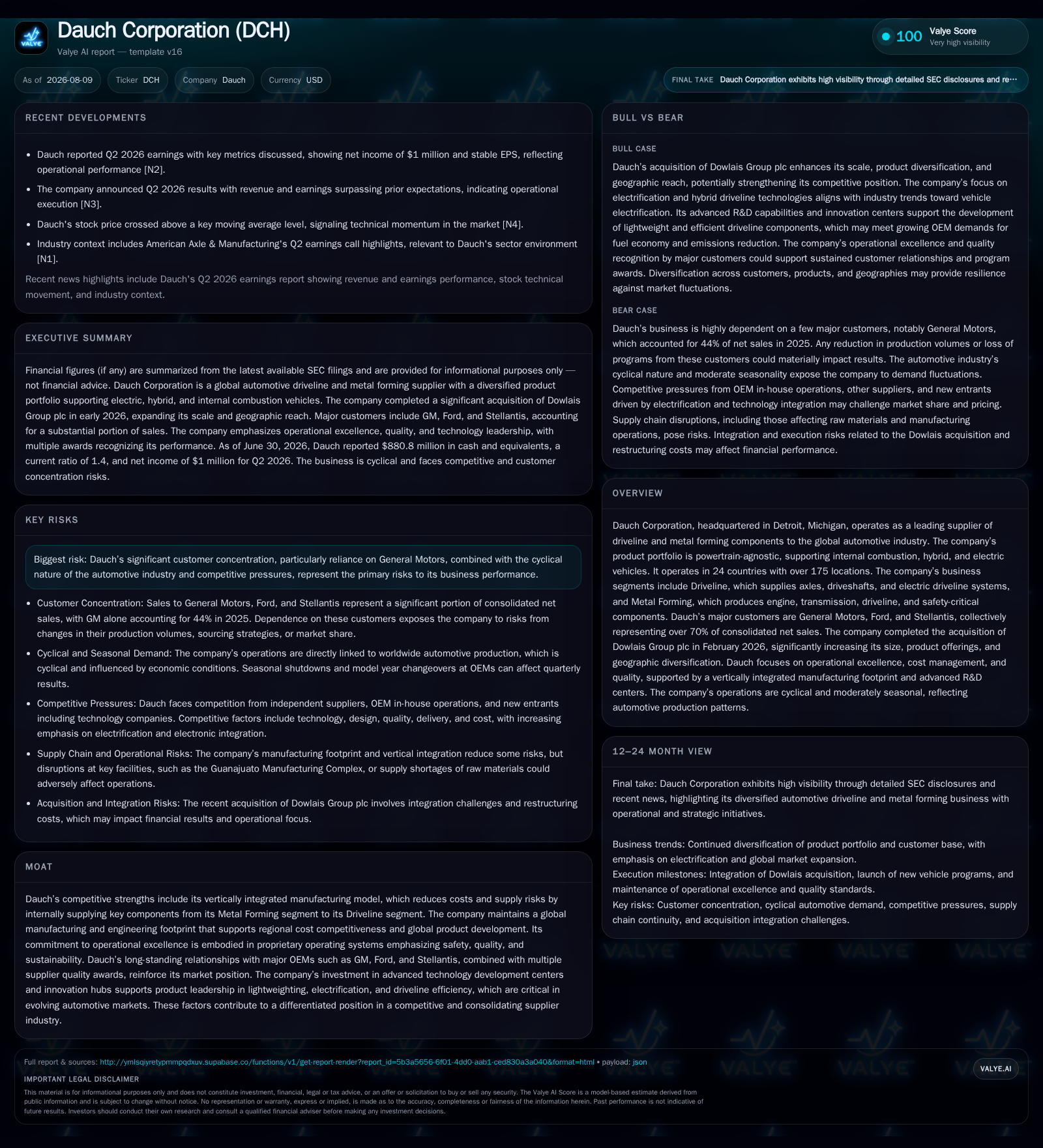
In Q2 2026, Dauch Corporation reported operational performance reflecting ongoing integration costs from its recent Dowlais acquisition while maintaining stable gross margins despite lower production volumes. The company’s powertrain-agnostic driveline and metal forming product portfolio, supported by a broad geographic base, positions it to serve evolving OEM needs across internal combustion, hybrid, and electric vehicles. However, significant customer concentration with GM, Ford, and Stellantis, coupled with industry cyclicality and raw material cost pressures, remain critical risks. Success in capturing electrification-related design wins and executing restructuring efforts will be key growth determinants.
Recent Operating Update Highlights
The company’s earning reports also emphasize no material changes in disclosed risk factors as of Q2 2026 compared to the previous year-end filing [S14],[S15], pointing to continuous vigilance on supply chain resiliency and customer exposure.
Business Model Specificity
Dauch operates primarily as a tier-1 automotive parts supplier specializing in driveline systems (axles, driveshafts, electric driveline modules) alongside metal forming components crucial to engine, transmission, driveline assemblies, and safety-critical parts. This dual segment approach underpins a vertically integrated manufacturing model that reduces reliance on external suppliers for critical inputs—enhancing cost control and supply continuity especially during raw material price volatility endemic to steel and aluminum markets [S1].
Crucially, Dauch positions itself powertrain-agnostic by supporting internal combustion engines (ICE), hybrid powertrains, and fully electric vehicles (EVs), broadening relevance as regulatory pressure intensifies for lower emissions worldwide. Its driveline segment includes advanced products such as e-Beam axles incorporating high-reduction gearboxes combined with integrated electrical inverters which are engineered to enhance fuel efficiency, reduce CO2 emissions, improve noise-vibration-harshness characteristics, and support all-wheel drive functionality [S1].
Monetization primarily flows through long-term supply agreements with major OEMs where revenues track production volumes across supported vehicle programs. Pricing generally incorporates a pass-through mechanism for raw material inflation but is partially constrained by competitive pressure within the tier-1 supplier ecosystem.
Industry Structure and Competitive Position
The automotive components sector is fiercely competitive among global tier-1 suppliers such as American Axle & Manufacturing (now part of Dauch pre-acquisition), Metaldyne Performance Group (incorporated into Dauch via past acquisitions), GKN Automotive, Magna International, BorgWarner, Dana Incorporated etc., all vying for design wins particularly in electrified driveline solutions. Success depends on technology leadership—especially lightweight materials development—and operational excellence facilitating just-in-time delivery aligned with OEM production schedules.
Dauch’s newly expanded footprint post-Dowlais acquisition spans 24 countries with over 175 manufacturing sites enhancing regional cost competitiveness while enabling proximity to North American European Asian OEM assembly lines [S1]. The combined R&D capability supports innovation pipelines essential for market differentiation.
Customer concentration remains high: GM alone accounted for approximately 44% of consolidated net sales in 2025 (up from prior years), followed by Ford at 15% and Stellantis at 13%, jointly driving over 70% of revenue [S1]. Such concentration institutes notable client dependency risk: any cutbacks or shifts in preferred suppliers by these OEMs could disproportionately impact top-line stability.
Growth Drivers
Several forces underpin Dauch’s growth outlook:
- Electrification Trends: The pivot towards hybrid/electric vehicles requires novel driveline architectures incorporating electric motors directly into axle assemblies. Dauch’s investment into scalable electric driveline platforms including e-Beam axles highlights its effort to capture this expanding market niche.
- Lightweighting: Regulatory pressure to reduce fuel consumption propels demand for lighter yet durable components which dovetails with metal forming expertise leveraging aluminum alloys or advanced stamping techniques.
- Global Vehicle Production Recovery: As emerging markets grow their automotive output capacity coupled with recovery/innovation cycles in North America and Europe post-pandemic perturbations support higher production volumes potentially benefiting tier-1 suppliers.
- Acquisition Synergies: Dowlais’ addition broadens product offerings into powder metallurgy—a complement to existing lines—and extends geographic reach particularly into Europe enhancing cross-selling opportunities.
Monitoring KPIs such as order backlog from OEMs for electrified vehicle programs, capacity utilization rates across international plants, rate of new product launches onboarded into mass production schedules will be critical validation points for sustained growth momentum.
Risks / Watchpoints / Constraints
Dauch faces several enduring challenges typical of the automotive components sector:
- Customer Concentration: Heavy sales reliance on three large OEMs exacerbates revenue cyclicality tied directly to these customers’ production forecasts subject to macroeconomic factors.
- Raw Material Volatility: Steel aluminum prices have surged intermittently; despite pass-through pricing capability some residual margin pressure can occur if market swings are abrupt or prolonged.
- Labor Market Pressures: Manufacturing site labor shortages or wage inflation could inflate fixed costs adversely impacting margins especially if productivity enhancements lag workforce constraints.
- Integration Costs: Executing complex cross-border mergers entails risks of cultural mismatch operational inefficiencies or synergy realization delays potentially diluting near-term financial results.
- Technological Obsolescence: Failure to innovate timely in fast-evolving electrification technologies may cause loss of strategic relevance versus peers investing aggressively.
Regulatory shifts around emissions/safety standards globally introduce ongoing compliance costs potentially requiring capital expenditures or re-engineering efforts.
What to Watch Next
Investors should focus on the following markers over the next quarters:
- Progress against targeted restructuring savings offsetting acquisition-related overheads slated at $100-$140 million total for 2026 [S1].
- Evidence of ramping revenue contribution from electric/hybrid drivetrain programs versus declining ICE-based volumes.
- Quality defect rates alongside delivery punctuality as indicators of operational excellence during integration phase.
- Changes in customer mix or any early signs of contract renewals or losses with GM/Ford/Stellantis.
- Capital expenditure trends signaling investments into new product platforms or capacity expansions aligning with electrification requirements.
- Raw material cost pass-through effectiveness mitigating margin erosion amid commodity price volatility.
Financial Profile Discussion
As of June 30, 2026, Dauch held $881 million in cash and equivalents providing liquidity cushion against its operational needs [F1]. The company’s current ratio stood at approximately 1.4x reflecting sufficient short-term asset coverage over liabilities as evidenced by $3.73 billion in current assets versus $2.67 billion in current liabilities [F1].
Although total debt figures post-acquisition are not explicitly updated in filings beyond September 2021’s reported $3.14 billion, prior corporate disclosures indicate roughly $5.4 billion combined indebtedness post-Dowlais transaction highlighting elevated leverage levels necessitating disciplined cash flow management [S11]
Operating income declined from $241 million in 2024 to $112 million in 2025 largely due to volume declines plus one-time restructuring/acquisition charges illustrating ongoing margin pressures during transformation phases despite steady gross margin percentages at circa 12% supported by effective cost controls [F1],[S1],[S28]. Interest expense rose materially driven by incremental debt issuance linked to business combination activity portending interest coverage concerns warranting monitoring alongside free cash flow generation sustaining debt servicing capabilities.
Overall cash flow from operations remained positive though slightly reduced compared to prior years signaling resilient core earnings generation despite transition challenges underscoring focus areas include managing integration expenses while optimizing working capital efficiencies going forward [S26]
This analysis is based solely on publicly available SEC filings through August 2026 including quarterly reports, event-driven disclosures, annual reports along with validated company facts data sets. It aims to provide an objective assessment grounded strictly within documented disclosures without speculative forecasts or investment research views.
Disclaimer: This is research-only, informational analysis and not investment advice. It may include AI-generated interpretation and general industry context. Always verify important details using primary sources.

Comments