
COMPASS Pathways Advances Psilocybin Therapy Amid Regulatory and Capital Challenges
Late-stage clinical progress and capital structure define COMPASS Pathways’ near-term profile as it prepares for commercialization.
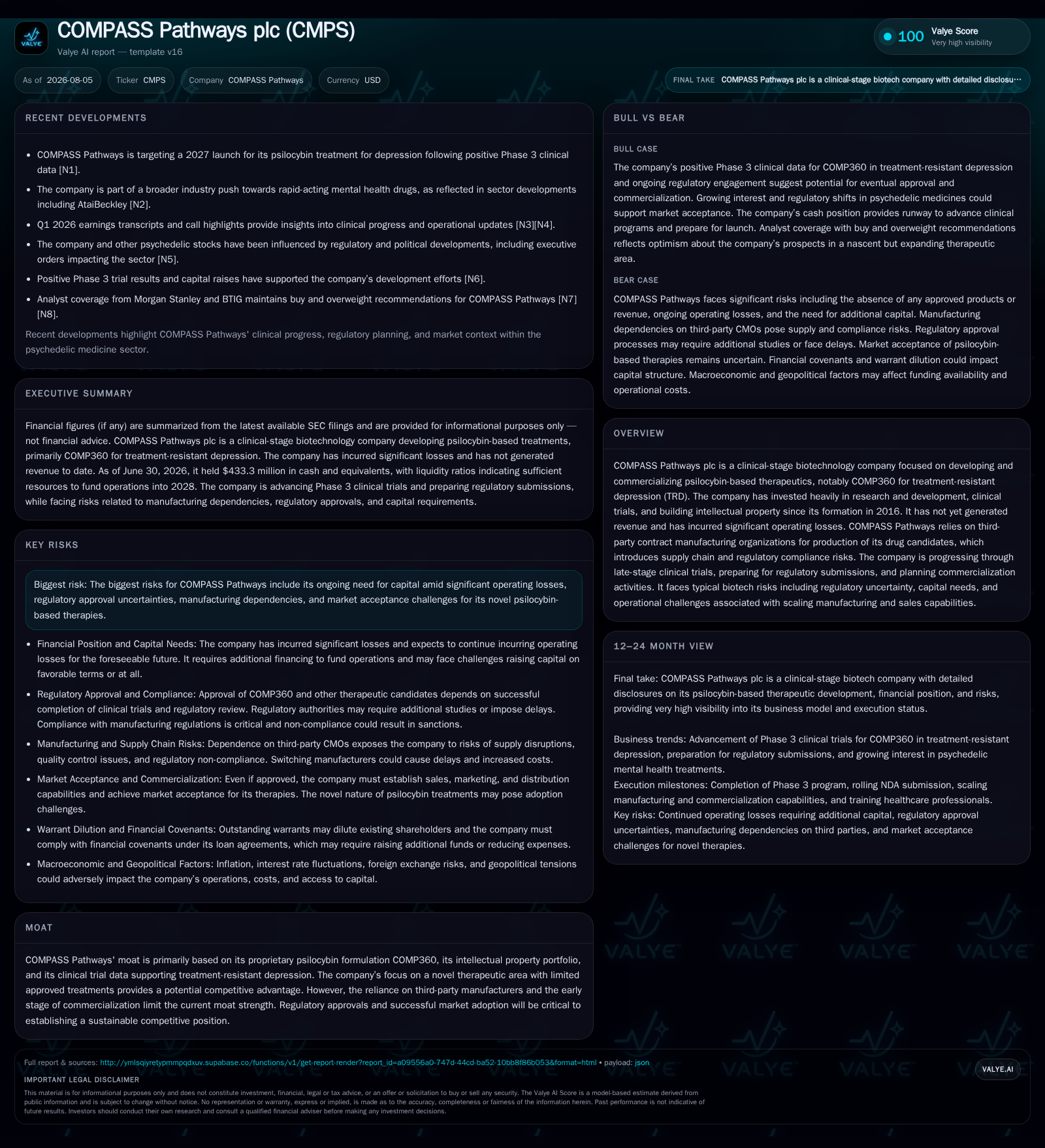
COMPASS Pathways is progressing its lead investigational psilocybin-based treatment, COMP360, targeting treatment-resistant depression (TRD) with pivotal Phase 3 trial data underpinning an anticipated regulatory submission. The company continues to operate at a significant operating loss while preparing for potential commercial launch, investing heavily in clinical development, manufacturing scale-up, and regulatory compliance activities. Reliance on third-party contract manufacturers and regulatory uncertainties around controlled substances constitute material operating risks. Financially, COMPASS carries moderate debt alongside over $430 million in cash but faces increasing expenditure demands ahead of product approval.
Recent Operating Update
COMPASS Pathways plc’s latest quarterly filing dated August 5, 2026 ([S2]) reveals continued advancement toward commercialization of COMP360, their proprietary psilocybin formulation aimed at treating treatment-resistant depression (TRD). The pivotal Phase 3 program is composed of two trials: COMP005 focusing on a single fixed-dose monotherapy and COMP006 evaluating repeat dosing regimens. As of mid-2026, enrollment for both studies was completed in 2025 with the first pivotal trial (COMP005) having achieved its primary efficacy endpoint based on the Montgomery-Åsberg Depression Rating Scale (MADRS) at week six. This trial showed a statistically significant and clinically meaningful symptom reduction versus placebo with a p-value below 0.001 and a mean treatment difference of -3.6 points on MADRS ([S1]).
The company is preparing a rolling New Drug Application (NDA) submission following these pivotal results and positive safety profiles from main studies ([S2]). However, while clinical progress anchors near-term optimism, revenue remains nonexistent as no approval or commercial sales have occurred yet. The operational focus remains on late-stage development support activities including patient follow-ups, training healthcare professionals for safe therapy administration, scaling manufacturing through contract organizations (CMOs), and initiating commercial infrastructure development ([S1]).
Business Model
As a clinical-stage biotechnology firm specializing exclusively in psychedelic therapeutics, COMPASS generates value principally by advancing investigational psilocybin treatments through clinical trials to regulatory approval and eventual commercialization. Revenue will be primarily earned from product sales post-approval, likely involving managed care reimbursement paradigms given the specialty mental health indication.
Their main asset is COMP360, a crystalline pharmaceutical-grade psilocybin formulation optimized for stability and purity, designed to be administered under controlled clinical conditions due to regulatory scheduling as a DEA Schedule I substance ([S1]). The company monetizes through direct sales or partnerships once approved but currently incurs extensive R&D costs without product income.
Manufacturing is outsourced entirely to third-party CMOs which handle complex synthesis and formulation processes regulated stringently due to the controlled status of psilocybin ([S1][S4]). This reliance introduces supply chain risk factors including quality compliance and capacity constraints that may impact launch timelines or cost structures.
Strategic emphasis also lies in building delivery networks (“Centers of Excellence”) where trained clinicians administer COMP360 treatments alongside psychotherapeutic support, underscoring a service-integrated delivery model requiring specialized provider training—adding complexity relative to traditional oral pharmaceuticals ([S1]).
Industry Structure and Competitive Position
COMPASS operates within the emerging sub-sector of psychedelic therapeutics targeting mental health disorders inadequately addressed by existing pharmacotherapies such as SSRIs or electroconvulsive therapy. This space is characterized by extensive clinical research investment balanced against novel regulatory frameworks due to controlled substance challenges.
Competitors include firms like AtaiBeckley, which recently underwent acquisition by Eli Lilly ([N2][N4]), signaling industry consolidation momentum driven by big pharma interest. Company moats are built on proprietary formulations, comprehensive clinical datasets demonstrating efficacy/safety endpoints—particularly around rapid onset and durable responses—and securing intellectual property rights covering composition and therapeutic protocols ([S1]).
Compared with peers still navigating early-phase trials or diversified portfolios, COMPASS's focused late-stage pipeline positions it ahead if regulatory approval milestones are achieved. However, its reliance on external manufacturing partners contrasts with vertically integrated models pursued by some pharmaceutical peers potentially affecting margin leverage post-launch.
Growth Drivers
Critical growth drivers center around successful completion of ongoing Phase 3 trials validating COMP360's efficacy and safety with statistically robust endpoints using MADRS scores—a standard measure in depression trials—as well as favorable FDA review outcomes facilitated by breakthrough therapy designation granted earlier for TRD indication ([S1]).
Expansion opportunities exist beyond TRD into related psychiatric conditions such as PTSD where Phase 2b/3 programs are planned or underway ([S1]). Achievement of FDA rescheduling decisions from Schedule I status by DEA is essential for commercial distribution in the United States following approval ([S21]).
Building out Centers of Excellence networks enhances therapy accessibility while payer negotiations aiming at securing reimbursement coverage will influence market penetration. Manufacturing scale-up readiness through qualified CMOs supports demand fulfillment efficiency.
Intellectual property protection covering crystalline polymorphs and method-of-use patents reinforces competitive positioning against generic entrants or alternative psychedelic formulations (945). Increasing patient awareness driven by growing acceptance of psychedelic medicine could further drive physician adoption once approved.
Risks and Watchpoints
The company's critical risks include substantial capital requirements driven by prolonged operating losses ($162.6 million net loss in H1 2026), absence of revenue generation thus far, and high dependency on achieving regulatory approvals that remain uncertain given novel therapy classification ([S2][F1]). Regulatory timelines may be affected by FDA resource constraints or U.S. federal drug scheduling complexities requiring DEA reclassification before legal marketing occurs ([S21]).
Manufacturing outsourcing creates vulnerability around CMO capacity limits or compliance failures that can delay supply availability impacting launch readiness ([S4]). Market acceptance challenges revolve around physician willingness to adopt psychedelics within psychiatric treatment algorithms and achieving adequate payer reimbursement policies given higher upfront costs compared with standard antidepressants ([S1]).
Additional risks include intellectual property litigation exposure which could erode exclusivity periods ([S23]), evolving healthcare fraud-and-abuse legal frameworks particularly relevant during commercial education efforts ([S4]), environmental health law compliance tied to laboratory hazardous material handling ([S17]), and external factors like potential U.S. drug pricing reforms threatening future revenue assumptions ([S14]).
What to Watch Next
Key upcoming milestones include:
- Completion of long-term follow-up data from pivotal trials affecting durability claims;
- Filing timeline progress for NDA submission(s) with FDA including any rolling review feedback;
- DEA scheduling decisions enabling commercialization pathways;
- Progress expanding clinical networks trained for administration;
- Manufacturing scale-up qualification events ensuring supply readiness;
- Announcements regarding payer engagement outcomes influencing access;
- Any new clinical data releases expanding indication breadth beyond TRD.
Monitoring quarterly R&D spending trends relative to cash reserves will also be important indicators of capital sustainability until positive cash flow begins post-commercial launch.
Financial Profile Discussion
Financially, COMPASS reported $433 million in cash and equivalents against $50 million total debt as of June 30, 2026 yielding an approximate net cash position near $383 million with a current ratio of 1.3 indicating acceptable short-term liquidity coverage at this juncture ([F1]). Nonetheless, operating losses continue on an elevated trajectory summing to approximately $163 million over the first half of calendar year 2026 alone attributed largely to R&D intensification gearing toward NDA submissions plus early commercial infrastructure investments ([F1][S2]).
The company’s indebtedness arises from a loan agreement amended multiple times recently totaling up to $150 million available tranches; however only tranches contingent upon specific clinical/commercial milestones have yet been drawn down partially ($50 million funded) thus far—highlighting conditional leverage management tied directly to pipeline progression ([S12],[S16]). Covenants restrict certain corporate actions until repayment, representing strategic financial constraints going forward.
Capital raise necessity remains material as revenues are not expected until after product launches potentially beginning in late 2027 or beyond according to public commentary; prudent capital allocation balancing accelerated development versus pre-launch expenditures will remain critical given industry-standard sustained losses pre-revenue generation phases typically seen across biotech peer groups ([N1][F1][S2]).
Disclaimer
This analysis is based solely on publicly available information including SEC filings dated through August 2026 and reputable news sources cited herein. It does not constitute investment advice or research views but aims to provide industry-informed insight into COMPASS Pathways plc’s operational outlook and business model dynamics.
Disclaimer: This is research-only, informational analysis and not investment advice. It may include AI-generated interpretation and general industry context. Always verify important details using primary sources.

Comments