
Third Coast Bancshares Strengthens Texas Regional Banking Grip Amid Growing Loan Demand
Mid-2026 filings show Third Coast Bancshares expanding commercial lending in Texas while maintaining cautious credit loss provisions amid competitive pressure on deposits.
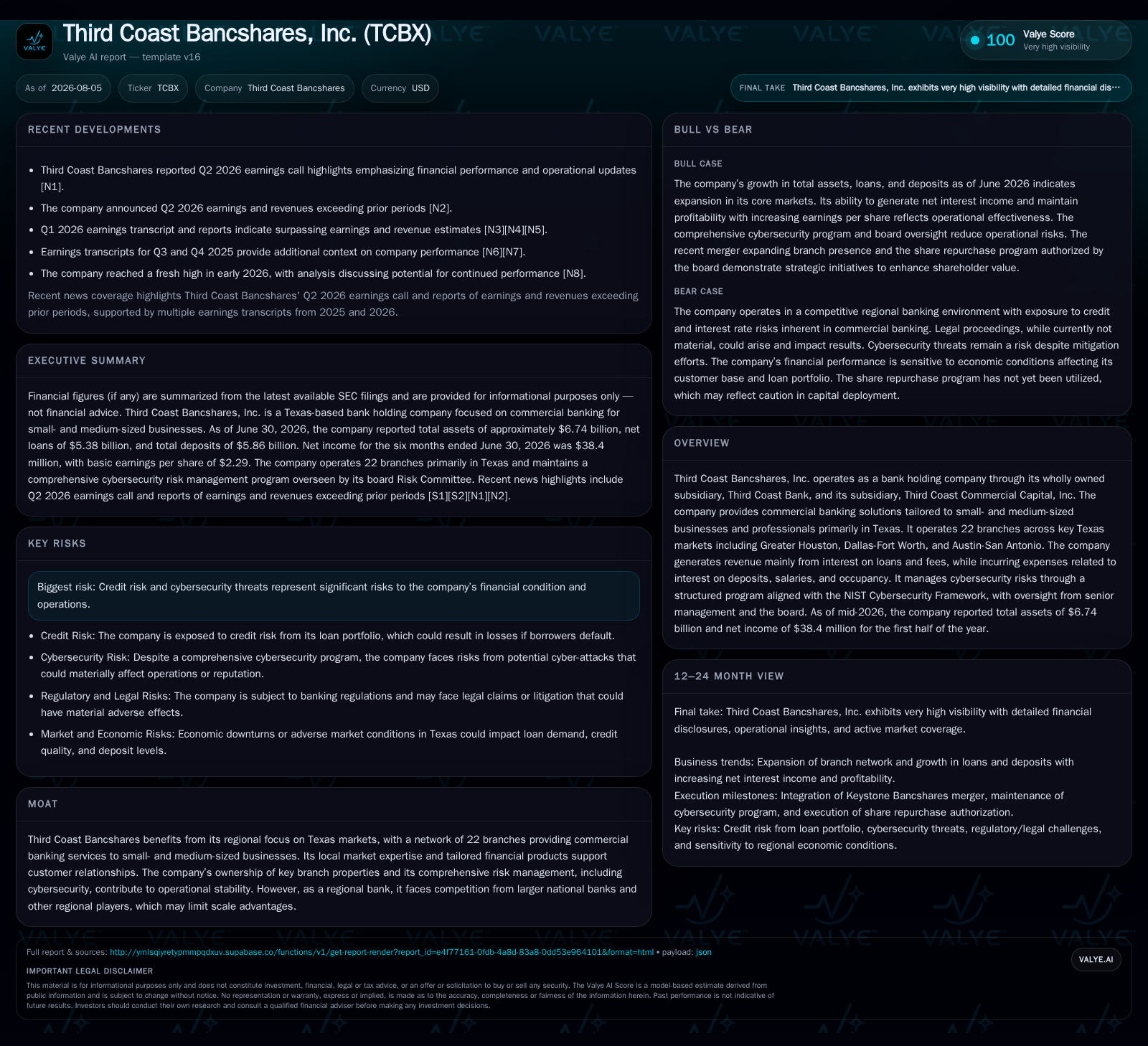
Third Coast Bancshares, Inc. reported robust growth in its Texas-focused commercial loan portfolio during the first half of 2026, highlighted by a 24% increase in net loans since year-end 2025, reflecting strong regional economic activity. Concurrently, the bank raised its allowance for loan losses by over $9 million, signaling proactive credit risk management amid emerging asset quality concerns typical to regional lenders. Its stable deposit base supported by a dense branch network and fee income diversification underpins financial resilience despite interest rate pressures and competition from larger banks. Capital adequacy remains sound, providing room for balanced growth.
Recent Loan Portfolio Growth Reflects Robust Texas Economic Activity
In the latest quarter ending June 30, 2026, Third Coast Bancshares expanded its gross loan portfolio substantially to approximately $5.44 billion—a near 24% increase from $4.39 billion at year-end 2025—primarily fueled by commercial and industrial lending within its Texas markets [S2]. This surge underscores strong demand from small- and medium-sized enterprises (SMEs) operating in resilient sectors such as energy services, manufacturing, and retail concentrated around Houston and Dallas-Fort Worth.
However, this aggressive loan growth has been accompanied by a deliberate increase in the allowance for loan losses to $53.6 million from $43.9 million at December 31, 2025—a rise exceeding 20%—indicating management’s proactive stance on credit risk during cyclical uncertainties common in regional banking [S2]. By building reserves ahead of potential deterioration in asset quality, the bank aims to mitigate future provision shocks while sustaining lending momentum.
This approach balances revenue generation via net interest margin (NIM) preservation against prudent underwriting discipline—a critical dynamic given regional banks’ exposure to localized economic fluctuations.
Branch Network Supports Stable Deposit Base during Competitive Pressures
Third Coast Bancshares operates a concentrated network of 22 branches strategically positioned across key Texas metropolitan areas including Greater Houston, Dallas-Fort Worth, and Austin-San Antonio [S1]. These branches play a vital role in relationship banking with local businesses and professionals requiring customized commercial banking solutions.
Deposits remain a cornerstone of funding stability; as of mid-2026, about 77% of deposits are interest-bearing accounts such as money market funds and certificates of deposit—a composition typical among peers like Fifth Third Bancorp but one that subjects the bank to rising cost of funds pressures during elevated interest rates [S2]. This deposit mix reflects both customer preference for yield and competitive constraints limiting pricing flexibility.
The ownership of branch real estate assets provides operational leverage against inflationary expense trends common across the banking sector but does not fully insulate TCBX from competitive pressures on deposit pricing driven by larger national banks.
Fee Income Diversification Adds Revenue Resilience
Beyond reliance on net interest income from loans less funding costs, Third Coast Bancshares generates meaningful fee income through treasury management services and other commercial banking products tailored for SMEs [S1][N1]. This diversification reduces earnings volatility associated with fluctuating net interest margins.
Cross-selling fee-based services enhances client retention in an increasingly competitive environment where fintech disruptors offer alternative lending platforms. Although fee income constitutes a smaller portion relative to interest income typical for regional banks, its growth supports overall financial resilience.
Cybersecurity Governance Aligns With Industry Standards
Recognizing elevated operational risks around data security inherent in banking operations, TCBX maintains a comprehensive cybersecurity framework based on National Institute of Standards and Technology Cybersecurity Framework (NIST CSF) principles [S1].
Governance includes board-level oversight through the Risk Committee and direct reporting lines from the Chief Information Security Officer (CISO), ensuring continuous risk assessments and managed detection-response capabilities. This layered defense strategy addresses growing regulatory scrutiny and emerging cyber threats that disproportionately impact community banks with constrained IT resources.
To date, no material cybersecurity incidents have been reported.
Emerging Risks: Credit Quality Pressure and Interest Rate Sensitivity
While loan growth reflects underlying demand strength, early signs point toward increased credit risk pressures within certain portfolio segments sensitive to economic cycles [S2][N2]. The elevated allowance for loan losses signals management’s cautious outlook anticipating potential asset quality deterioration.
Concurrently, an environment of Federal Reserve tightening has compressed net interest margins due to lagging deposit repricing relative to loan yields—a challenge accentuated for regional banks like TCBX lacking scale advantages or diversified funding sources compared with larger institutions [S2].
These dynamics necessitate calibrated balance between growth ambitions and credit risk management.
Key Metrics To Watch for Growth Sustainability
Investor attention should focus on several critical performance indicators:
- Loan-to-deposit ratio: Stability or modest increases indicate balanced liquidity management supporting sustainable asset expansion.
- Non-performing loan (NPL) ratio: Rising NPLs would signal deteriorating credit quality warranting additional provisions.
- Allowance coverage: Changes reveal evolving risk appetite towards portfolio quality assumptions.
- Deposit inflows: Consistent gains underpin low-cost funding essential for profitable lending.
- Capital adequacy: Tier 1 capital ratios well above regulatory minimums provide cushion for growth or earnings volatility [S2][S3][F1]
Monitoring these alongside macroeconomic trends will determine if current momentum can be maintained or is vulnerable to cyclical reversals.
Financial Profile Discussion: Liquidity Strength and Capital Adequacy Support Growth
As of June 30, 2026, Third Coast Bancshares held cash and cash equivalents totaling approximately $410.9 million—more than double the $181.2 million recorded at December-end 2025—providing substantial liquidity buffers to absorb unexpected withdrawals or market disruptions typical in retail-heavy banking operations [S2][F1]
Shareholders’ equity increased by roughly $139.7 million over six months to about $670.8 million driven primarily by net income accumulation post-acquisition activities combined with retained earnings after preferred dividends declared [S11]. This solid capital base ensures Tier 1 leverage ratios comfortably exceed minimum regulatory thresholds (above 9%), supporting continued loan book expansion without immediate capital constraints under FDIC “well capitalized” standards [S11].
Debt management reflects prudent stewardship with a modified revolving line of credit extended through March 2028 at favorable terms alongside stable subordinated notes totaling $82.3 million—maintaining an overall borrowing cost near six percent—balancing internal funding needs against external financing efficiency [S10][S15]
Together these factors highlight robust financial health underpinning Third Coast Bancshares’ strategic positioning within its regional market footprint.
This analysis synthesizes recent SEC filings through August 4, 2026 alongside contemporaneous earnings releases without offering investment advice or forward-looking forecasts. Third Coast Bancshares exemplifies a regional bank leveraging localized expertise across Texas SME markets while navigating typical sector risks around credit quality and margin pressures amid evolving macroeconomic conditions.
Disclaimer: This is research-only, informational analysis and not investment advice. It may include AI-generated interpretation and general industry context. Always verify important details using primary sources.

Comments