
Rapport Therapeutics Advances RAP-219 Amid Solid Cash Buffer and Strategic Partnerships
Clinical progress on RAP-219 in focal onset seizures is supported by strong liquidity and a key regional partnership, setting the stage for upcoming regulatory milestones.
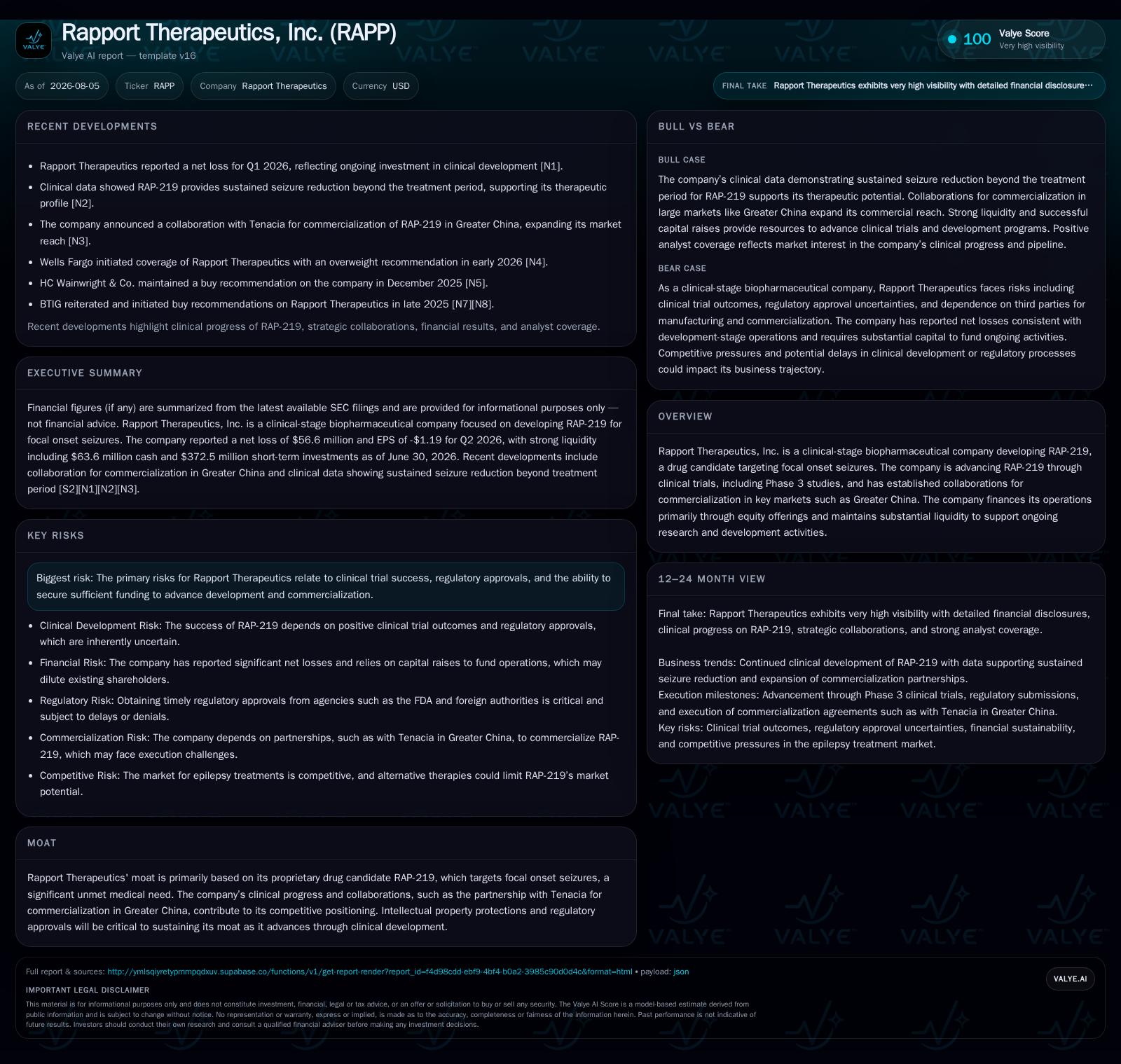
Rapport Therapeutics, a clinical-stage biotech focused on developing RAP-219 for focal onset seizures, reported continued advancement in its Phase 3 clinical program as of June 2026. The company benefits from a strategic collaboration with Tenacia for commercialization rights in Greater China, ensuring geographic market access while maintaining focus on pivotal trials. Solid cash reserves of approximately $63.6 million and a robust current ratio provide financial flexibility amid typical clinical-stage burn. Despite promising developments, residual risk remains around trial enrollment rates, data readouts, and regulatory approvals.
Clinical Progress Update Unlocks Imminent Milestones for RAP-219 Development
Rapport Therapeutics continues steady advancement of its lead drug candidate RAP-219 aimed at treating focal onset seizures—a significant unmet need within epilepsy management. The latest quarterly filing dated August 5, 2026, highlights ongoing Phase 3 studies where patient enrollment cadence and data collection are progressing toward forthcoming interim analyses [S2],[S3]. Given that late-stage epilepsy therapeutics typically require robust safety and efficacy endpoints due to competitive market pressures and stringent regulatory scrutiny, such progression represents a vital near-term value driver. These clinical updates effectively frame possible catalyst windows tied to milestone announcements or regulatory submissions.
The clinical trial design emphasizes achieving meaningful reduction in seizure frequency and favorable tolerability profiles versus existing standard-of-care options. While exact enrollment statistics remain undisclosed, the company references sustained recruitment efforts supporting trial momentum—a critical KPI for de-risking late-stage programs during historical sector challenges with patient recruitment delays. Regulatory engagement appears ongoing but with no definitive approval timing disclosed yet; however, the path forward includes potential interactions with FDA and other global authorities as data maturity improves.
Business Model Leverages Proprietary Drug Candidate Plus Strategic Regional Partnerships
Rapport’s business model is emblematic of clinical-stage biopharmaceutical firms reliant on advancing proprietary assets through cost-intensive development stages funded predominantly via equity capital raises. The absence of commercial revenue generates negative operating income and net losses, reflective of sustained research and development investment focused squarely on RAP-219's completion of pivotal trials [F1],[S1],[S2].
Notably, Rapport’s collaboration with Tenacia grants commercialization rights in Greater China—an astute move to access one of the largest epilepsy treatment markets worldwide without direct operational footprint expansion [S1],[S3]. Such partnerships mitigate geographic concentration risks common among small biotech developers by enabling regional licensing structures, which can accelerate market entry after approval while sharing commercialization costs and regulatory burdens. Although initial revenues from this arrangement remain prospective pending market launch and reimbursement factors, it signals strategic geographic scalability.
Intellectual property underpins this model by protecting RAP-219’s novel mechanism of action targeting neuronal pathways implicated in focal seizures. This patent portfolio safeguards long-term exclusivity essential to justify heavy upfront R&D expenditure and negotiate favorable licensing terms.
Industry Competitive Dynamics Frame RAP-219's Distinct Mechanism in Epilepsy Therapeutics
Within neurological disorder therapeutics—particularly epilepsy—clinical differentiation hinges on mechanisms offering improved efficacy or tolerability compared to widely prescribed anti-seizure drugs with varied side-effect profiles. Rapports’ emphasis on a unique mechanism aims to position RAP-219 favorably amid crowded indication space where incremental innovation encounters steep regulatory benchmarks [S1].
Given no direct competitor metrics were disclosed, it remains imperative that future trial data convincingly demonstrate clear advantages over existing therapies to underpin pricing power post-launch. Success in late-phase trials also translates into enhanced attractiveness for additional partnerships or out-licensing opportunities against peers who often rely heavily on such collaborations before commercial scale.
Catalysts Driving Growth: Trial Advancement, Capital Efficiency, and Market Expansion Pathways
Risks typical to clinical-stage biotechs like Rapport notwithstanding, the company’s forward-looking catalysts predominantly center on Phase 3 trial progression milestones—including interim data analyses that could significantly de-risk the asset—and related regulatory submission activities tracked closely by investors and partners alike [S2],[S3],[S1].
Additionally, capital deployment efficiency is evident from well-managed cash runway extending through crucial development phases without immediate dilution threats noted recently. The sizable cash position sustained reflects successful prior equity raises allowing uninterrupted investment in clinical operations [F1],[S2].
Regional expansion via Tenacia not only diversifies commercial exposure but could also unlock value through tiered licensing fees or royalties contingent upon successful RAP-219 approval in Asian markets. This multi-pronged growth approach aligns well with sector practices where diverse revenue streams post-commercialization enhance valuation support.
Risks Underscore Clinical and Regulatory Uncertainty Plus Funding Dependence Watchlists
Despite encouraging operational progress articulated in public filings, inherent risks remain materially salient as outlined extensively in Rapport’s risk disclosures [S1],[S2]. Chief among these are potential trial delays stemming from slower-than-planned enrollment rates or unforeseen safety signals impacting continuation decisions.
Regulatory agencies’ ultimate appraisal may diverge from expectations based on evolving standards and comparative efficacy demands within epileptology treatments. Intellectual property challenges or adversarial patent claims could further encumber future profitability.
Financially, the company holds a strong liquidity position with approximately $63.6 million in cash and equivalents and a current ratio of about 15.72 as of June 30, 2026, indicating ample short-term resources relative to obligations [F1]. However, the high burn rate characteristic of neurology R&D implies ongoing capital requirements likely necessitating additional equity issuance or partnering transactions beyond currently secured funds.
Monitoring fundraising dynamics alongside scientific execution remains essential given development discontinuities can induce abrupt valuation adjustments.
What To Monitor: Upcoming Patient Enrollment Trends and Regulatory Submissions
Key near-term validation points to watch include quarterly updates quantifying patient enrollment velocity—critical to sustaining pivotal study timelines—and any announcements regarding planned regulatory filings or expedited review requests across jurisdictions relevant to epilsepsy therapeutics marketing such as FDA or NMPA licenses [S2],[S3].
Safety event disclosures during these intervals will also influence investor sentiment given fragile tolerance balances dictate broad prescriber acceptance levels post-launch. Additionally, further refinement or expansion of commercialization partnerships could signal enhanced market confidence ahead of eventual product approval phases.
Financial Profile Discussion: Cash Bridge Through Clinical Development Enables Strategic Optionality
As of June 30, 2026, Rapport Therapeutics held approximately $63.6 million in cash and equivalents with current assets totaling roughly $447 million versus current liabilities near $28 million — resulting in a very strong current ratio over 15 — signifying ample short-term liquidity relative to obligations [F1]. This cushion is high relative to many peers at comparable stages who often face tighter runway constraints.
Operating losses continue reflecting intensive trial spending consistent with pre-commercial biopharma economics; net losses reported at approximately $111 million for the full year ended December 31, 2025 indicate typical negative earnings profiles during pivotal drug development phases [F1]. While substantial financial resources buffer near-term development efforts and strategic partnerships extend geographic reach, careful monitoring of patient enrollment trends and regulatory advances remains critical given their direct bearing on future valuation inflections.
Disclaimer: This report does not constitute investment advice or research views. It is prepared solely for informational purposes based on publicly available filings as of August 2026.
Disclaimer: This is research-only, informational analysis and not investment advice. It may include AI-generated interpretation and general industry context. Always verify important details using primary sources.

Comments