
Creative Medical Technology Expands Regenerative Platforms Amid Capital Constraints
Recent quarterly disclosures highlight CELZ’s clinical progress and intellectual property developments against financial and commercialization challenges.
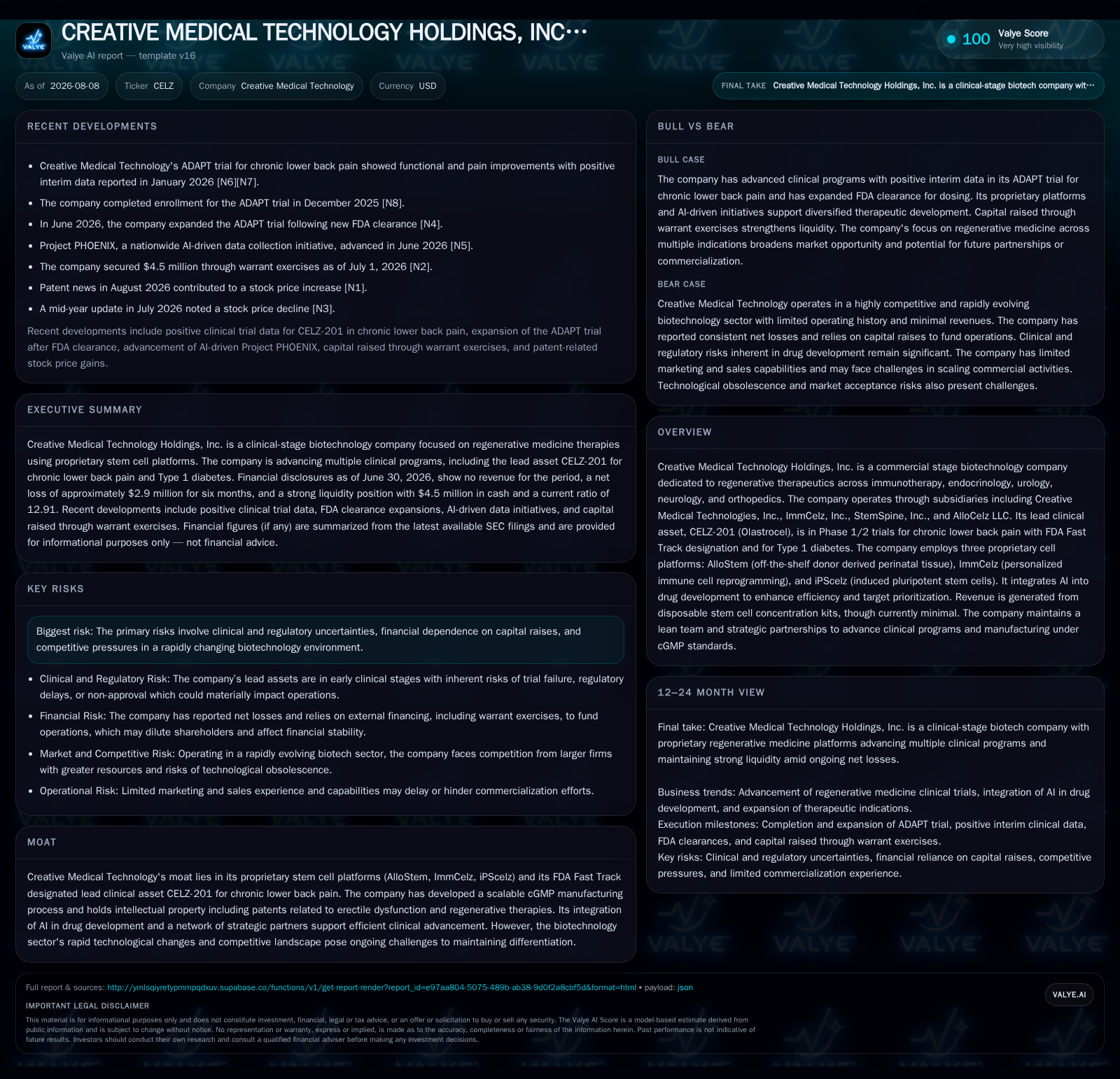
Creative Medical Technology Holdings operates proprietary stem cell therapy platforms targeting multiple indications, including its lead asset CELZ-201 with FDA Fast Track designation. The latest 10-Q underscores ongoing clinical trials, minimal current revenues from stem cell kits, and limited sales infrastructure amid tight capital resources. While its intellectual property portfolio and AI integration underpin differentiation, financial sustainability remains constrained by operating losses and modest liquidity. Key near-term milestones include clinical trial enrollment progress and regulatory milestones that will validate pipeline advancement.
Recent Operating Update: Clinical Progress Under Capital Constraints
Creative Medical Technology Holdings' latest quarterly report dated August 7, 2026 ([S2]) provides insight into the company's operational status within its regenerative therapeutics focus. The company maintains active Phase 1/2 clinical trials for its lead product CELZ-201 (Olastrocel) targeting chronic lower back pain—granted FDA Fast Track designation—and for Type 1 diabetes. Continued dosing of patient cohorts in these trials reflects deliberate progress despite the early developmental stage typical of regenerative biotechnology. However, revenue remains minimal and derived mainly from the limited sales of autologous stem cell concentration kits used in physician-administered procedures ([S1], [S20]). The report signals that CELZ is competing in a technologically dynamic environment where marketing efforts are hampered by limited capital allocation to sales operations and lack of an established sales force ([S2]). This duality—clinical advancement paired with operational cash constraints—frames the near-term strategic challenge.
In a complementary update via an 8-K filing on July 2, 2026 ([S3]), CELZ disclosed inducement warrants tied to private placement transactions dependent on stockholder approvals for exercise. These financing measures reflect ongoing efforts to bolster liquidity without relying exclusively on conventional capital markets during marketplace uncertainties. Nevertheless, practical financial limits may delay or restrict marketing scale-up efforts necessary to convert investigational therapies into commercial revenue streams.
Business Model: Proprietary Cell Platforms and Minimal Commercial Revenues
CELZ’s business model centers on developing regenerative medicine therapies leveraging three proprietary cell therapy platforms: AlloStem (off-the-shelf perinatal donor tissues), ImmCelz (personalized immune cell reprogramming), and iPScelz (induced pluripotent stem cells) ([S1], [S20]). These platforms collectively target a range of therapeutic areas—immunotherapy, endocrinology, urology, neurology, orthopedics—with the aim to address chronic diseases typically underserved by conventional small-molecule or biologic drugs.
Revenue generation is currently limited to the sale of disposable kits designed for autologous stem cell concentration procedures administered by physicians ([S20], [S25]). Given the nascent stage of these commercial activities and the company’s thin sales infrastructure coupled with tight marketing budgets ([S2]), top-line growth from direct product sales is minimal to date. The core value proposition rests in advancing CELZ-201 through regulatory milestones supported by FDA Fast Track designation which potentially accelerates clinical trial timelines and market entry under expedited review pathways.
Monetization beyond kit sales is anticipated through successful clinical development culminating in regulatory approvals followed by direct commercialization or strategic licensing arrangements. The company also aims to validate its immune cell reprogramming technology as a scalable solution capable of penetrating damaged tissues more effectively than traditional stem cells due to smaller cell size ([S20]).
Industry Structure and Competitive Position
The regenerative medicine sector is marked by high R&D intensity with prolonged clinical development timelines combined with stringent regulatory scrutiny. Market incumbents such as Mesoblast, Athersys, and Fate Therapeutics exemplify companies balancing pipeline breadth with manufacturing scalability under cGMP conditions to satisfy quality standards required for therapeutic use.
Within this competitive milieu, CELZ’s differentiated positioning stems from its diversified platform approach integrating immune cell reprogramming alongside iPSC-based technologies—a domain witnessing rapid innovation compounded by increasing AI-driven drug discovery applications that optimize target validation and preclinical workflows ([S1]). Its substantial patent holdings related to erectile dysfunction treatment bolster its intellectual property moat but must be continuously expanded in light of technological obsolescence risks inherent to biotech fields ([S6]).
However, compared with larger peers investing heavily in commercialization capabilities, CELZ’s limited marketing reach constrains immediate revenue diversification. This gap heightens dependency on successful clinical development outcomes to add strategic partnering or licensing optionality requisite for scaling deployments.
Growth Drivers
Key growth drivers for Creative Medical Technology include:
- Clinical Advancement: Positive enrollment progression in CELZ-201 Phase 1/2 trials serving as a critical validation step toward market authorization.
- Regulatory Incentives: FDA Fast Track designation facilitates expedited review enhancing time-to-market prospects.
- Platform Innovation: Ongoing research validating immune cell reprogramming efficacy offers potential expansion across multiple disease indications.
- AI Integration: Utilization of artificial intelligence in drug development aims to accelerate discovery pipelines and optimize resource allocation.
- Strategic Capital Raises: Incremental financing via warrants supports sustained R&D activity while bridging liquidity needs.
Success against these drivers is confirmed through key performance indicators such as accelerated clinical trial enrollment rates documented by independent safety boards endorsements ([S24]), milestone completions recognized under FDA frameworks, research expenditure trends aligned with pipeline initiatives ([S17]), and contractual collaborations facilitating co-development or IP licensing.
Risks and Watchpoints
Creative Medical Technology faces numerous execution risks typical within regenerative biotech. Principal among them are:
Monitoring these factors requires attention to cash burn rates relative to capital availability, progress updates on clinical endpoints including patient dosing completion dates, patent filings or grants expanding coverage areas, and any joint ventures or partnerships signaling enhanced resource access.
What To Watch Next
Key near-term milestones shaping Creative Medical Technology’s trajectory include:
- Completion of current patient cohorts in CELZ-201 ADAPT (chronic lower back pain) and CREATE-1 (Type 1 diabetes) Phase 1/2 studies with subsequent data readouts guiding regulatory strategy decisions.
- Achievement of additional regulatory interactions with FDA aiming toward potential Breakthrough Therapy designations or accelerated pathways enhancing approval probability.
- Execution of warrant exercises or other financing transactions sustaining research momentum amid restricted cash resources highlighted by current assets-to-liabilities ratio approximating 13x but limited absolute cash balances ([F1], [S2]).
- IP portfolio enhancements perhaps following recent patent news excitement reported publicly contemporaneously with stock price gains indicating market recognition of underlying technology strength [N1].
- Strategic partner announcements potentially unlocking licensing revenues or development cost-sharing benefits alleviating financial pressure.
Developments on these fronts will materially influence enterprise valuation paradigms typical for biotech firms at comparable lifecycle stages where commercial proof points remain aspirational rather than realized.
Financial Profile Discussion
Despite some operational progressions reported up through mid-2026 filings ([S2]), Creative Medical Technology’s latest balance sheet reflects an enterprise still firmly pre-commercial. Total current assets stood at about $9 million versus current liabilities below $700 thousand as of June 30, 2026 yielding a strong current ratio near 12.9x that suggests short-term liquidity adequacy but masks absolute funding limitations given the low cash equivalents relative to ongoing R&D costs ([F1]). Total debt remains negligible around $27 thousand historically without substantive new borrowing reported recently ([F1]).
Operating losses continue reflecting significant expenses dedicated to research activities supporting multiple cell therapy platforms along with administrative overhead needed to maintain corporate functions. Minimal revenues primarily connected with disposable kit sales offer little margin contribution at this stage. Capital inflows have been augmented intermittently through warrant exercises as disclosed in July filings providing modest incremental funding buffers but highlighting continuing dependence on equity-related financings rather than sustainable operational cash flow generation ([N3], [S3]).
Accordingly, financial sustainability hinges on balancing R&D spend pacing relative to available capital while strategically prioritizing programs likely to deliver compelling clinical milestones that unlock downstream revenue streams or attract partnership investments essential for operational scaling beyond bench-to-bedside transitions.
This analysis synthesizes publicly filed SEC documents along with sector contextual knowledge relevant to biotechnology companies focused on regenerative medicine. It does not constitute investment advice but aims to elucidate company-specific developments within prevailing industry dynamics.
Disclaimer: This is research-only, informational analysis and not investment advice. It may include AI-generated interpretation and general industry context. Always verify important details using primary sources.

Comments