
Rubber Leaf Inc’s Strategic Restructuring Streamlines Sealing Component Supply Amid Market Competition
Recent restructuring refocuses Rubber Leaf on Hong Kong-based sales operations with stable OEM partnerships despite legacy risks.
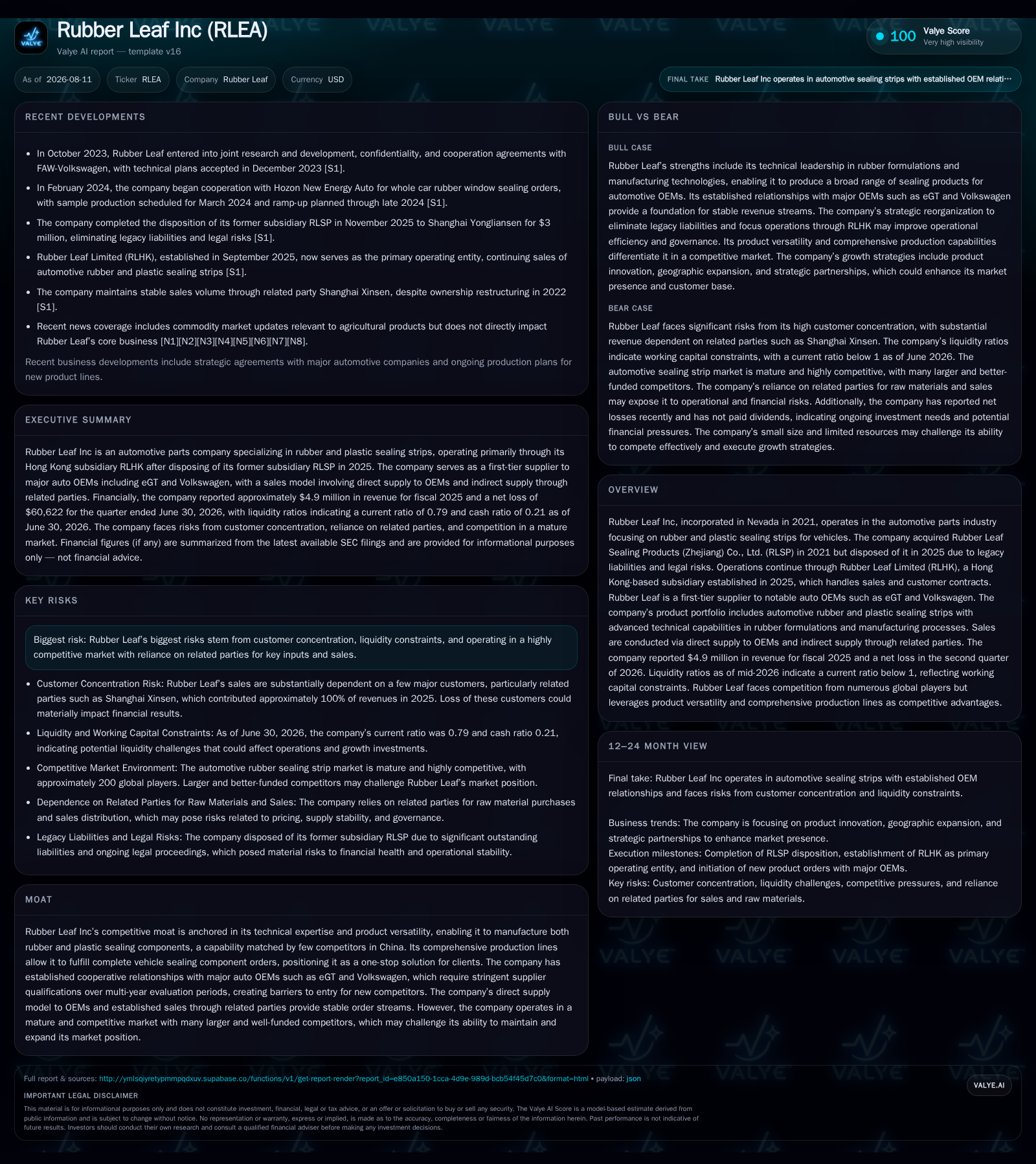
Rubber Leaf Inc navigated a significant corporate restructuring in 2025, disposing of its PRC manufacturing subsidiary burdened by legacy liabilities and transferring operations to Rubber Leaf Limited in Hong Kong. This move effectively isolates regulatory and legal risks while preserving first-tier supplier relationships with major auto OEMs such as eGT and Volkswagen. The company’s niche technical capability to produce both rubber and plastic sealing strips positions it uniquely in a mature, competitive automotive components market. However, revenue remains modest at $4.9 million for fiscal 2025 with ongoing net losses, and customer concentration and liquidity constraints represent key challenges. Future growth depends on expanding the customer base, managing supply chain efficiencies, and maintaining OEM qualification status.
Recent Operating Update
Rubber Leaf Inc’s latest quarterly filing dated August 10, 2026, confirms that following its November 2025 disposition of Rubber Leaf Sealing Products (Zhejiang) Co., Ltd. (RLSP), the company now conducts principal operations through its wholly owned Hong Kong subsidiary, Rubber Leaf Limited (RLHK) [S2][S13]. This strategic divestiture was executed to isolate substantial legacy liabilities and legal risks tied to RLSP. By shifting commercial activities—including customer contracts and supply arrangements—to RLHK established only months earlier in September 2025, Rubber Leaf effectively reset its operational platform free from historical encumbrances while retaining continuity with established customers [S1][S13].[S6]
No material cash transfers between RLSP and parent occurred prior to the sale, and no dividends have been paid either from RLSP or RLHK to the parent company or investors since inception [S5]. This highlights a cautious capital allocation approach focused on conserving resources to fund R&D and production capacity expansion rather than returning capital [S9][S28].
Business Model
Rubber Leaf operates as a first-tier automotive components supplier specializing in rubber and plastic sealing strips integral to vehicle vibration damping, sound insulation, and environmental protection during assembly. Its direct sales model involves securing OEM qualification—requiring rigorous on-site inspections—enabling Rubber Leaf to supply finished products directly into OEM warehouses such as those of eGT and Volkswagen under formal purchase contracts [S1][S20]. This positions Rubber Leaf as a critical link in the OEM’s supply chain with responsibility spanning raw material procurement, subcontracted manufacturing oversight, final quality assurance, and logistics.
The company also functions through an indirect supply model involving related parties Shanghai Xinsen Import & Export Co., Ltd. and Xinsen Sealing Products (Hangzhou) Co., Ltd., which together form the "Xinsen Group." These related entities place purchase orders fulfilled by Rubber Leaf operating units either via outsourced subcontractors or internal processing steps before final acceptance by upstream first-tier suppliers of Xinsen Group customers [S7][S20]. Revenue recognition under this model occurs upon invoice issuance post-qualified delivery acceptance by Xinsen Group customers.
Technically, Rubber Leaf distinguishes itself by offering a comprehensive production line capable of manufacturing all rubber and plastic sealing components required per vehicle assembly—unlike most competitors focusing narrowly on one material type alone. This versatility affords customers a one-stop sourcing option facilitating order consistency across sealing parts [S24]. The company leverages proprietary technical formulations to meet demanding automotive quality standards driving repeat OEM contracts.
Industry Structure and Competitive Position
The automotive sealing components sector is highly mature with over 200 global companies competing across rubber and plastic segments. Industry giants like Trelleborg, Hutchinson, and Parker Hannifin dominate via global scale advantages, advanced materials technology investments, integrated production lines, broad OEM networks, and extensive quality certifications.
Rubber Leaf’s smaller scale constrains its ability to compete purely on price or breadth but its product versatility creates a niche moat appealing to OEMs seeking integrated sealing component solutions under single-sourced contracts. Supplier qualification barriers imposed by blue-chip OEMs such as Volkswagen provide some protection against new entrants but require continuous innovation investments especially given evolving vehicle architectures including electric vehicles demanding specialized sealants for battery compartments.[S24]
Customer concentration remains a concern; substantial reliance on Shanghai Xinsen Group for indirect sales alongside limited diversification among direct OEM customers increases revenue volatility risk amid industry-wide pricing pressures from larger competitors requiring aggressive operational efficiency improvements [S7][F1].[S24]
Growth Drivers
Growth prospects hinge on expanding automotive production in emerging markets where vehicle unit volume climbs amid rising income levels—a trend expected to outpace mature markets beyond 2023 according to economic forecasts referenced by management [S1]. Increasing vehicle complexity raises demand for advanced sealing solutions integrating environmental friendliness compliant with stricter regulations on emissions noise pollution.
Technological innovation in rubber/plastic formulations could enhance product differentiation supporting multi-year OEM contracts renewing at favorable price points sensitive to quality yield improvements and defect rate reductions—key KPIs governing supplier retention.
The company's expanded focus on its Hong Kong-based subsidiary aims to enhance governance controls and operational efficiency vital for scaling capacity without inheriting problematic legacy liabilities that previously constrained growth resources [S6].[S24]
Emerging demand avenues include specialized seals required for electric vehicles’ battery packs or autonomous vehicles requiring advanced vibration damping materials that meet new performance standards presenting opportunities for targeted R&D investments.
Risks and Constraints
Rubber Leaf faces pronounced risks related to:
- Customer concentration: Heavy dependence on related parties for bulk sales heightens revenue risk should these relationships weaken or contracts not renew [S7].
- Legacy liabilities: While disposition of RLSP limits risk exposure to past legal proceedings, residual reputational or contractual consequences could linger indirectly affecting supplier trust.
- Liquidity constraints: The company reported a current ratio below one at 0.79 as of June 2026 alongside limited cash reserves near $2.2 million posing constraints against capital expenditures or scaling requirements absent additional financing sources [F1].
- Competitive pressures: Larger peers' cost advantage may constrain pricing flexibility underscoring need for continuous process improvement.
- Regulatory uncertainty: Operating mainly through Hong Kong shields some PRC regulatory risks; however evolving laws governing data privacy, cybersecurity compliance or export controls remain potential disruptors requiring monitoring [S12][S25].
- Key personnel dependency: The company is heavily reliant on founder CEO Xingxiu Hua whose leadership continuity affects strategic stability given no key-man insurance coverage disclosed [S1].
What To Watch Next
Key near-term milestones include:
- Stability or growth in order backlog from first-tier OEM partners eGT and Volkswagen as leading demand indicators.
- Execution effectiveness of RLHK operational expansion plans including capacity utilization improvements without triggering liquidity stress.
- New contract awards or renewals expanding customer base beyond existing related party networks.
- R&D progress targeting innovative material formulations suitable for electric/autonomous vehicles enhancing competitive positioning.
- Management commentary on market conditions impacting raw material prices—primarily rubber/plastic feedstocks—and resulting margin impact.
- Any regulatory developments influencing cross-border trade or compliance costs affecting Hong Kong subsidiary operations.
Financial Profile Discussion
The balance sheet reveals liquidity tensions evidenced by a current ratio below 1 (0.79) at June 30, 2026 due principally to current liabilities exceeding current assets considerably ($10.8 million versus $8.5 million) raising concerns about short-term financial flexibility without external funding access or improved cash flows.[F1] Modest cash balances at approximately $2.2 million suggest tight day-to-day working capital management is crucial moving forward.[F1]
Capital expenditure prioritization appears focused firmly toward research & development plus incremental capacity increase rather than dividend distributions reflecting early-growth stage reinvestment strategy confirmed by management commentary; no dividends are planned near term [S9][S28]
Overall financial posture signals continuing need for prudent cash flow management aligned with operational scaling efforts raising focus on working capital KPIs such as inventory turnover rates, receivables collections efficiency, and procurement lead times that materially affect margin sustainability.
This analysis synthesizes the latest SEC filings alongside industry context but avoids speculative claims unsupported by explicit evidence provided by Rubber Leaf’s disclosures or validated market intelligence. The views expressed herein are informational only with no investment advice intended.
Disclaimer: This is research-only, informational analysis and not investment advice. It may include AI-generated interpretation and general industry context. Always verify important details using primary sources.

Comments