
Harrow, Inc. Expands Ophthalmic Portfolio Amid Pricing and Regulatory Challenges
Harrow's latest quarter reflects strategic product launches and pipeline advances tempered by reimbursement pressures in the U.S. ophthalmic pharmaceutical sector.
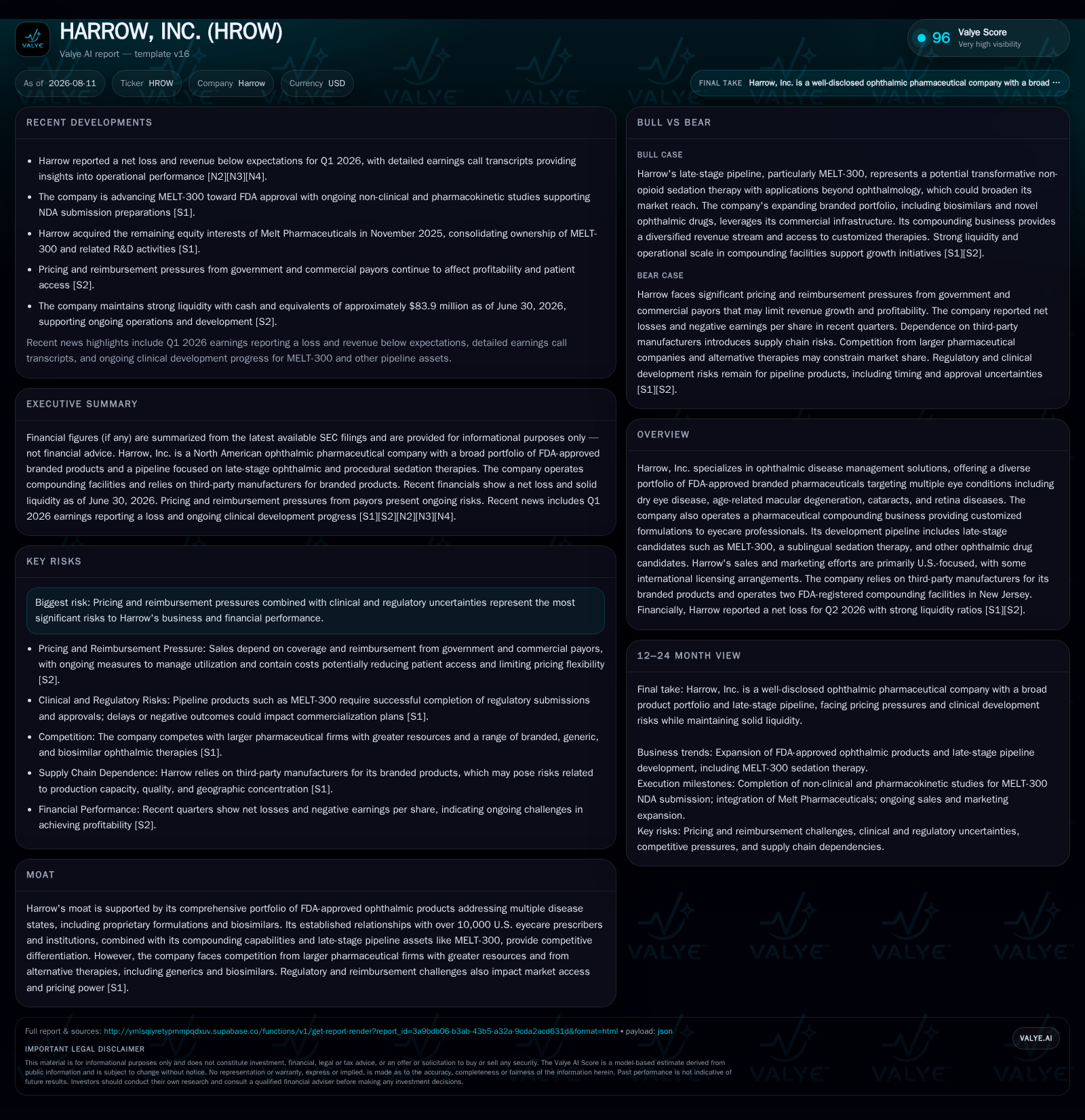
In Q2 2026, Harrow, Inc. reported ongoing investment in its branded ophthalmic pharmaceuticals portfolio with new biosimilar launches planned and a deepening pipeline including the MELT-300 sublingual sedation therapy. The company’s business model mixes sales from FDA-approved branded products with revenue from pharmaceutical compounding services aimed at eyecare professionals. Harrow's competitive position relies on its broad product range and late-stage assets but faces headwinds from intensified pricing and reimbursement pressures, regulatory risks, and legal contingencies. Growth drivers include aging demographics, innovative product development, and international licensing agreements. Monitoring commercial ramp of biosimilars BYOOVIZ and OPUVIZ, along with evolving reimbursement policies, will be crucial indicators of Harrow’s trajectory.
Recent Operating Update
In its Q2 2026 filing dated August 10, 2026, Harrow, Inc. disclosed progress on multiple fronts including the commercial launch preparations for BYOOVIZ (ranibizumab-nuna) launched mid-2026 as the first FDA-approved Lucentis biosimilar for treatment of wet age-related macular degeneration (AMD) and related retinal indications. This complements the upcoming planned mid-2027 launch of OPUVIZ (aflibercept-yszy), an Eylea biosimilar targeting a wider diabetic eye disease spectrum [S2][S1]. The addition of these biosimilars to Harrow’s portfolio reflects a strategic expansion into high-value ophthalmic treatment segments traditionally dominated by innovator biologics.
Concurrently, Harrow continues to operate two FDA-registered compounding facilities located in New Jersey enabling it to provide tailored formulations where commercial products may not meet specific patient needs or prescribing preferences. Such customization allows Harrow to serve a specialized niche within eyecare professional practices that demand unique compositions beyond standard approved pharmaceuticals [S1][S14].
However, the company faces persistent headwinds due to intensifying reimbursement challenges across U.S. government payors including Medicare Part B. Legislative initiatives such as international reference pricing models and the Inflation Reduction Act have introduced greater scrutiny on drug costs. Payer restrictions—step edits, prior authorizations, formulary constraints—and pricing pressures continue to limit patient access and compress margins on branded products despite their clinical utility [S2]. These dynamics are critical constraints given that Harrow’s customer base consists chiefly of U.S.-based eyecare professionals reliant on third-party payor coverage.
Business Model Analysis
Harrow’s model integrates two principal revenue streams: direct sales of FDA-approved branded ophthalmic pharmaceuticals to eyecare-focused distributors that serve clinical practices and institutions; alongside revenues derived from its compounding subsidiary ImprimisRx which prepares non-FDA approved but clinically necessary customized formulations often on a cash-pay basis [S11][S14]. The branded portfolio includes agents addressing anterior segment conditions like dry eye disease (VEVYE) and ocular surface anesthesia (IHEEZO), as well as posterior segment diseases treated by injectables such as TRIESENCE steroid suspension.
A distinctive aspect is the company’s incorporation of biosimilar offerings targeting biologic blockbuster drugs used in retinal diseases—the fastest growing segment driven by demographic shifts toward aging populations with diabetes and AMD prevalence rising sharply. By owning the U.S. commercial rights to proprietary technologies such as BYOOVIZ and OPUVIZ biosimilars coupled with earlier stage assets like BYQLOVITM corticosteroid formulated via proprietary nanoparticle technology for post-surgical inflammation, Harrow aims to leverage existing commercial infrastructure while addressing multiple ophthalmic disease states [S1]
Sale channels predominantly involve third-party distributors who resell to pharmacies servicing eyecare providers; this creates dependency on effective distribution networks alongside successful physician education campaigns essential for adoption of newer therapies. Market access is heavily influenced by third-party reimbursement policies impacting pricing flexibility.
Industry Structure and Competitive Position
Within the ophthalmic pharmaceuticals sector—which spans treatments ranging from dry eye to complex retinal disorders—Harrow occupies a mid-tier role combining branded product marketing with pharmaceutical compounding capabilities. Competitors range from large diversified firms such as Bausch + Lomb or Alcon possessing broad portfolios and established global reach to biosimilar developers focusing exclusively on biologics.
Harrow's moat derives from its portfolio breadth including multiple FDA-approved agents across front- and back-of-eye conditions backed by intellectual property rights in nanoparticle formulation technologies and biosimilar approvals that facilitate market entry against expensive innovator drugs [S1]. Its established relationships with over 10,000 U.S. eyecare prescribers underpin physician adoption potential.
However, competition is keen particularly from generic manufacturers offering low-cost alternatives and biopharma companies endorsing novel agents potentially changing standard-of-care treatment algorithms. Further challenges arise from evolving regulatory landscapes governing compound pharmacy operations which require continuous compliance investments.
Growth Drivers
Key industry tailwinds supporting Harrow’s growth include the increasing prevalence of ophthalmic diseases driven by an aging population with higher incidences of dry eye syndrome, macular degeneration, diabetic retinopathy, cataracts, glaucoma, and other retinal pathologies. This drives demand for both branded therapies and personalized compounded treatments where commercial products lack flexibility.
Technological advancements in drug delivery vehicles—such as water-free ophthalmic solutions used in VEVYE or novel nanoparticle suspensions exemplified by BYQLOVITM—enhance product differentiation potentially improving patient adherence through reduced dosing frequency or better tolerability. The commercial rollout of first-to-market biosimilars addressing costly biologics expands treatment accessibility while tapping into sizeable markets constrained by price sensitivity.
Moreover, international licensing deals broaden geographic reach beyond North America where unmet needs persist amid varying regulatory regimes increasing upside potential if successfully executed. R&D investment continues as underlying late-stage pipeline candidates like MELT-300—an innovative sublingual sedation therapy acquired through Melt Pharmaceuticals—offer diversification beyond ophthalmology into sedation therapeutics for broader clinical use [S1].
Risks and Watchpoints
Pricing and reimbursement remain paramount risks amidst an environment marked by government efforts to reduce drug costs via measures enacted under the Inflation Reduction Act affecting Medicare drug pricing structures [S2][S19]. Proposed policies referencing international drug prices risk further downward pressure on manufacturer revenues particularly for injectables reimbursed under Medicare Part B which comprise significant portions of Harrow’s biologic biosimilar sales base
Regulatory risks extend to compounding operations where state-level restrictions or federal enforcement actions could limit business scope or increase compliance costs adversely affecting profitability. Physicians’ reluctance to prescribe compounded formulations due to legal limitations on efficacy communications or inconsistent insurance coverage constrains volume growth [S21]
Intellectual property litigation is another consideration highlighted by ongoing appeals following a multi-million dollar judgment involving ImprimisRx subsidiary against OSRX competitors that has yet to be monetized given pending appeals but poses contingent liabilities [S1][S13]. Competition from larger pharma firms with deeper marketing resources creates ongoing market share pressure.
What to Watch Next
Critical near-term milestones include monitoring the uptake pace for BYOOVIZ since mid-2026 launch relative to established Lucentis prescriptions—the rate at which physicians substitute brand-name biologics with biosimilars will signal market acceptance important for scaling revenues.
Successful commercial preparation for OPUVIZ rollout in mid-2027 will also be pivotal given EYLEA’s entrenched position in treating a broader spectrum of retinal diseases including diabetic macular edema.
Regulatory developments regarding Medicare Part B demonstration projects like GLOBE or GUARD involving international reference pricing frameworks deserve close attention as policy shifts could materially reshape reimbursement scenarios impacting all ophthalmic biologics players.
Additionally, execution against MELT-300 regulatory approvals and commercialization outcomes would diversify revenue beyond traditional eye care but require navigating separate clinical trial endpoints.
Financial Profile Discussion
As of June 30, 2026, Harrow held cash and equivalents totaling approximately $83.9 million against total debt around $300 million resulting in net debt near $216 million indicating leveraged positioning supportive of ongoing R&D investment but requiring prudent capital management [F1]. The current ratio stands at a healthy 2.24 reflecting sound short-term liquidity sufficiency relative to current liabilities [$102 million] [F1].
Though the company reported a net loss most recently attributable partly to elevated sales & marketing expenditures supporting new product launches plus continued R&D costs linked to pipeline development [F1], such spending aligns with foreseeable growth strategies within specialized pharmaceutical sectors where upfront investment precedes scale economies.
Continued operational focus will likely emphasize improving gross margins on branded products through scale gains while managing cost structure inherent in maintaining dual business segments: branded pharmaceuticals plus specialized compounding services.
This analysis incorporates publicly filed SEC documents through August 10, 2026, alongside industry sector expertise contextualizing ophthalmic pharmaceuticals’ commercial dynamics relevant to Harrow's positioning. This report is intended solely for informational purposes without constituting investment advice.
Disclaimer: This is research-only, informational analysis and not investment advice. It may include AI-generated interpretation and general industry context. Always verify important details using primary sources.

Comments