
First Commonwealth Financial Reports Stable Q2 Amid Regional Banking Pressures
Regional bank managing interest rate volatility and credit risk maintains liquidity and profitability in Q2 2026.
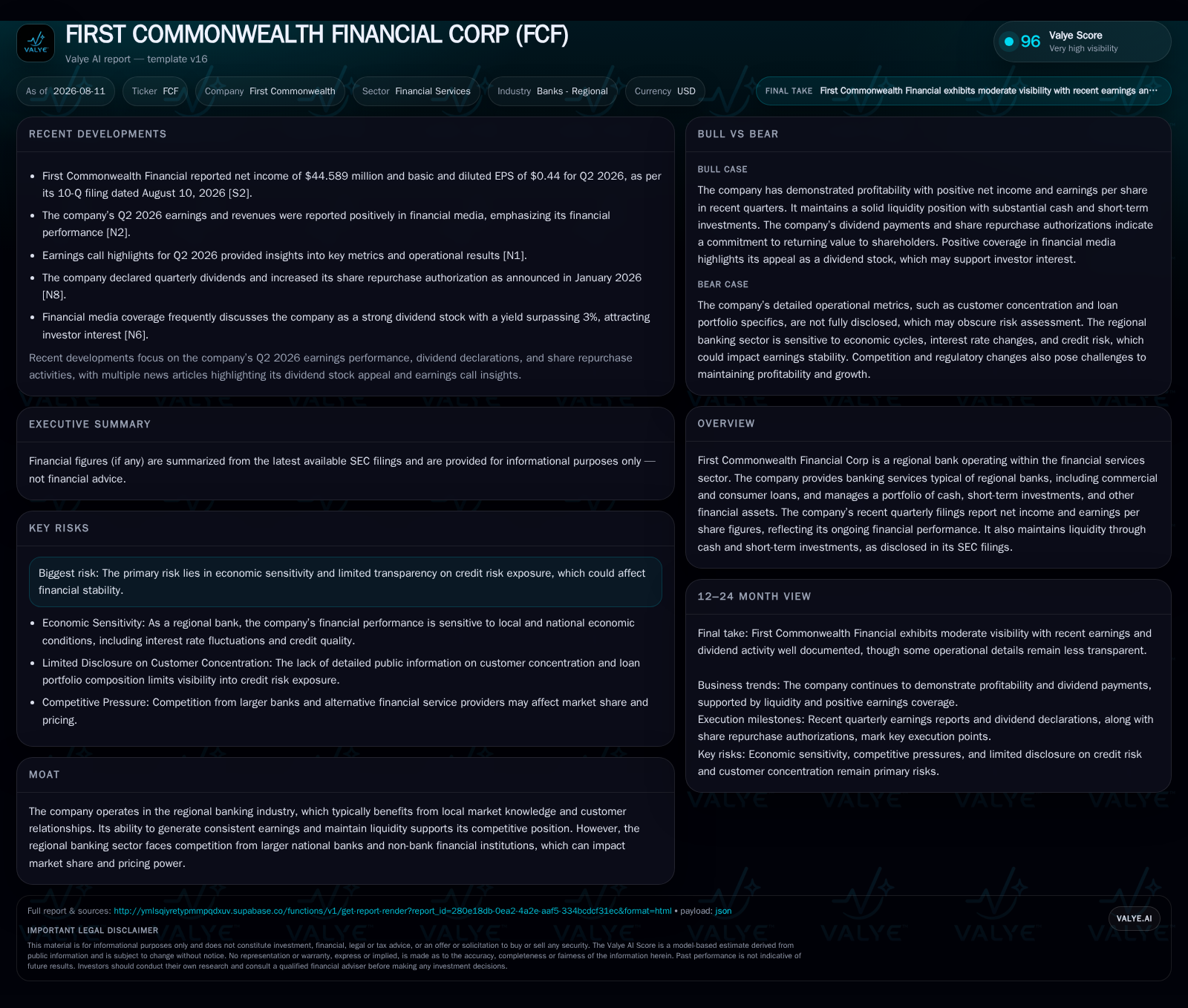
First Commonwealth Financial Corp, a regional bank focused on community banking in Pennsylvania and Ohio, reported a stable operating quarter ending June 30, 2026. The company continues to generate net interest income through a diversified loan portfolio while managing asset quality and liquidity prudently. Despite regulatory and economic headwinds typical of regional banks, First Commonwealth sustains competitive positioning through local market knowledge and effective cybersecurity oversight. Key risks remain credit exposure sensitivity and pressure from larger national banks and non-bank fintech competitors.
Recent Operating Update: Q2 2026 Financials Reflect Stability during Sector Challenges
First Commonwealth Financial Corp’s latest 10-Q filing for the quarter ended June 30, 2026 highlights consistent financial performance despite ongoing sector headwinds faced by regional banks [S2][N2]. The company reported sustained net income supported principally by net interest income generated from its lending activities across commercial, consumer, and real estate segments. This reflects prudent management of the net interest margin (NIM), which remains a critical profitability lever given the prevailing interest rate volatility impacting many regional lenders.
Business Model: Community-Centric Lending Driving Net Interest Income
As a regional bank, First Commonwealth operates primarily through its community banking network comprising 126 offices—most owned rather than leased—which facilitates deep local customer relationships essential for screening credit risk and cross-selling services [S1]. Its business model relies heavily on generating net interest income as the main revenue source: the difference between interest earned on loans/securities and interest paid on deposits/borrowings.
The loan portfolio spans commercial loans (including owner-occupied commercial real estate), residential real estate loans (senior and junior liens), construction financing, consumer loans (including automobile financing), and credit card receivables. This diversified lending mix helps modulate concentration risks while catering to small- and medium-sized businesses alongside individual consumers within its service regions [S1][S2].
Fee-based revenues from deposit accounts, wealth management subsidiaries, insurance products, and advisory services complement core lending. However, these streams constitute a smaller portion compared to peer regional banks with broader non-interest income diversification.
Industry Structure and Competitive Positioning
The regional banking sector revolves around locality advantage—embedding institutions within community ecosystems to build durable customer loyalty that contrasts with national banks’ scale but less personalized footprint. First Commonwealth's competitive strength lies in its entrenched presence in Pennsylvania's mid-market cities plus expanding Delaware County footprints in Ohio.
Nonetheless, it contends with intensified competition from national commercial banks like Huntington Bancshares or M&T Bank that offer wider product portfolios backed by technology-enabled platforms. Moreover, non-bank fintech lenders increasingly disrupt traditional credit origination channels by providing faster underwriting or specialized digital products directly to consumers or small businesses.
Against this backdrop, maintaining asset quality through rigorous underwriting standards combined with steady deposit growth funded by community trust forms an essential moat approximation for First Commonwealth. Additionally, active cybersecurity governance driven by board-level oversight serves as a crucial operational safeguard amidst increasing cyber threats targeting financial institutions [S1].
Growth Drivers
Principal avenues for growth include:
- Expanding the loan portfolio selectively within core commercial real estate and consumer segments aligned with regional economic conditions.
- Enhancing deposit base growth via local market penetration enabled by branch network stability along with modest organic customer acquisition.
- Augmenting fee income streams through cross-selling complementary services such as insurance agency offerings and advisory products.
- Leveraging favorable interest rate environments to boost net interest margins while remaining vigilant on funding cost dynamics.
- Pursuing disciplined acquisitions or branch purchases of smaller entities culturally aligned with First Commonwealth’s business ethos to increase geographic coverage without diluting operational focus [S1][N1].
- Investing in digital banking tools bolstering customer engagement yet balancing efficiency improvements against legacy infrastructure expenses.
Tracking KPIs such as loan growth rate relative to deposit expansion (loan-to-deposit ratio), NIM trends against regionals peers like Regions Financial or Huntington Bancshares provides useful benchmarks.
Risks / Watchpoints / Growth Constraints
Key risks shaping the outlook encompass:
- Interest rate risk could compress NIM if deposit-related funding costs increase disproportionately or if loan repricing lags benchmark hikes.
- Credit risk exposure heightened by adverse local economic trends or borrower weaknesses impacting non-performing loans ratio could prompt higher provisions [S2].
- Regulatory burden escalation including prescribed capital ratios or compliance standards might strain operational flexibility or inflate costs.
- Competitive pressure from larger national banks leveraging scale efficiencies or fintech innovations eroding market share particularly among younger demographics.
- Liquidity risk arising from unexpected deposit outflows or market disruptions challenging cash reserve adequacy.
- Government shutdowns potentially hindering federal-backed lending programs or dampening borrower incomes connected to government contracts translating into credit losses or muted loan demand [S1].
- Shifts in consumer behavior towards digital platforms reducing physical branch foot traffic necessitate costly adaptation strategies balancing channel economics versus client retention.
- Risks associated with acquisitions involve integration challenges including cultural fit, realization of synergies, unexpected liabilities affecting earnings per share dilution prospects [S1].
- Operational risks around cybersecurity attacks remain ever-present although robust governance mechanisms are in place currently preventing material incidents over past three years [S1].
What to Watch Next
Investors should monitor quarterly updates focusing on:
- Quarterly net interest margin trajectory reflecting interplay between prevailing rate cycles and funding mix adjustments.
- Loan growth figures vis-à-vis deposit trends signaling demand strength or funding challenges.
- Provision for credit losses changes uncovering shifts in asset quality amidst evolving regional economic indicators.
- Non-interest income development especially fee diversification progress impacting overall revenue resilience over cyclical swings.
- Updates related to any merger & acquisition activities including announced terms or integration progress signals.
- Regulatory capital levels particularly tier 1 capital ratios informing lending capacity and compliance status.
- Management commentary on digital transformation investments balancing customer acquisition gains against potential cost inflation.
Collectively these markers will clarify whether First Commonwealth can sustain returns amid intensifying sector pressures while navigating local economic nuances prudently.
Financial Profile Discussion
Capital allocation priorities appear geared towards supporting organic loan book growth financed primarily through stable deposits supplemented by low-cost borrowings rather than expensive wholesale funding sources—a standard approach aligning with best practices amongst peer midsize regional banks.
Overall financial dynamics reflect a stable regional bank navigating complex economic conditions while leveraging localized expertise combined with prudent risk management frameworks to maintain competitive viability into future periods.
This analysis synthesizes SEC filings dated August 10, 2026 (Form 10-Q), July 31, 2026 (8-K), March 2, 2026 (10-K), complemented by recent earnings call summaries reported on Nasdaq.com. It situates First Commonwealth Financial Corporation within broader U.S. regional banking sector dynamics emphasizing key operating variables germane to stakeholders evaluating ongoing financial condition without offering investment advice.
Disclaimer: This is research-only, informational analysis and not investment advice. It may include AI-generated interpretation and general industry context. Always verify important details using primary sources.

Comments