
Rackspace Technology Embeds AI in Managed Cloud Offerings While Managing Liquidity Pressures
Rackspace's Q2 results highlight strategic AI investments paired with operational challenges in a competitive managed cloud landscape.
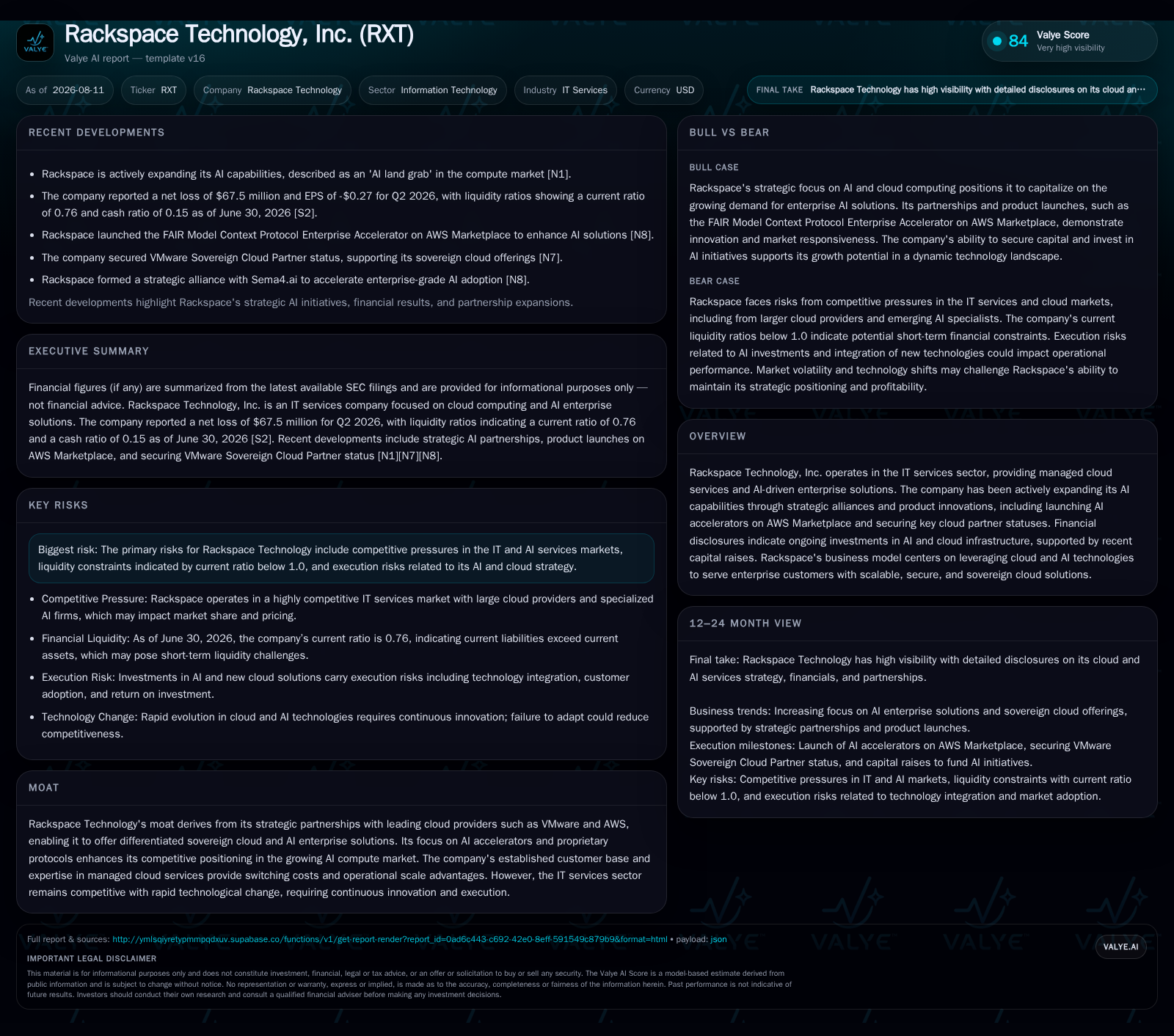
Rackspace Technology’s latest quarterly filing underscores a pivot toward AI-driven enterprise solutions alongside conventional managed cloud services, supported by strategic alliances with hyperscale providers. Despite cutting full-year guidance, the company is actively investing in AI accelerators and sovereign cloud capabilities to differentiate itself in a rapidly evolving IT services sector. Financially, liquidity constraints and ongoing losses reveal execution risks amid aggressive growth initiatives. Monitoring recurring revenue trends and execution on AI integration will be key to assessing sustainability.
Recent Operating Update
Rackspace Technology’s second quarter ended June 30, 2026 results reflected a mix of cautious optimism over revenue growth tempered by profitability challenges inherent in its agility investments. The company guided Q2 revenue between $641 million and $649 million, segmented between approximately $242-$246 million from Private Cloud services and $399-$403 million from Public Cloud offerings [S25]. This mix illustrates Rackspace's role as a hybrid managed cloud provider catering to enterprises requiring both bespoke private environments and scalable public cloud capabilities.
Losses persist on a GAAP basis, with an operating loss forecast of $(53) million to $(33) million for the quarter; however, non-GAAP metrics adjusted for restructuring, intangible amortization, and stock-based compensation projects a positive operating profit range of $19 to $23 million [S13]. Adjusted EBITDA is expected within $58-$62 million. These financials convey ongoing transformation costs tied to repositioning towards AI-enabled cloud services while maintaining legacy operations.
Critical to near-term strategy is Rackspace's pursuit of AI integration through launching AI accelerators on platforms like AWS Marketplace and securing privileged partner statuses with hyperscale providers such as VMware [S1]. This reinforces the company's ambition to capture emerging demand for AI compute enablement atop managed cloud infrastructure—a sector growing amid broad enterprise digital transformations.
Business Model Analysis
Rackspace operates primarily as a managed cloud service provider positioned between hyperscale public cloud infrastructure (AWS, Microsoft Azure) and large enterprises seeking flexible IT outsourcing with higher-touch service models. Its revenue mechanics combine recurring managed services contracts generating Annual Recurring Revenue (ARR) with professional services fees for consulting, migration, and integration.
The company’s emerging revenue stream targets value-added AI offerings that tap customer demand for workload automation and data analytics acceleration. Monetization involves usage-based billing through AI accelerator deployment alongside traditional subscription fees associated with sovereign cloud environments designed for clients facing stringent regulatory compliance.
Switching costs arise from proprietary protocols built into their sovereign cloud solutions as well as operational scale benefits in managing complex hybrid IT environments. Strategic partnerships amplify this positioning by granting access to partner-centric co-selling incentives and joint innovation pathways.
Industry Structure and Competitive Position
The managed cloud services industry is marked by rapid technological disruption largely propelled by hyperscale providers whose commoditized infrastructure drives down pricing power for resellers. Rackspace differentiates via deeper integration of AI accelerators, sovereign cloud capabilities responding to geographic compliance demands, and tailored enterprise solutions blending public/private architectures.
Peers such as Cognizant, DXC Technology, and Infosys share overlapping client bases but vary in global scale or service breadth. Meanwhile, Accenture and IBM compete more directly in AI-driven consulting paired with migration services. Rackspace’s moat hinges on its alliances that embed it within hyperscalers' ecosystems while maintaining flexibility that pure hyperscale players cannot match.
Growth Drivers
Enterprise IT spending continues shifting from CAPEX-heavy hardware purchases toward OPEX-driven managed services benefiting vendors like Rackspace. Key growth vectors include:
- Expanding enterprise migration to hybrid multi-cloud architectures necessitating complex orchestration support.
- Growing demand for AI-powered business process automation prompting interest in specialized accelerators.
- Rising regulatory pressures globally fueling sovereign cloud adoption where data residency is mandated.
- Strengthened strategic alliances allowing accelerated product innovation cycles and expanded market reach.
- Digital transformation momentum sustaining long sales cycles but promising sticky contract renewals when successful.
Risks and Watchpoints
Despite the strategic thrust into AI-enabled services, Rackspace faces several execution risks:
- Liquidity constraints evident from a current ratio of 0.76 signal tight operational cash flow conditions amid heavy debt load ($2.57 billion total debt; net debt ~$2.46 billion) [F1]. Continued stress here could impair capital expenditure or R&D investment capability.
- Competitive pricing pressures in commoditized managed services risk compressing gross margins unless value-add differentiation gains traction.
- The sales cycle length in enterprise IT outsourcing can extend customer acquisition costs (CAC) recovery timelines, stressing near-term profitability.
- Customer churn remains a perennial threat exacerbated by availability of alternative MSPs or direct hyperscale engagement options.
- Rapid technological evolution mandates continuous innovation expenditure with no assured commercial success.
- Dependence on hyperscale partners’ platform roadmaps could constrain Rackspace’s product development autonomy.
What to Watch Next
Analysts and stakeholders should focus on several upcoming indicators:
- Updates on Annual Recurring Revenue (ARR) growth rates will signal sustainability of the recurring revenue base underpinning business valuation.
- Net retention metrics reflecting existing customer expansion versus churn would illuminate customer satisfaction dynamics absent explicit disclosure currently.
- Margins trajectory post-transformation phase gains will confirm whether restructuring efforts translate into operational leverage.
- Progress on AI accelerator commercialization including pipeline announcements or reference customer adoptions will validate the firm’s strategic repositioning.
- Any refinancing activities or debt reduction moves are critical given high leverage levels limiting financial flexibility.
- Disclosure around sales cycle duration or CAC payback intervals would clarify efficiency of go-to-market execution amid competitive headwinds.
Financial Profile Discussion
As of June 30, 2026, Rackspace reported cash & equivalents totaling approximately $110.6 million against total debt nearing $2.57 billion resulting in net debt around $2.46 billion [F1]. The current ratio stood at a suboptimal 0.76 indicating limited short-term liquidity cushion relative to current liabilities of about $735 million versus current assets close to $556 million [F1]. These figures underscore ongoing liquidity management challenges compounded by restructuring outlays outlined in recent periods driving GAAP operating losses despite adjusted EBITDA positivity [S13].
Capital structure pressure likely motivated the recent $250 million equity raise disclosed alongside guidance revision aimed at funding aggressive investments into AI product development initiatives outlined in mid-2026 commentary [N1][S25]. Adjusted EBITDA ranging between $58-$62 million suggests foundational earnings potential but still below levels needed for meaningful deleveraging absent substantial free cash flow improvements or asset divestitures [S13].
In sum, Rackspace’s financial profile reflects transitional dynamics typical for companies reshaping legacy IT service models toward emergent technology stacks under capital constraints. Monitoring free cash flow conversion post-transformation will be crucial to assess resilience against competitive market volatility.
This analysis synthesizes publicly available SEC filings through August 2026 combined with industry sector expertise in managed cloud and AI-enabled IT services. It does not constitute investment advice but aims to inform understanding of Rackspace Technology’s evolving position within its sector landscape.
Disclaimer: This is research-only, informational analysis and not investment advice. It may include AI-generated interpretation and general industry context. Always verify important details using primary sources.

Comments