
El Pollo Loco Advances Growth Through Unit Expansion and Comparable Sales Gains Amid Capital Investment
The company reports accelerating system-wide same-store sales growth alongside ongoing restaurant development and remodeling programs.
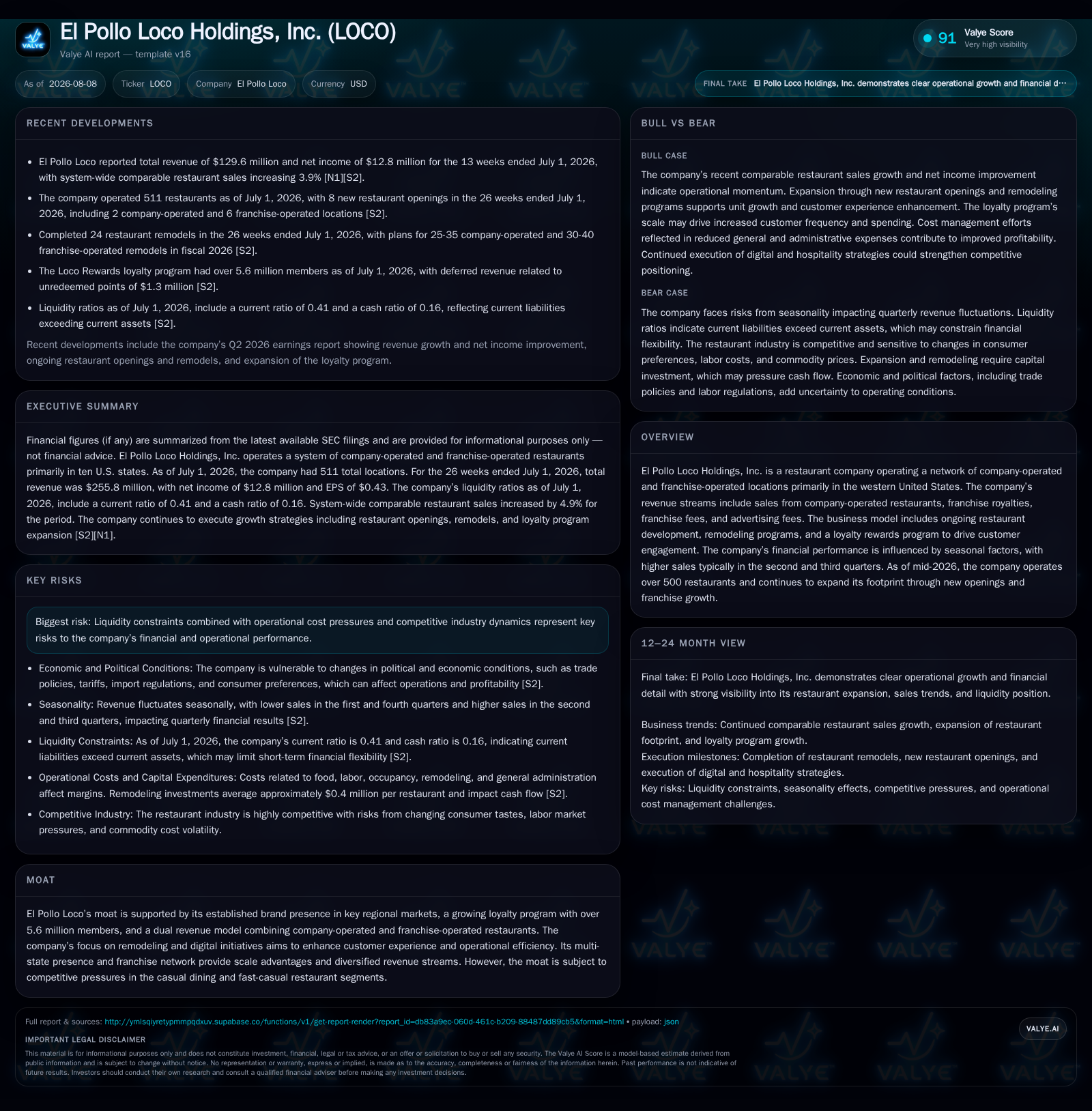
El Pollo Loco Holdings, Inc. demonstrated notable progress in its second-quarter fiscal 2026 results, with system-wide comparable restaurant sales increasing nearly 4% year-over-year and continued expansion of its restaurant footprint to over 510 locations across ten states [S2]. The company pursues a dual revenue model blending company-operated sales with franchise royalties and fees, leveraging a loyalty rewards program and digital initiatives to drive customer engagement [S1]. While sustained growth in average check size supports revenue gains, transaction counts show mixed trends, reflecting competitive pressures common within the quick service restaurant sector [S1][S2]. Capital allocation emphasizes remodeling and new unit development, key for maintaining brand relevance and driving unit economics. Financially, liquidity remains constrained with a current ratio below one and net leverage above $57 million, though recent debt paydowns and covenant compliance mitigate immediate refinancing concerns [F1][S7][S9]. Going forward, execution on unit openings, loyalty program expansion, and comparable sales momentum will be critical to offset operating cost challenges and strengthen the company’s competitive positioning.
Recent Operating Update
The total restaurant count reached 511 as of July 1, 2026, expanding from fiscal year-end 2025 (503 stores) thanks to ongoing unit openings: the company added one location each in California and Texas during the first half of the year while franchise partners opened six new outlets across multiple states including Colorado, Arizona, Idaho, Texas and California [S2][S1]. The deliberate balance between company-owned and franchised units aims to optimize capital deployment efficiency while sustaining control over key markets.
Total revenue for the thirteen weeks ended July 1 was approximately $129.6 million split between $108.1 million from company-operated restaurants and $21.5 million from franchise-related income including royalties and advertising fees [S2]. For the first half of 2026, these figures scaled linearly supporting stable revenue mechanics that mix direct retail sales with recurring franchise fees based on outlet performance metrics
Comparable restaurant sales gains were supported by a meaningful increase in average check size driven partially through menu price increases implemented earlier; this was partially offset by softening transaction volume typical in mature QSR segments facing competition intensity [S1]. Restaurant-level profitability depends heavily on achieving favorable per-transaction economics alongside cost controls around labor and food inputs.
Capital expenditures accelerated compared to prior periods reflecting investments into remodeling existing stores to modernize customer experience alongside opening new restaurants. Pre-opening expenses associated with training labor forces before store launch also remain a sizable upfront cost element impacting short-term margins but essential for long-term unit economics improvement [S8][S23]
Business Model Analysis
El Pollo Loco operates within the quick service restaurant (QSR) industry emphasizing fast-casual dining anchored by fire-grilled chicken offerings distinctive to its brand heritage. Its revenue streams derive principally from two sources: food sales at company-operated locations generating transaction-based revenue; and franchising income composed of royalties tied directly to franchisee sales plus advertising contributions.
This dual revenue model provides diversified cash flows—company stores offer immediate top-line volume while franchised units contribute recurring fee income without direct operational risk or capital outlay by El Pollo Loco beyond brand support.
Central to its strategy is driving comparable restaurant sales via increasing customer visits (frequency), attracting new customers (traffic), and optimizing per-person spend through menu innovation, pricing cadence adjustments, loyalty program engagement, and upselling opportunities. The recently reported system-wide same-store sales growth reflects traction across these vectors.
Ongoing remodeling programs serve not only aesthetic enhancement but also operational efficiency gains that can improve throughput and reduce cost per transaction—the crux of sustainable unit economics crucial for both corporate-owned sites and franchisees.
Digital initiatives under the "Digital First" pillar encompass online ordering platforms and mobile app integration tied closely with the loyalty rewards program which boasted over 5.6 million members as of fiscal year-end. This ecosystem offers enhanced data analytics capabilities enabling personalized marketing campaigns geared towards improving customer retention rates and spending levels.
Industry Structure & Competitive Position
Within the broader QSR landscape dominated by giant players such as McDonald's or regional fast-casual operators like Chipotle Mexican Grill or CAVA, El Pollo Loco occupies a niche focused largely on southwestern U.S markets where cultural affinity for flame-grilled chicken recipes supports brand differentiation.
Its mixed company/franchise model resembles that of many regional chains balancing organic footprint control against leveraging franchisees’ local market knowledge for expansion agility.
Competitive pressures stem primarily from increasing fast-casual entrants emphasizing health-conscious menus or delivery-centric models. Cost inflation in labor wages and commodities further compresses margin headroom across peers [N5][N3]
El Pollo Loco's strategy to enhance hospitality quality alongside digital convenience seeks to offset such pressures by building incremental customer loyalty while maintaining attractive price points aligned with consumer willingness-to-pay dynamics prevalent in mid-tier casual service dining.
Growth Drivers
Growth rests on several coordinated levers:
- Unit Expansion: Targeted openings in California, Texas, Arizona among others expand geographic reach in high-potential markets with strong demographic tailwinds. In fiscal year 2026 alone management expects three-to-four new company-operated restaurants complemented by around fifteen franchise openings reflecting robust pipeline activity [S1][S2].
- Comparable Restaurant Sales Improvement: Sustained increases driven by menu innovation combined with pricing strategies aiming at balancing yield capture against transaction stabilization remain central to top-line momentum.
- Loyalty Program Engagement: With millions enrolled, program growth fuels repeat business lifting average visit frequency—an especially critical KPI given observed transaction declines amid competitive promotions elsewhere.
- Remodeling & Digital Enhancements: Store refresh cycles keep assets modernized enhancing frontline staff productivity while digital ordering platforms integrate omnichannel convenience benefiting overall sales conversion funnel efficiency.
- Marketing & Brand Investments: Focus on brand strength contributes further differentiation supporting traffic generation despite a crowded field.
Risks & Watchpoints
Several headwinds challenge El Pollo Loco’s trajectory:
- Liquidity Constraints: The company's current ratio stands at roughly 0.41 indicating working capital tightness exacerbated by sizable short-term liabilities substantially exceeding current assets ([F1]). Continued cash flow generation must remain high enough to fund ongoing remodels without stress.
- Debt Levels & Refinancing Risk: The company had approximately $13.3 million in cash and equivalents as of July 1, 2026, with total debt last reported at about $71.2 million as of March 2019 [F1]. Borrowing under the revolving credit facility was reported at $30 million end-July 2026 with borrowing availability around $109 million after factoring letters of credit usage [S7][S9]. The revolving credit facility amended post-quarter extended maturity through August 2031, providing refinancing flexibility.
- Operating Cost Inflation: Wage increases mandated by regional labor markets combined with food commodity price volatility compress operating margins if menu price hikes trigger volume softness or customer resistance [S1][N6].
- Competitive Intensity: Rise of new entrants focused on health trends or delivery ecosystems means incubation pace and promotional discipline are critical levers affecting market share retention.
- Franchisee Performance Variability: Dependence on franchise partners maintaining their own operating standards impacts overall brand health; failures here may limit royalty-fee growth potential or damage reputation if not managed closely.
- Seasonality: As noted historically revenues dip in quarters impacted by weather or holiday timing affecting foot traffic patterns requiring accurate forecasting for capacity planning [S2].
What To Watch Next
Key milestones include:
- Execution speed on planned unit openings during remainder of calendar year particularly balancing company-owned versus franchised mix which influences capital intensity profiles.
- Quarterly updates on comparable restaurant sales should be monitored for sustained momentum or emerging softness especially tracking transaction trends against average check size inflation.
- Loyalty rewards program membership progression potentially signaling deeper engagement levels unlocking recurrent purchase behaviors aiding per-store economics.
- Progress on remodeling schedules contributing not only aesthetic updates but operational benefits such as queue reduction impacting customer satisfaction metrics.
- Any changes in debt levels or amendments signaling evolving liquidity positions given current tight working capital ratios.
- Management commentary on supply chain dynamics or wage inflation responses that may presage margin deceleration risks ahead.
Financial Profile Discussion
As of July 1, 2026, El Pollo Loco had approximately $13.3 million in cash and equivalents alongside current assets totaling $34.3 million which fall significantly short of $84.5 million current liabilities supporting a current ratio near 0.41 — an indicator of tight liquidity conditions requiring careful working capital management [F1]. Total debt recorded at approximately $71.2 million (latest reliable point: March 2019) paired with this cash position implies net debt north of $57 million though actual current borrowing under the revolving credit facility was reported at $30 million end-July 2026 with borrowing availability remaining around $109 million after factoring letters of credit usage [F1][S7][S9].
The revolving credit facility amended post-quarter extended maturity through August 2031 alleviating refinance urgency but debt service cost remains substantial given interest rates fluctuating between roughly ~5%–7% depending on base rate chosen which impacts net interest expense load on EBITDA-margin constrained operations further pressed by inflationary wage/food cost environments [S9][S16]
Cash flows from operations appear adequate based on reported improvements in net income helped by better-than-prior-year revenue trends plus non-cash reversals such as deferred tax adjustments; nonetheless elevated capital expenditure outlays related primarily to remodeling capex represent a meaningful use of funds reducing free cash flow conversion rates relative to net earnings reported recently [S8][F1]
Continued trajectory toward scaling store count combined with stable royalty fee inflows from franchised units should enhance cash inflow diversity helping address balance sheet leverage over time if execution proceeds without disruption.
This analysis synthesizes publicly available SEC filings through August 7, 2026 as well as complementary industry framing characteristic of quick service restaurant operators focusing on multi-channel revenue models leveraging digital engagement tools amid moderate economic cyclicity affecting discretionary dining out habits. Market-sensitive variables such as cost inflation pressures and competitive dynamics necessitate ongoing monitoring alongside operational KPIs including comparable restaurant sales progression, unit growth cadence, loyalty program scale development metrics, and capital allocation effectiveness over remodel/new store portfolios.
Disclaimer: This is research-only, informational analysis and not investment advice. It may include AI-generated interpretation and general industry context. Always verify important details using primary sources.

Comments