
OKYO Pharma Strengthens Insider Confidence Amid Regulatory Progress for Urcosimod
Insider share purchases and FDA alignment on clinical trial design underscore OKYO Pharma’s advancing development of Urcosimod within a challenging clinical-stage financing environment.
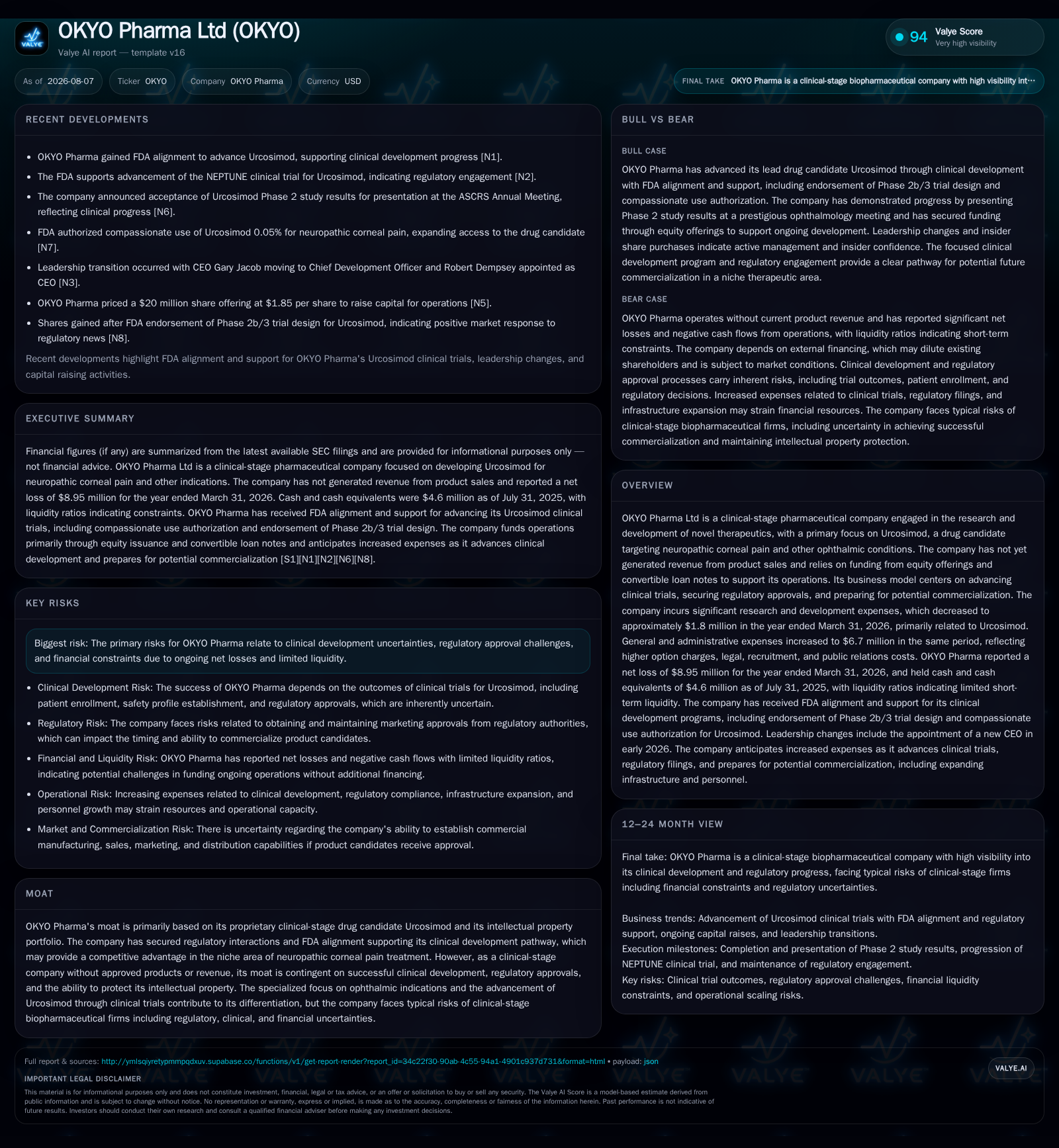
In July 2026, OKYO Pharma’s Chief Scientific Officer increased his equity stake, signaling management confidence amid ongoing clinical development of Urcosimod for neuropathic corneal pain. Recent FDA feedback endorsing the NEPTUNE trial design reduces regulatory uncertainty and supports streamlined progression. The company remains pre-revenue, funding operations through equity and convertible loans, with R&D and administrative costs reflecting typical early-stage biotech burn. While operating in a niche ophthalmic indication with some IP protection, OKYO faces standard industry risks including clinical execution, funding demands, and regulatory challenges.
Insider Buying Reflects Management Confidence
On July 28, 2026, OKYO Pharma’s Chief Scientific Officer Raj Patil acquired an additional 3,363 shares at $1.49 per share on NASDAQ, increasing his total holdings to over 20,000 shares [S2]. Insider purchases in clinical-stage biopharma often signify internal conviction regarding pipeline prospects or upcoming milestones. This transaction suggests management’s positive outlook on the company’s lead asset Urcosimod during its ongoing clinical development.
FDA Alignment Advances Clinical Development of Urcosimod
OKYO Pharma recently secured FDA alignment supporting its NEPTUNE phase trial design for Urcosimod targeting neuropathic corneal pain [N1][N2][S1]. The FDA’s endorsement of trial endpoints and structure mitigates regulatory uncertainty—a significant factor given the subjective symptomatology challenges inherent in neuropathic ocular conditions. This regulatory clarity facilitates smoother trial execution and could accelerate progression toward pivotal data readouts.
Such FDA engagement distinguishes OKYO within the ophthalmic biotech space by reducing a key development risk that often complicates approval timelines for novel indications.
Financing Model during Ongoing R&D Investment
As a pre-revenue entity with no current product sales, OKYO funds its operations predominantly through equity issuances and convertible loan arrangements [S1]. For the fiscal year ending March 31, 2026, research and development expenses were approximately $1.8 million. These costs primarily reflect external services from contract research organizations (CROs), contract manufacturing organizations (CMOs), clinical site activities, and manufacturing scale-up efforts necessary to progress Urcosimod through clinical phases.
General and administrative expenses increased to around $6.7 million during the same period due largely to higher stock option charges alongside expanded legal support, talent acquisition efforts, and public relations initiatives aimed at preparing for eventual commercialization.
This expense profile typifies early-stage biopharma companies balancing costly development activities with organizational scaling before revenue generation.
Competitive Position Within a Specialized Ophthalmic Niche
OKYO operates in a focused therapeutic area addressing neuropathic corneal pain—a niche unmet medical need lacking approved targeted therapies. Its lead candidate Urcosimod is a proprietary small molecule designed to modulate neuropathic pain pathways localized to corneal tissue. This focus offers differentiation relative to peers such as Aerie Pharmaceuticals and Kala Pharmaceuticals who develop treatments targeting broader or adjacent ocular conditions.
The company’s intellectual property portfolio provides some exclusivity within this specialized segment; however, ultimate competitive advantage will depend on successful clinical advancement and ability to secure regulatory approvals ahead of potential future entrants.
Growth Drivers: Clinical Progression and Partnership Potential
Key growth catalysts for OKYO include advancing the NEPTUNE trial leveraging recent FDA guidance to reduce uncertainties around endpoints. Positive safety and efficacy data would validate Urcosimod’s therapeutic promise in an underserved indication with significant unmet patient needs.
Strategic partnerships or licensing agreements remain potential avenues to bolster capital resources and access commercial infrastructure post-approval. Expanding intellectual property coverage into related ophthalmic disorders could also enhance future pipeline breadth.
Capital raising capacity will hinge on demonstrating tangible developmental milestones that can attract investor interest despite ongoing cash burn constraints.
Risks: Clinical Complexity, Funding Needs, Regulatory Hurdles
OKYO faces standard risks typical of clinical-stage biopharma:
- Clinical execution risks include challenges in enrolling patients demonstrating neuropathic corneal pain symptoms objectively measurable under FDA-accepted endpoints.
- Regulatory risks persist despite FDA alignment; later-stage review could impose additional requirements or delay approvals.
- Funding risks arise from dependence on equity markets or licensing deals amid continued net losses; capital raises may dilute existing shareholders if market conditions are unfavorable.
- Intellectual property risks involve defending patents against competitors or navigating complex exclusivity landscapes in niche indications.
Effective mitigation of these risks will be critical for sustaining developmental momentum.
What To Watch: Trial Milestones and Capital Strategy
Upcoming indicators include enrollment pace updates from the NEPTUNE trial alongside initial safety/tolerability data releases anticipated during ongoing study phases [N1][N2][S1]. Successful recruitment rates would reflect operational capability while favorable early data could bolster valuation prospects.
Additionally, OKYO's presence at the BTIG Biotechnology Conference in late July 2026 offers a platform for investor engagement potentially facilitating forthcoming financing initiatives [S3]. Monitoring announcements regarding partnership deals or capital raises will be essential for assessing financial runway sufficiency.
Financial Profile Discussion: Liquidity Constraints Amid Operating Losses
Absent near-term revenue or large upfront licensing fees disclosed publicly so far, the company must prioritize prudent capital management while preparing for additional fundraises—dilution remains an inherent risk at this stage. Strategic partnerships could alleviate cash needs but have yet to materialize publicly.
This analysis integrates OKYO Pharma’s latest insider transactions signaling management conviction alongside important regulatory feedback clarifying its lead asset development path. While operational momentum benefits from reduced regulatory uncertainty within a specialized therapeutic niche, typical biotech risks from funding dependencies through clinical complexities remain prominent. Investors should closely monitor upcoming trial execution metrics coupled with financial maneuvers critical for sustaining progress in this evolving ophthalmology-focused pipeline play.
Disclaimer: This report does not constitute investment advice or a research view regarding securities of OKYO Pharma Ltd.
Disclaimer: This is research-only, informational analysis and not investment advice. It may include AI-generated interpretation and general industry context. Always verify important details using primary sources.

Comments