
Atossa Therapeutics Advances (Z)-Endoxifen Trials Amid Patent Strength but Faces Capital and Regulatory Hurdles
Clinical-stage biotech Atossa progresses proprietary breast cancer drug amid cash constraints and regulatory complexities.
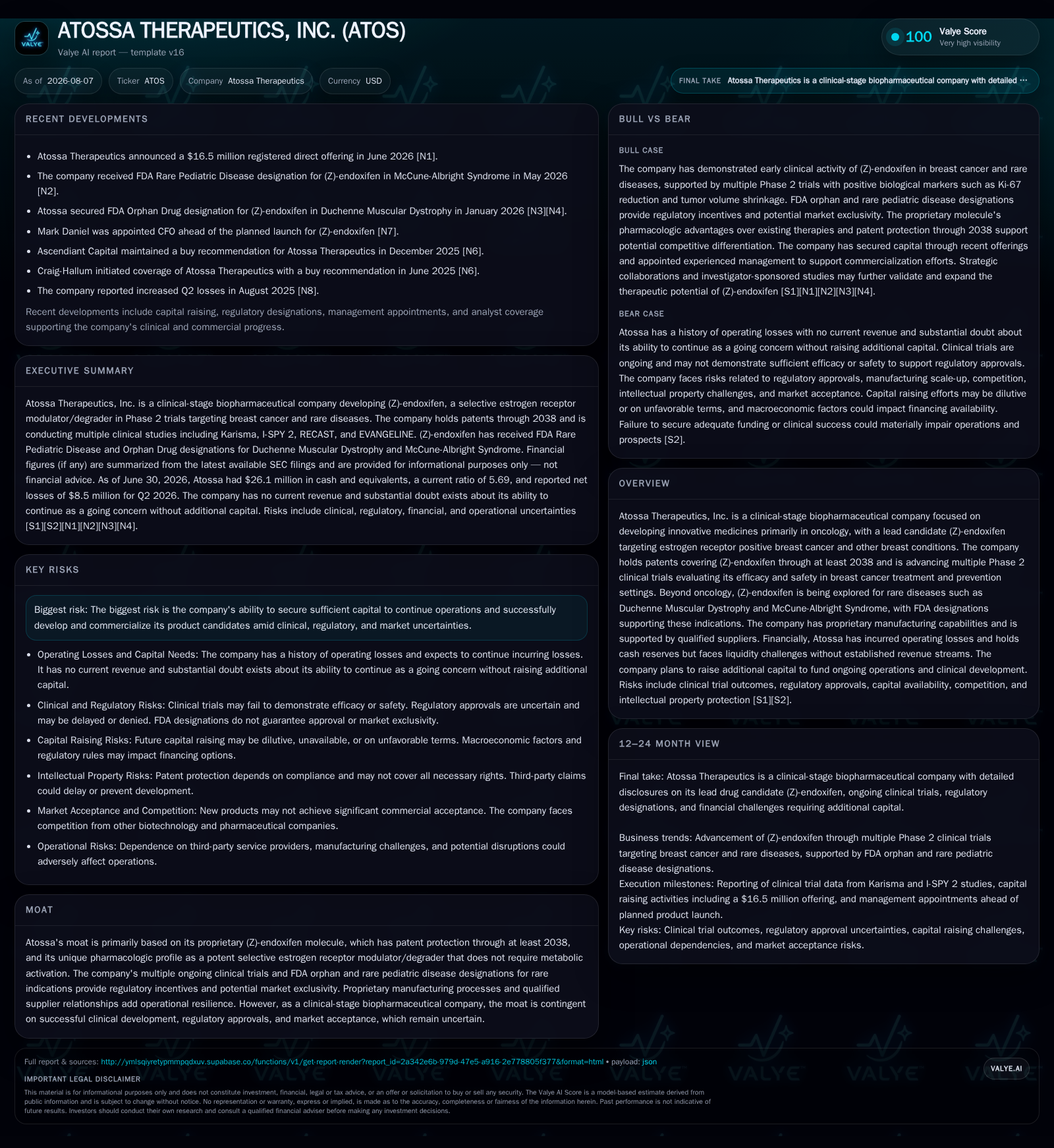
Atossa Therapeutics, a clinical-stage biopharmaceutical focused on developing (Z)-endoxifen for estrogen receptor positive breast cancer and rare diseases, reported ongoing Phase 2 clinical activities in its latest quarterly filings. While protected by patents until at least 2038 and supported by orphan drug designations, the company continues to operate at a loss with no current revenue streams. Its business hinges on advancing clinical trials successfully, navigating regulatory challenges, securing additional capital, and eventually commercializing its treatment amid competition and systemic healthcare uncertainties.
Recent Operating Update
In its latest quarterly filing dated August 7, 2026 [S2], Atossa Therapeutics updated investors on its continuing Phase 2 clinical development programs centered around (Z)-endoxifen, an oral selective estrogen receptor modulator/degrader (SERM/D) targeting estrogen receptor positive (ER+) breast cancer. The company remains in the research and development phase with no commercial revenue streams to date. Cash and equivalents were reported at approximately $26.1 million as of June 30, 2026, accompanied by zero debt and a current ratio around 5.7 [F1]. This liquidity position offers short-term runway but underlines the ongoing need for capital infusion to sustain costly clinical trials.
Operations continue to focus on advancing multiple Phase 2 studies exploring (Z)-endoxifen’s efficacy in neoadjuvant treatment settings, adjuvant therapy post-surgery, and potential breast density reduction applications–a proxy marker linked to breast cancer risk reduction [S1]. Additionally, the company is exploring rare pediatric indications such as Duchenne Muscular Dystrophy and McCune-Albright Syndrome under FDA orphan drug designations that provide regulatory incentives including potential market exclusivity [S1]. These development programs are instrumental to Atossa’s strategic plan but entail typical early-stage biotech uncertainties including enrollment rates and clinical outcome variability.
Business Model and Product Positioning
Atossa operates in the critical drug discovery and early clinical development segment of the biotechnology value chain. Its monetization strategy is based around proprietary therapeutic innovation delivered through patent-protected small molecule drugs. Specifically, its lead product candidate (Z)-endoxifen is distinguished by not requiring first-pass liver metabolism unlike tamoxifen—commonly used in ER+ breast cancer—which suffers variable patient bioactivation due to CYP2D6 enzymatic differences [S1]. This pharmacologic advantage could translate into more consistent clinical efficacy across patient populations.
Revenue generation for Atossa is currently non-existent as the company has not launched any approved products; financial support arises predominantly from equity financing aimed at underwriting R&D expenses—largely composed of manufacturing costs for investigational drug batches plus clinical trial operational expenses including contracted research organizations (CROs) [S10]. The path to revenue depends heavily on successful Phase 3 trial outcomes, securing regulatory approvals from authorities such as the FDA or EMA, establishing manufacturing scale-up capabilities compliant with good manufacturing practice (GMP), and developing sales/marketing infrastructure either internally or via partnerships.
Industry Structure and Competitive Position
Atossa competes within a dense cohort of clinical-stage biopharmaceutical companies that target ER+ breast cancer—a significant segment of oncology therapeutics due to its prevalence in breast cancer diagnosis. Peers such as Puma Biotechnology or Radius Health illustrate companies with similar pipeline profiles that blend novel mechanisms with late-stage trials seeking FDA approvals. In this context, Atossa's differentiation arises from its patented (Z)-endoxifen molecule's unique pharmacologic profile coupled with orphan indications providing regulatory exclusivity benefits.
However, the industry is characterized by high attrition rates in drug development phases; nearly half of investigational agents fail during late-stage trials due to safety or efficacy concerns. The company’s reliance on third-party CROs for trial execution along with external CMOs for pharmaceutical manufacturing introduces operational dependencies which could pose risks if quality standards or timelines slip [S29]. Moreover, regulatory landscapes are dynamic with increasing scrutiny over trial designs and post-approval pharmacovigilance obligations both in the U.S. and Europe, amplifying compliance costs [S9][S11].
Growth Drivers
Key growth drivers revolve around successful clinical trial progression producing positive efficacy and safety data that enable advancement to pivotal Phase 3 studies—substantially increasing the asset's valuation—and eventual regulatory submissions. Expansion of indication breadth from oncology into rare diseases endorsed by FDA orphan designations enhances market potential while leveraging existing molecular IP protections extending patent life through at least late 2038 [S1]. Licensing agreements or partnerships could also provide capital infusions or operational leverage if pursued opportunistically.
On the development front, improved patient enrollment rates in ongoing studies would alleviate one common bottleneck impeding trial timelines [S24]. Regulatory milestone achievements such as fast-track approvals or breakthrough therapy designations would further accelerate access pathways and improve investor confidence.
Manufacturing advances improving production capacity while maintaining GMP compliance underpin scalability needed for commercial launch consistency. Finally, favorable changes in healthcare reimbursement policies affecting oncology medications would positively influence commercial viability once market entry is achieved.
Risks and Watchpoints
Intellectual property challenges remain pertinent despite strong patent protection—third-party claims or evolving patent law could erode exclusivity [S29]. Manufacturing supply chain disruptions involving CMOs or raw material shortages pose operational vulnerabilities alongside possible cybersecurity incidents affecting outsourced partners [S7]. Market acceptance post-approval must navigate competitive pressures from established hormone therapies or emerging modalities such as CDK4/6 inhibitors targeting similar patient segments.
Human resource retention challenges especially of key executives engaged deeply in R&D activities represent internal risks that could impact continuity if manifested [S2]. Moreover, legislative reforms impacting healthcare reimbursement landscapes might constrain pricing power ultimately affecting commercialization economics.
What to Watch Next
Critical near-term indicators include enrollment progress updates from ongoing Phase 2 trials—slower-than-expected patient recruitment would delay data collection timelines. Initial interim efficacy or safety analyses will signal whether subsequent studies can proceed swiftly towards pivotal registrational trials.
Regulatory communications regarding trial protocols or special designations will provide insight into agency receptiveness potentially accelerating approval paths. Concurrently monitoring cash burn rates against liquidity will reveal when fresh capital needs crystallize given ongoing operating losses reported recently exceeding $34 million annually [F1][S2]. Any announcements regarding collaborations or licensing arrangements could materially shift operational leverage.
Observing competitive developments among peers pursuing comparable mechanisms offers contextual benchmarks for Atossa’s relative positioning. Lastly, key management continuity announcements may affect investor sentiment given CEO involvement hallmarking company culture and strategic leadership.
Financial Profile Discussion
As of June 30, 2026, Atossa reported cash and cash equivalents of approximately $26.1 million with current assets totaling $31 million against current liabilities near $5.5 million—a healthy working capital cushion reflected by a current ratio around 5.7 indicating solid short-term liquidity [F1][S2]. The firm carries no recorded debt enhancing financial flexibility.
The lack of recurring revenues necessitates ongoing equity fundraising to bridge cash burn associated with expensive multi-center global trials managed via outsourced CROs/CMOs. Prior raise instruments include “at-the-market” offering agreements facilitating timely access to capital markets without negotiating fixed-price offerings [S15], though timing remains dependent on market conditions.
Cost control measures appear focused on optimizing R&D spend while retaining critical personnel amid low headcount levels supplemented by consultants [S23]. Sustained investment in intellectual property maintenance involves procedural fees essential for upholding patent rights internationally seen as vital long-term assets underpinning future revenue potential.
In summary, while financially sound in near term with a clean balance sheet visually supportive of continued operations next twelve months without immediate refinancing obligations, longer-term survival contingent upon additional capital raises weighed against successful pipeline advancement remains a pivotal metric going forward.
--- This analysis reflects an aggregation of Atossa Therapeutics' publicly filed SEC documents through August 7, 2026 combined with sector-specific considerations relevant to early-stage oncology-focused biotech firms developing novel small-molecule therapeutics under patent protection amid typical industry operating dynamics [S1][S2][F1]. It does not constitute investment advice but serves as a comprehensive internal research perspective grounded strictly in disclosed data.
Disclaimer: This is research-only, informational analysis and not investment advice. It may include AI-generated interpretation and general industry context. Always verify important details using primary sources.

Comments