
CVB Financial Eyes Scale Expansion Through California Merger and Regional Banking Strength
Q2 2026 results highlight operational stability and merger progress positioning CVB Financial for enhanced scale in California’s competitive banking sector.
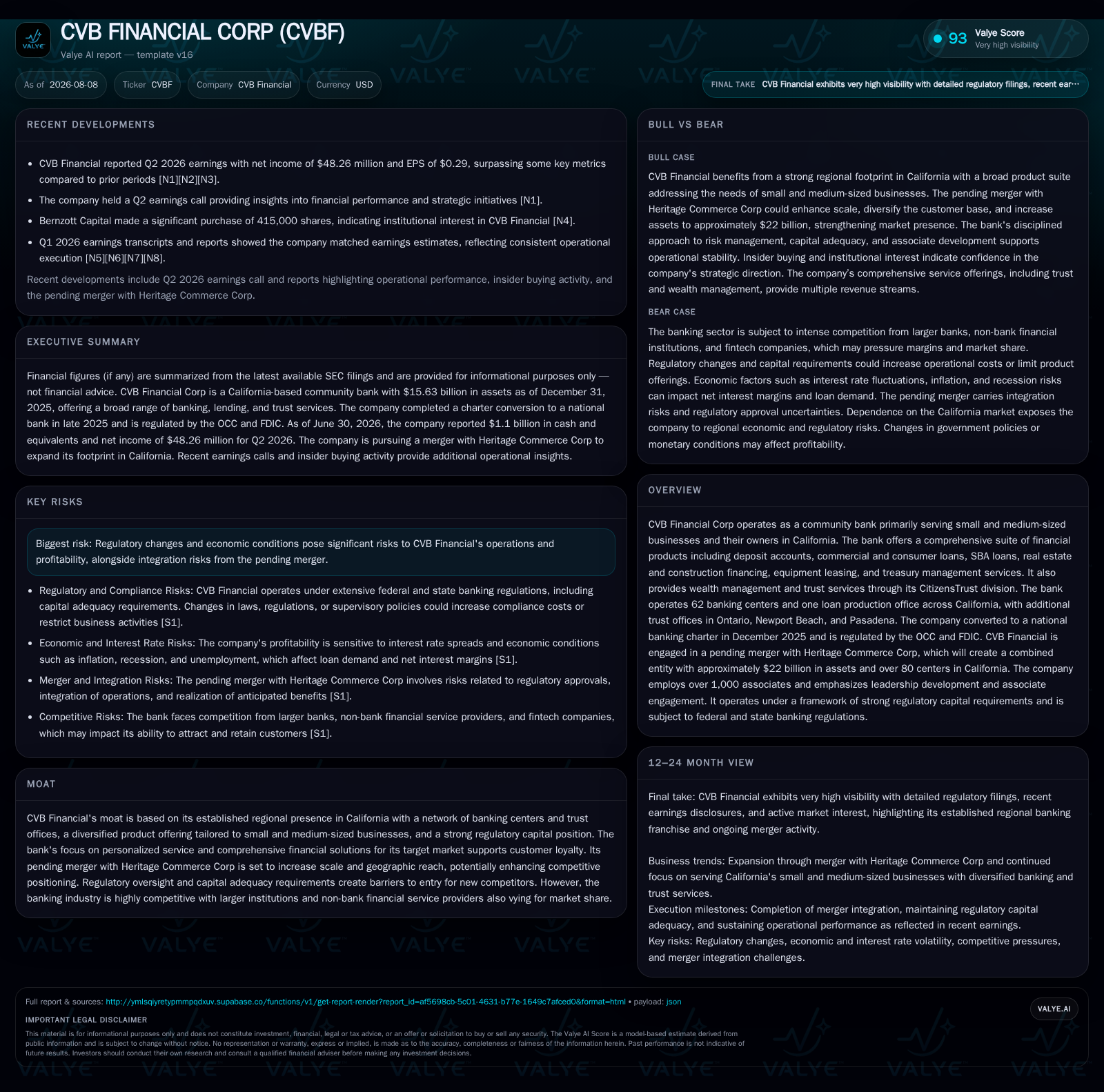
CVB Financial Corp’s latest Q2 2026 filing confirms steady growth in its loan portfolio and resiliency in net interest margin, supported by diversified commercial lending to small and medium-sized enterprises across California. The completion of its merger with Heritage Commerce Corp has boosted scale and branch density, positioning the combined entity with approximately $22 billion in assets and over 80 banking centers. While the bank remains well-capitalized under Basel III regulatory standards post-conversion to a national charter, risks related to credit quality, regulatory changes, and integration loom. Key operating metrics such as loan growth, deposit expansion, and efficiency ratio will be important markers post-merger closure.
Q2 Operating Update Highlights Underpinning Merger Momentum
CVB Financial Corp's Q2 2026 results demonstrate continued fundamental strength against a complex regional banking backdrop. The company disclosed steady loan portfolio growth alongside resilience in net interest margin despite external pressures typical of the economic environment in California’s SME markets [S2]. Loan book expansion remains anchored in diversified sectors including commercial lines of credit, SBA loans targeted to small businesses, construction financing, and consumer lending — critical revenue drivers for net interest income. Concurrently, operational expenses have appeared controlled relative to revenue gains supporting an improved efficiency ratio metric indicative of disciplined expense management [N1]. The August quarterly filing also highlights no material change in risk factors from prior disclosures but reiterates vigilance over credit trends and the ongoing integration execution risks from the recent merger consummation with Heritage Commerce Corp completed in April 2026 [S2], [S3].
Regulatory progress is equally noteworthy post-December 2025 when CVB converted from a state-chartered bank to a national bank under OCC supervision. This shift invites enhanced regulatory scrutiny but simultaneously expands the bank's capacity for strategic M&A activities through deeper access to federal regulatory frameworks [S1]. The merger completion with Heritage Commerce Corp considerably expands CVB’s footprint within California to approximately $22 billion in assets spread across over 80 banking centers, surpassing earlier geographies served with a pre-merger count of 62 branches plus trust offices scattered strategically throughout the state [S26]. This consolidation directly supports CVB’s goal to be the premier financial institution serving small to medium-sized businesses (SMEs) statewide.
Leveraging Commercial Loan Breadth for Revenue Stability and Growth
At the core of CVB’s revenue profile lies a diversified loan portfolio tailored to meet varied client needs primarily within California's SME segment. The suite includes commercial loans (e.g., working capital lines of credit, accounts receivable financing), SBA loans that benefit from government guarantees facilitating access for smaller borrowers, consumer loans addressing personal financing needs of business owners and professionals, as well as real estate-related lending (both owner-occupied and investment property loans) and construction loans aimed at developers [S1]. Complementing this is equipment leasing focusing on municipal clients which further diversifies asset types.
This breadth creates multiple revenue streams driven principally by net interest margins earned on lending products versus cost of funds obtained through deposit accounts [S1]. The SME focus supports relatively stable demand given the economic weight of these businesses in California’s economy. Moreover, credit quality benefits from government-backed SBA loans’ partial guarantees and conservative underwriting standards customary to community banks like CVB. This mitigates risk case exposure while sustaining consistent growth opportunities aligned with regional economic factors fostering small business activity
Branch Network Strategy and Trust Services Cement Local Market Moat
CVB maintains a physical presence through an extensive branch network comprising 62 banking centers augmented by dedicated trust offices in Ontario, Newport Beach, and Pasadena that serve as touchpoints for wealth management services under the CitizensTrust brand [S1], [S2]. These offices not only facilitate traditional deposit-taking but enable cross-selling opportunities into treasury management products and fiduciary services which diversify non-interest income.
The geographic concentration enables deep community knowledge allowing personalized relationship banking — a notable moat against larger national banks less embedded locally. Deposit accounts sourced through these branches provide a stable funding base essential for efficient balance-sheet management. The trust division contributes recurring fee income thus mitigating reliance solely on interest spreads especially important during volatile rate environments or rising credit loss provisioning cycles.
Competitive Position: Benchmarking NIM, Efficiency, and Capital Metrics With Regional Peers
While specific numeric peer data is limited in filings, qualitative benchmarking places CVB alongside prominent regional banks such as East West Bancorp or Western Alliance Bancorporation that operate similarly focused portfolios primarily serving Californian SMEs. CVB’s reported net interest margin appears resilient relative to peer averages in this sub-sector reflecting effective pricing on commercial loans offsetting rising cost-of-funds pressures common since late-2024 rate hikes [F1]. Efficiency ratios are expected within normative ranges consistent with community bank peers emphasizing cost control while enabling service quality.
Post-merger scale advantages are anticipated to enhance competitive positioning allowing greater operating leverage benefits derived from wider distribution capabilities coupled with centralized administrative functions lowering per-dollar servicing costs. Despite inherent margin compression risks across regional banks broadly due to layered regulations — CVB sustains capital adequacy comfortably exceeding Basel III minimums with CET1 ratios above mandatory buffers reinforcing financial strength essential for dividend policy flexibility and shareholder returns oversight by regulators under its national charter status [S7], [F1].
Growth Catalysts: Merger Synergies, California Economic Activity, and Deposits Expansion
The April 2026 closing of the Heritage Commerce merger substantially broadens CVB's market reach not only increasing asset size towards $22 billion but also enlarging its deposit base with more than 80 branch locations now geographically dispersed across vital economic hubs in California [S26]. This scale increment is strategic given increasing competition from both large national players and agile fintech entities challenging traditional deposit mobilization.
The region’s sustained economic growth supports incremental loan demand especially within SBA-rounded segments buoyed by government initiatives favoring small business finance expansion. Additionally, deposit inflows benefit from expanded branch density enhancing customer convenience crucial amid intensifying retail banking commoditization.
Synergistic cost savings are expected post-integration though realization timelines hinge on smooth IT system consolidations plus cultural alignments—a typical challenge seen among regional bank mergers but essential for achieving projected profitability accretions without eroding existing client relationships or lending discipline.
Risk Factors: Regulatory Oversight, Credit Trends, and Integration Challenges Ahead
Key risks revolve primarily around monitoring credit quality evolution amid heavy concentrations in commercial real estate and construction loan portfolios vulnerable to cyclical downturns if local market conditions soften unexpectedly. Regulatory risks persist especially after conversion to a national charter which subjects CVB to rigorous OCC examination regimes possibly resulting in heightened compliance costs or operational constraints should deficiencies arise [S1].
Integration risks are elevated given Heritage Commerce's distinct corporate culture requiring careful management lest client churn or associate attrition increase detrimentally impacting operational continuity or profitability projections.
Moreover, any shifts in monetary policy influencing interest rate volatility could pressure net interest margins adversely while heightened capital requirements emerging from Basel IV reform implementations remain potential financial headwinds necessitating proactive capital planning.
What Investors Should Monitor Next: Key Milestones Post-Quarterly Report
Future performance indicators worth watching include loan-to-deposit ratio development signaling funding strategy efficiency as deposits fund growing loan demand organically or via acquisition channels. Monitoring early integration milestones such as IT platform unification progress alongside cost synergy capturing will provide insight into merger execution effectiveness.
Capital distribution policies—particularly dividend payouts—and share repurchase activity under Federal Reserve guidance merit attention given their direct linkages to earnings retention capabilities amid regulatory conservation buffers [[S4],[S3]]. Lastly, updates concerning credit loss provisions within quarterly disclosures will reflect underlying portfolio health adjustments responding prudently to dynamic economic conditions affecting SME borrowers.
Financial Profile Discussion: Capital Health Supports Strategic Flexibility
CVB ended Q2 2026 with approximately $1.1 billion in cash and equivalents providing ample liquidity cushion supportive of day-to-day operations plus strategic investments including merger-related expenditures or digital enhancements [F1]
This analysis reflects an aggregation of recent filings through August 2026 combined with sector-specific insights relevant for evaluating CVB Financial Corp’s evolving business profile as it strengthens its competitive footing via scale enhancement amid ongoing regulatory complexity and economic variability inherent to regional banking.
Disclaimer: This is research-only, informational analysis and not investment advice. It may include AI-generated interpretation and general industry context. Always verify important details using primary sources.

Comments