
abrdn Gold ETF Trust’s Physical Gold Backing Sustains Investor Appeal Amid Market Volatility
Latest quarterly filing confirms stable operational structure and ongoing trust in physical gold-backed ETF model.
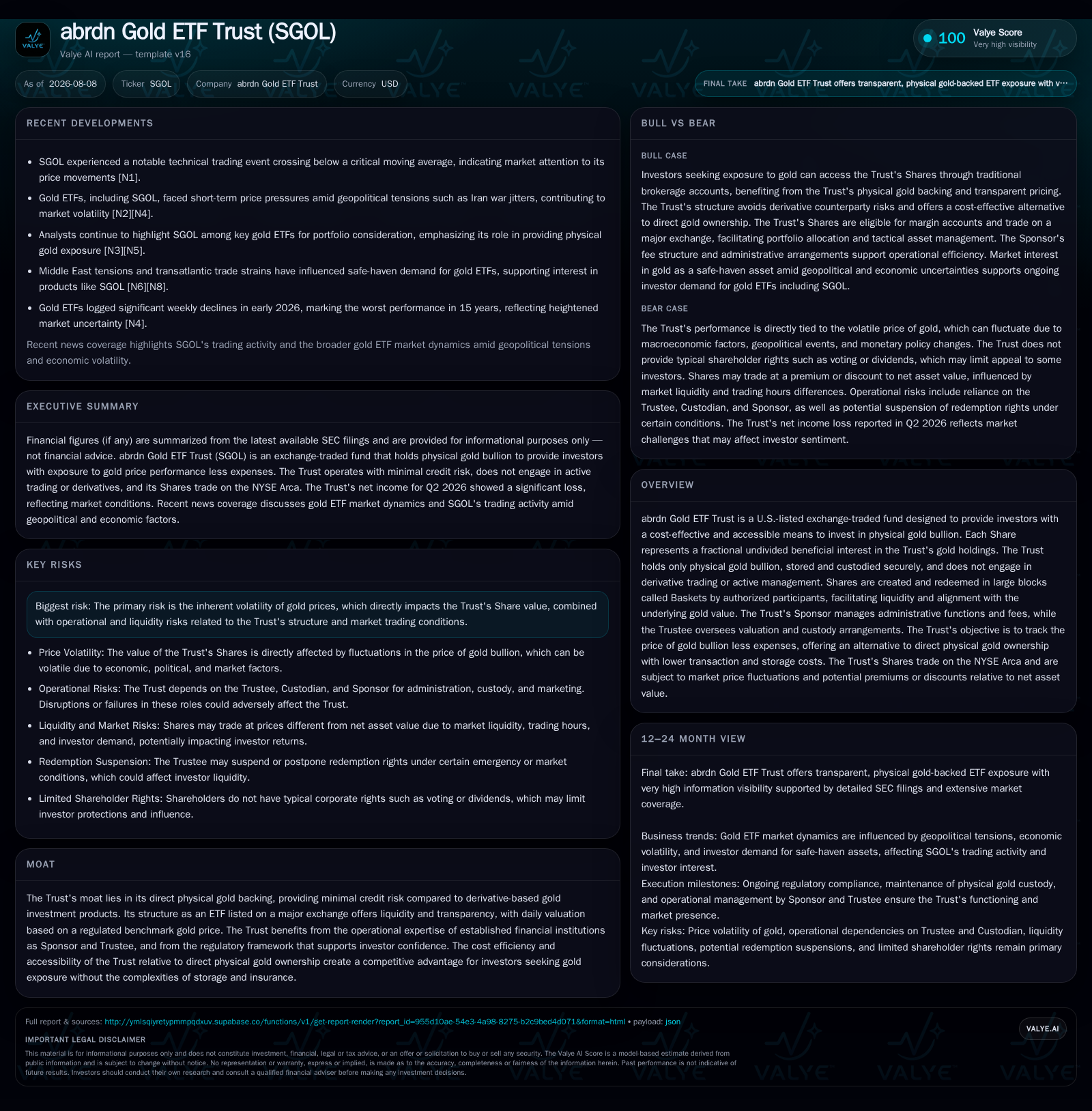
The abrdn Gold ETF Trust (SGOL) remains a focused physical gold bullion ETF offering investors direct exposure to gold price movements without active management or derivative risk. The latest 10-Q filing confirms no material changes in risk factors or operational approach, underscoring the trust’s consistent business model centered on secure custody and transparent valuation. Growth continues to be driven by rising assets under management and investor appetite for gold as a diversification tool amid economic uncertainty. Key industry metrics such as tracking error, liquidity, and premium/discount behavior remain critical for assessing relative performance versus peer funds like GLD. Operational stability and regulatory compliance anchor SGOL’s position within the physical commodity ETF space.
Recent Operating Update
The abrdn Gold ETF Trust filed its latest quarterly report on August 7, 2026 [S2], confirming that no material changes have occurred to the previously disclosed risk factors or trust operations detailed in the March 3, 2026 annual report [S1]. This stability underscores the persistent clarity of the Trust’s core business model: providing investors with a simple, cost-efficient vehicle to gain exposure to physical gold bullion through exchange-traded shares. The absence of new risks or structural modifications indicates a mature product operating within established regulatory frameworks and market practices.
The Trust’s fundamental structure remains unchanged—it does not engage in active management or derivatives trading but solely holds physical gold bullion stored securely under custodian oversight. Shares represent fractional undivided beneficial interests in this gold holding, facilitating exact valuation parity minus an expense ratio. Liquidity is maintained via authorized participants who transact creation and redemption of large share blocks known as Baskets, presently sized at 100,000 shares each [S1]. This mechanism promotes tight alignment between the market price of SGOL shares and their net asset value (NAV), minimizing tracking error against spot gold prices.
Business Model Overview
Revenue mechanics hinge on AUM growth inflows balanced against expense ratio costs encompassing custody, vaulting services, administration by the Sponsor, Trustee fees, and other administrative expenses. Investors benefit from simplified access to bullion without navigating storage logistics or insurance obligations. Open-market share trading on the NYSE delivers additional liquidity advantages compared to private bullion ownership.
Authorized Participants play a crucial role by arbitraging differences between SGOL’s market price and NAV through Basket creations/redemptions—minting new shares when demand rises or redeeming shares when selling pressure emerges. This supply-side flexibility lowers investor friction and assists in stabilizing premium or discount levels relative to underlying gold holdings.
Industry Structure and Competitive Position
The physical commodity-backed ETF sector, particularly focused on gold, is dominated by several key trusts including SPDR Gold Shares (GLD), iShares Physical Gold ETCs, and abrdn Gold ETF Trust. SGOL’s moat resides mainly in its solid physical backstop which eliminates issuer counterparty risk common to derivative-based commodity funds reliant on futures contracts or swaps. Custodial integrity — involving robust vault storage under recognized financial custodians— strengthens investor confidence by reducing operational risks associated with theft or mismanagement.
Regulatory oversight spans multiple jurisdictions; the UK Financial Conduct Authority (FCA) supervises major participants involved via frameworks such as the Financial Services and Markets Act 2000 [S1], while US SEC mandates govern disclosure, reporting transparency, and market conduct compliance. These layers collectively underpin product credibility.
SGOL competes by combining transparent pricing linked tightly to LBMA benchmark gold spot prices with competitive expense ratios that impact net returns over time compared to peers like GLD. While GLD often represents the market leader due to scale advantage, SGOL differentiates through sponsorship arrangements offering alternative fee structures and custody setups tailored for particular investor segments seeking lower credit risk by steering clear of derivatives altogether.
Tracking error—the deviation between SGOL’s share price movement and underlying spot gold price—is a critical metric monitored closely by investors. Low tracking error favors these ETFs since they must replicate commodity performance accurately less expenses without slippage arising from synthetic strategies or excessive trading costs.
Growth Drivers
Persistent economic uncertainty globally perpetuates demand for tangible safe-haven assets such as gold. Inflation hedging motivation combined with geopolitical tensions continues to attract both retail and institutional money flowing into physical-gold ETFs like SGOL. The COVID-19 pandemic aftermath amplified this trend initially; though recent quarters reflect normalization dynamics with intermittent volatility spikes renewing interest periodically.
Accessibility advantages inherent in an exchange-traded structure stimulate retail adoption due to reduced minimum investment sizes versus traditional bullion purchases requiring upfront capital commitments plus separate storage fees. Enhanced electronic trading platforms expand institutional participation as portfolio diversification tools amid equity market corrections or bond yield fluctuations.
Technological advancements improving custody security further reduce barriers surrounding trustworthiness of vault operators—a key growth enabler especially as cyber-security concerns escalate across financial markets. Regulatory clarity combined with evolving investor preference towards ESG-compliant precious metal investments also hints at incremental tailwinds supporting fund inflows.
Risks and Watchpoints
Gold price volatility remains the predominant risk directly impacting shareholder value since SGOL’s net asset value mimics bullion prices less operating expenses [S1]. Sharp swings influenced by macroeconomic events—such as shifts in real interest rates, currency exchange rate fluctuations particularly USD strength/weakness, central bank policies affecting supply-demand balance—and speculative positioning can adversely affect short-term share prices.
Liquidity dynamics also pose watchpoints; although authorized participant activity facilitates efficient creation/redemption processes maintaining tight bid-ask spreads under normal conditions, periods of broader market distress could impair these mechanisms leading to wider premiums or discounts from NAV.
Operational risks revolve around custody breaches or physical losses during storage or transit posing downside threats despite insured vaulting safeguards. Regulatory changes affecting gold trading rules or ETF operational requirements could impose unforeseen compliance costs or structural adjustments.
Tracking error deviations arising from unforeseen fee escalations or disruptions in authorized participant engagement warrant monitoring since they can impair fund attractiveness relative to competitors.
Finally, given that SGOL trades primarily on U.S. exchanges but holds globally priced commodities denominated largely in USD terms—currency exchange rate risks are present especially when considering foreign investor base diversification trends.
What To Watch Next
Investor attention will likely focus on AUM trends reported quarterly as front-line indicators of demand momentum compounded by evolving macroeconomic perceptions toward inflation prospects and interest rate trajectories.
Continued maintenance of low tracking error metrics combined with stable expense ratios will affirm ongoing execution quality versus peer benchmarks like GLD whose scale creates additional pricing power but may introduce different vulnerability vectors related to liquidity saturation effects.
Authorized participant volume activity—including creations/redemptions—should be analyzed carefully for any sign of waning support which might signal upcoming liquidity risks impacting secondary market efficiency.
Regulatory developments across U.S. SEC policies or UK FCA guidance concerning physical commodity ETFs will influence operational parameters so early disclosures warrant scrutiny.
The Trust itself has no employees nor engages in active trading operations which limits overhead burden.
Credit risk profile is relatively low due to direct ownership of physical assets mitigating insolvency risks linked with counterparty derivatives exposure common among alternative commodity ETFs. Consequently, financial health is principally tied to healthy inflows sustaining AUM scale coupled with disciplined cost control safeguarding expense ratios crucial for competitive positioning over time.
This analysis is based solely on available regulatory filings up through August 7, 2026 [S2][S1] supplemented by publicly accessible financial data [F1] alongside industry-standard knowledge about physical commodity-backed ETFs. No forward-looking statements or investment research views are provided.
Disclaimer: This is research-only, informational analysis and not investment advice. It may include AI-generated interpretation and general industry context. Always verify important details using primary sources.

Comments