
Iris Acquisition Corp II’s Path to Completing Initial Business Combination in a Crowded SPAC Market
Iris Acquisition Corp II remains in its pre-combination phase, leveraging a globally experienced management team to identify promising small to mid-market targets across diverse sectors.
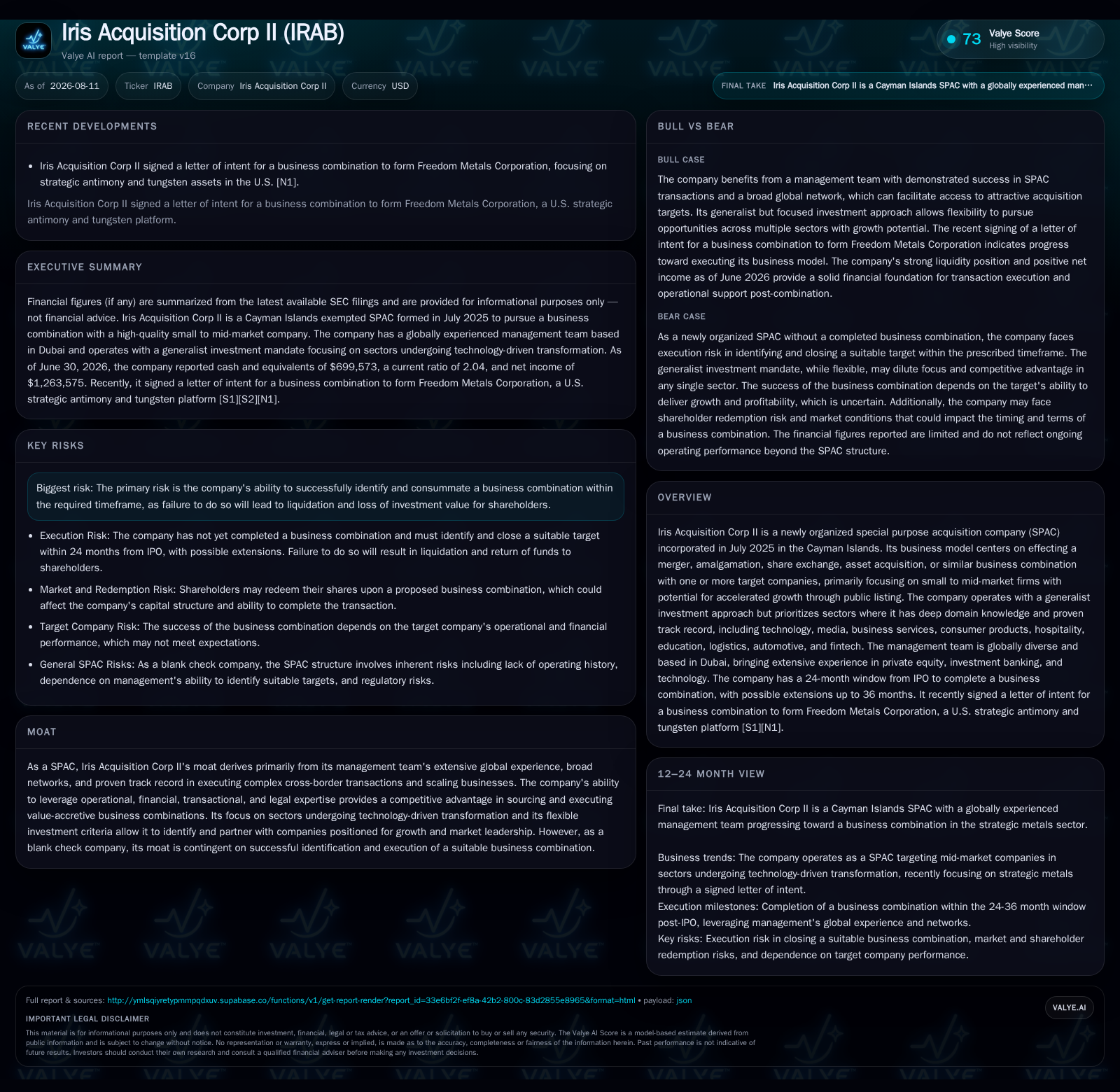
Iris Acquisition Corp II (IRAB), incorporated in July 2025 as a Cayman Islands exempted company, is a blank check company with a 24-month window to complete a business combination. Its latest quarterly filing (August 2026) confirms no formal acquisition discussions or engagements yet, underscoring the early-stage nature of its search. IRAB’s value proposition centers on its management’s global network and sector-agnostic approach targeting high-growth small to mid-cap companies that could benefit from public market access. Key risks include the limited timeframe to close a deal, the potential impact of shareholder redemptions on available capital, and execution challenges typical for SPACs amid evolving regulatory scrutiny. Monitoring pipeline developments, transaction disclosures, and redemption trends will be critical to assessing IRAB’s prospects for delivering shareholder value through a de-SPAC transaction.
Operating Context and Recent Developments
Iris Acquisition Corp II (IRAB) continues in its early lifecycle stage as a Special Purpose Acquisition Company (SPAC), having been incorporated in July 2025 as an exempted Cayman Islands entity with no operating revenues or commercial activities yet undertaken [S1]. The company’s latest quarterly filing dated August 10, 2026 confirms that it has not retained any advisory firms nor engaged in substantive discussions regarding potential business combinations as of mid-2026 [S2]. This status underscores the typical early-phase profile of SPACs which raise capital upfront without underlying revenue streams. IRAB must complete an initial business combination within twenty-four months post-IPO or face liquidation [S1], leaving less than eighteen months remaining.
Business Model and Strategic Focus
IRAB’s business model reflects the standard SPAC framework: funds raised through its IPO are held in trust pending deployment toward acquiring or merging with one or more private companies suitable for public listing via a de-SPAC transaction [S1]. No revenue is generated prior to closing such a deal; shareholder returns depend on successful completion of the business combination within the timeline. The structure incorporates warrants and redemption rights that can dilute equity value depending on shareholder elections.
Strategically, IRAB pursues a global generalist investment approach emphasizing sectors benefiting from technology-driven transformation including fintech, digital platforms, consumer goods adapting to e-commerce trends, hospitality recovering post-pandemic disruptions, education technology expanding remote learning modalities, logistics modernization through supply chain digitization, and automotive electrification initiatives [S1]. This diversification broadens potential target pools but requires comprehensive due diligence across heterogeneous industries.
Management’s strength lies in its internationally diverse team headquartered in Dubai with backgrounds spanning private equity investing, investment banking syndication, operational scaling of technology ventures, and cross-border M&A transactions [S1]. This expertise is critical given the competitive SPAC landscape where sponsor experience significantly influences deal sourcing quality and execution success.
Industry Structure and Competitive Positioning
SPACs act as financial intermediaries upstream of traditional IPO underwriters and private equity firms by providing alternative public market access routes for private companies seeking liquidity more quickly or with less regulatory complexity than conventional IPOs. However, their success depends heavily on timely deal execution amid increasing competition among sponsors and heightened regulatory scrutiny from bodies like the SEC.
Peers such as Pershing Square Tontine Holdings and Churchill Capital illustrate varied outcomes often tied closely to sponsor credibility and sector focus. IRAB’s broad sector mandate targeting small to mid-market companies contrasts with some peers focusing on mega-cap or niche industries but also exposes it to greater execution risk if pipeline development lags.
Dilution pressures arise from sponsor promotes plus warrant issuances balanced against shareholder redemptions which reduce funds available for acquisition consideration. Maintaining investor confidence through transparent disclosures and credible pipeline progress is therefore essential.
Growth Drivers: Pipeline Development & Market Environment
IRAB’s growth opportunity primarily rests upon leveraging its management team’s extensive global networks to source attractive acquisition candidates aligned with current market demand for alternative listing pathways. Increasing private company interest in faster liquidity events complements stable equity valuations supporting PIPE (Private Investment in Public Equity) financing rounds post-announcement—critical mechanisms that enhance deal size and institutional investor participation.
Regulatory clarity around de-SPAC accounting treatments and disclosure requirements has improved institutional investor sentiment after prior industry controversies. Such trends favor experienced sponsors capable of navigating complex legal frameworks efficiently while delivering timely transaction closures.
Risks and Watchpoints
Key risks center on IRAB’s ability to consummate at least one qualifying business combination before expiration of its charter (circa July 2027) [S1]. Failure triggers liquidation returning less than IPO proceeds to shareholders
Regular disclosure cadence around these events will improve transparency into IRAB’s execution trajectory mitigating binary liquidation risk inherent absent timely deal closure.
Financial Profile Discussion
Consistent with its pre-combination status as a blank check vehicle, Iris Acquisition Corp II reported cash and cash equivalents of approximately $699,573 as of June 30, 2026 supporting ongoing administrative expenses while preserving capital for future acquisitions [F1]. Total debt stands at roughly $63,207 representing primarily operating liabilities rather than leveraged financing structures [F1]. With current assets exceeding current liabilities ($772,678 vs. $378,786) resulting in a current ratio above 2.0, IRAB maintains satisfactory short-term liquidity buffers indicative of prudent financial stewardship [F1].
Operating income remains negative (-$68K at year-end 2025) reflecting typical minimal expenses prior to transaction completion; no revenues exist consistent with the SPAC model where value generation derives exclusively from successful mergers rather than ongoing operations [F1][S2]
Preserving IPO proceeds intact is critical since depletion through redemptions constrains capacity to pursue viable targets—especially those requiring significant growth investments potentially supported by PIPE financing post-merger announcement.
Overall financial metrics align with standard SPAC balance-sheet profiles positioning IRAB well ahead of its critical execution phase over the coming year.
This analysis is based solely on publicly filed documents through August 2026. It does not constitute investment advice or predict future outcomes related to Iris Acquisition Corp II's business combination efforts.
Disclaimer: This is research-only, informational analysis and not investment advice. It may include AI-generated interpretation and general industry context. Always verify important details using primary sources.

Comments