
FutureFuel Corp. Faces Biofuels Regulatory Uncertainty Amid Strategic Chemicals Expansion
FutureFuel balances a technically sophisticated chemicals business with a biofuels segment challenged by fading incentives and volatile feedstock prices.
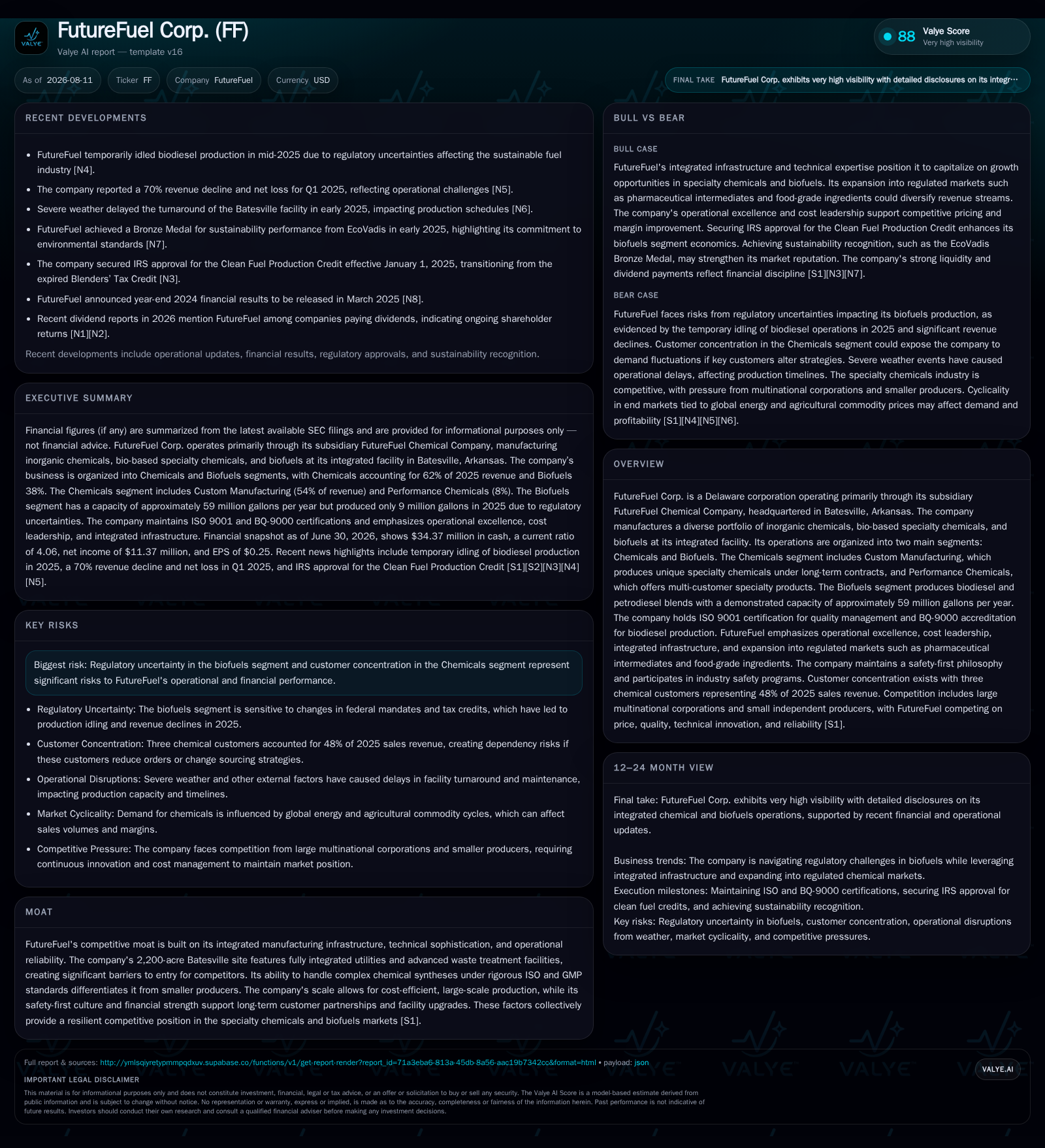
In its latest quarterly report, FutureFuel Corp. reaffirmed its dependence on unstable government biofuel incentives while advancing its chemicals segment through vertical integration and operational excellence initiatives. The company’s integrated manufacturing platform underpins cost leadership in specialty chemicals, but the biofuels unit continues to grapple with regulatory flux and feedstock price volatility that cloud production volumes and margins. Growth ambitions hinge on expanding custom chemical revenues and securing sustainable biofuels economics amid shifting policy landscapes.
Recent Operating Update: Enduring Biofuels Volatility Limits Visibility
FutureFuel’s Q2 2026 earnings reflected ongoing challenges in its biodiesel-focused biofuels segment driven by an uncertain regulatory environment. The company continues to face significant ambiguity around the implementation of the Clean Fuel Production Credit (CFPC), which replaced the longstanding Biodiesel Tax Credit (BTC) at the start of 2025 but remains subject to final rulemaking anticipated mid-2026 [S2][S1]. This delay creates a non-permanent economic framework that complicates forward planning for production volumes and pricing.
Concurrently, feedstock price volatility remains a key operational risk. FutureFuel procures all its own biodiesel feedstocks—including vegetable oils, animal fats, and separated food waste oils—with flexibility between rail and truck logistics supported by substantial onsite storage capacity [S1]. This enables opportunistic purchases when market conditions allow but does not insulate completely against sharp commodity swings that compress margins when feedstock costs rise faster than finished product prices
The transition in governmental support programs is compounded by competitive pressures favoring renewable diesel. Policies generally grant renewable diesel higher equivalency values (1.7 versus 1.5 for traditional biodiesel) under Renewable Fuel Standard (RFS2) credit calculations, disadvantaging FutureFuel’s core product economically relative to alternatives [S1]. Moreover, increased adoption of electric vehicles also threatens long-term demand for all liquid combustion fuels.
Business Model: Integrated Manufacturing Blends Specialty Chemicals with Biofuels
FutureFuel operates through two linked segments: Chemicals and Biofuels. Its chemicals business features custom manufacturing—producing specialty chemicals tailored exclusively for single customers—and performance chemicals manufactured for broader markets to more diverse customers. Examples include specialty polymers for consumer products and polymer modifiers like SSIPA/LiSIPA used in nylon and polyester applications [S1].
Custom chemical contracts often involve negotiated pricing mechanisms that may or may not include raw material or energy cost pass-throughs. Performance chemicals tend to rely on market-driven pricing but benefit from scale economies due to FutureFuel’s large integrated plant structure in Batesville [S1]. This facility encompasses advanced utilities infrastructure with ISO 9001 quality management and BQ-9000 biodiesel accreditation.
The biofuels segment draws heavily on the company’s chemical process expertise to manufacture biodiesel at an annual capacity near 59 million gallons [S1]. Revenue stems primarily from direct wholesale sales of biodiesel blends; FutureFuel owns its feedstock supply chain end-to-end—minimizing reliance on third parties—which serves both to reduce supply risk and create inventory positioning advantages during volatile pricing periods
Revenue drivers across both segments include contract renewals for custom chemicals, volume sales growth in performance chemicals aligned with industrial polymer markets, biofuel production volumes sensitive to policy incentives, and realized commodity input costs. Margins depend critically on feedstock cost management in biofuels plus efficient plant operations reducing conversion costs.
Industry Structure & Competitive Position: A Fortified Niche Amid Volatile Policy Backdrop
FutureFuel’s competitive advantage is anchored in its fully integrated Batesville manufacturing site spanning roughly 2,200 acres with linked utilities and waste treatment systems. This scale and integration establish high barriers to entry by smaller specialty chemical manufacturers or independent biodiesel producers lacking such infrastructure [S1]. The company balances technical complexity—required for custom chemical syntheses—and cost leadership enabled by operating efficiency.
Quality certifications ISO 9001 and BQ-9000 provide ongoing customer assurance critical in highly regulated chemical markets where contamination risks could be costly. The blending of specialty chemicals customers under long-term contracts alongside spot-market performance chemical sales creates diversification that mitigates cyclical exposure somewhat.
However, supply chain dynamics pose challenges: significant customer concentration in custom chemistry introduces negotiation leverage risks but may be offset by deep technical relationships supporting switching costs [S1]. On the biofuels side, systemic regulatory uncertainty undermines planning for production expansions or capital deployment.
Peers include specialty chemical firms such as Albemarle or Eastman Chemical on the chemicals side while Renewable Energy Group represents similarly structured biofuel players focused more narrowly on renewable diesel—a segment benefiting from more favorable RIN valuation structures.
Growth Drivers: Vertical Integration & Operational Excellence Fuel Expansion Ambitions
FutureFuel’s strategy focuses on expanding market reach through diversification within its chemicals portfolio coupled with backward integration into intermediate raw material production [S1]. By internalizing critical upstream feedstock supplies for custom chemistry processes, the firm aims to stabilize input costs and unlock new external sales opportunities beyond captive use
Simultaneously, investments in lean manufacturing practices and automated process controls target enhanced throughput reliability—key KPIs include contract renewal rates for multi-customer products plus improving capacity utilization metrics across segments. Supply chain integration further supports inventory turnover improvements.
Biofuels growth remains contingent primarily on supportive government policies stabilizing incentive frameworks post-CFPC implementation. Opportunities exist from increasing demand for low-carbon fuels spurred by environmental regulations favoring bio-based products over petroleum counterparts.
Risks & Constraints: Policy Flux & Supply Chain Fragility Temper Prospects
By far the most salient risk derives from fluctuating federal and state incentives governing biodiesel economics. The transition from BTC to CFPC introduces uncertainty both in timing (finalization lag) and credit levels achievable based on GHG intensity thresholds unlikely met fully by conventional producers like FutureFuel [S1]. Delays or reductions could render fuel production uneconomic if feedstock prices fail to adjust downward proportionally.
Customer concentration concentrations carry risk for the Chemicals segment if key contracts are not renewed or diminish due to competitor actions or alternative technology adoption 1 Sizable feedstock price increases caused by global market disruptions or local supply constraints would compress margins sharply given limited spot recovery options.
Emerging substitute technologies such as widespread EV adoption or growing renewable diesel supply further depress long-term volume potential for lower-equivalency biodiesel products offered by FutureFuel.
Operational plant disruptions due to safety incidents or equipment failures at their single-site Batesville facility could severely affect short-term output given limited geographic diversification.
What To Watch Next: Milestones & Market Signals To Track
- Finalization status of CFPC regulations expected mid-2026 will directly impact incentive availability timing; monitoring SEC filings for updates is critical.
- Feedstock price trends relative to finished biodiesel prices represent leading indicators of margin sustainability.
- Quarterly updates regarding contract renewal success rates within the Chemicals segment will illuminate durability amid customer concentration.
- Announcements of capacity expansion initiatives or new intermediate raw material integrations will signal execution progress on strategic roadmaps.
- Legislative developments at federal/state levels affecting renewable fuel standards or carbon credit markets remain central macro drivers.
Financial Profile Discussion
As of June 30, 2026, FutureFuel reported cash and equivalents totaling approximately $34 million with current assets exceeding current liabilities by a factor of over four (current ratio ~4.06), signifying strong short-term liquidity to support ongoing operations [F1]. This financial buffer provides operational flexibility amid market uncertainty but reflects historical operating losses including an operating loss around $53 million reported at year-end 2025 indicating profitability challenges mainly attributed to biofuel segment headwinds [F1].
The capital-intensive nature of integrated specialty chemical manufacturing requires continued disciplined capital expenditures focused on facility reliability enhancements rather than aggressive expansion until policy clarity improves. Working capital efficiency gains tied to improved inventory turnover will support cash flow generation alongside margin recovery efforts.
Overall leverage appears manageable though profitability restoration depends materially on stabilizing biofuel economics paired with continued strength in chemically specialized contract segments where technology-driven differentiation sustains pricing power despite customer concentration risks.
This analysis leverages facts disclosed through the latest quarterly filing supported by contextual industry framing without speculative forecasts or investment advice.
Disclaimer: This is research-only, informational analysis and not investment advice. It may include AI-generated interpretation and general industry context. Always verify important details using primary sources.

Comments