
LightWave Acquisition Corp. Advances SPAC Lifecycle with Significant Capital Raise and Trust Account Stability
As a blank check company, LightWave Acquisition Corp. relies on its IPO proceeds and management expertise to execute a transformative business combination.
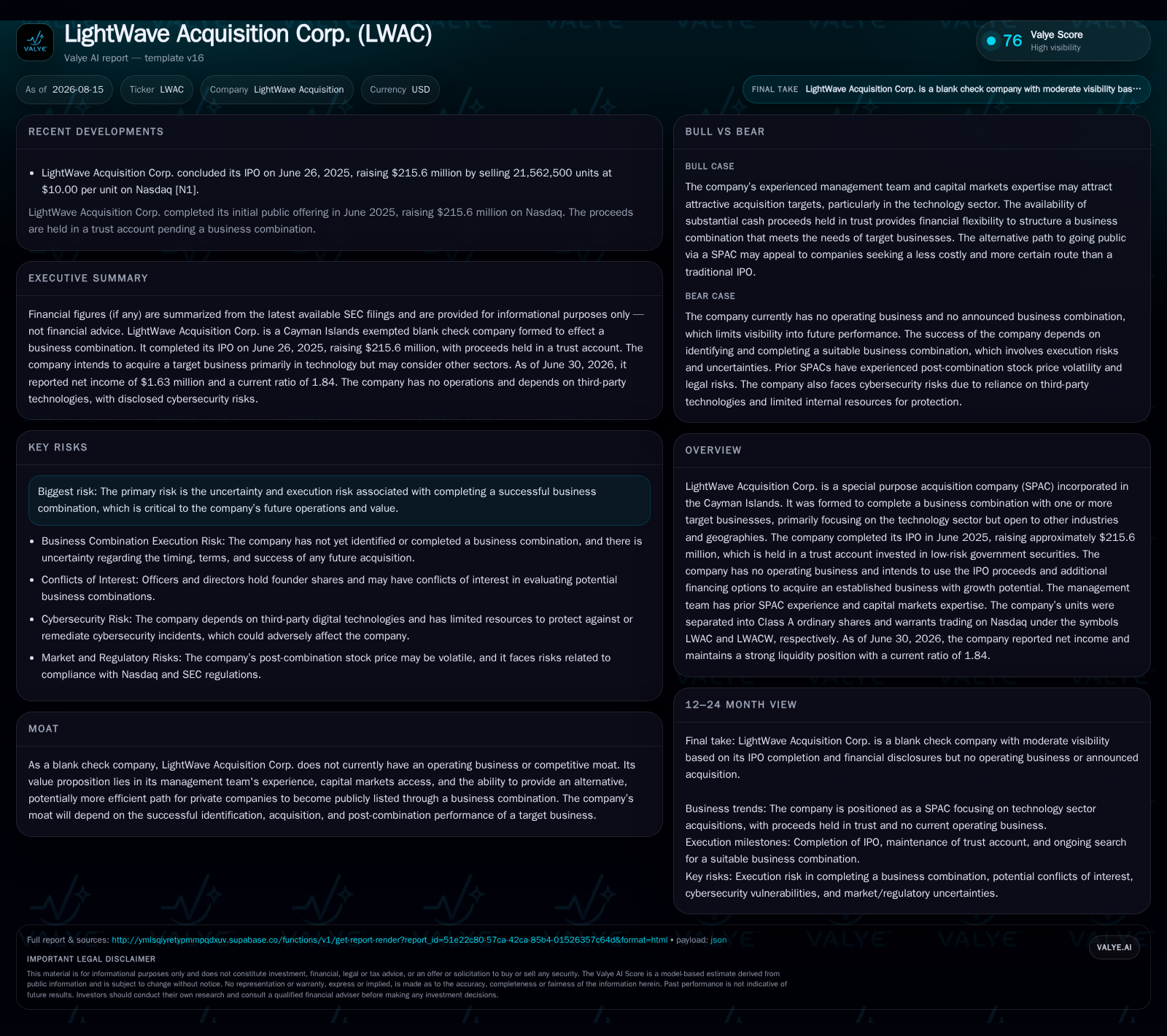
LightWave Acquisition Corp., a Cayman Islands-based SPAC formed in early 2025, completed a $215.6 million IPO and has placed these proceeds in a risk-averse trust account. The company reports no operating revenues as expected from its blank check structure but generates net income from trust investment earnings. Its value proposition hinges on management's ability to identify a suitable target within the typical SPAC timeframe and successfully complete a business combination, providing an alternative route to the public markets. Key risks include execution challenges, shareholder redemption behavior, and regulatory scrutiny.
Recent Operating Synopsis
LightWave Acquisition Corp., incorporated in the Cayman Islands in January 2025 as a special purpose acquisition company (SPAC), reported its latest quarterly filing on August 14, 2026 [S2]. The filing reconfirms its status as a blank check entity without operating activities or revenues pending completion of a business combination. Its near-term operational focus remains on identifying and executing a merger or acquisition with a private technology or other sector company that meets its growth criteria. No material changes to previously disclosed risk factors were noted, consistent with ongoing uncertainties inherent in the SPAC structure [S2], [S3].
Business Model Overview
As typical for SPACs, LightWave's business model is primarily financial-intermediary based: it raises capital through an initial public offering (IPO) by issuing units composed of Class A ordinary shares paired with warrants, holds the proceeds in a segregated trust account invested conservatively, and seeks one or more private companies to merge with – effectively taking them public through the so-called de-SPAC transaction [S1].
The June 2025 IPO raised gross proceeds of approximately $215.6 million, including the full exercise of underwriters' over-allotment options. In parallel with the IPO, LightWave conducted a private placement sale of units totaling about $6.06 million to its Sponsor and underwriting representatives at the same unit price, supplying additional lower-cost capital outside public investors [S1]. Following these transactions, nearly all net proceeds ($215.6 million) were deposited into the Trust Account.
Revenue mechanisms are atypical since LightWave does not produce goods or services; instead, any income arises from interest earned on the Trust Account assets invested in U.S. government treasury securities or money market funds aligned with SEC constraints [S1]. Operating expenses—including legal compliance, due diligence evaluations, administrative costs, and compensation of management—are funded outside this Trust Account.
This model places significant emphasis on management’s ability to identify suitable acquisition candidates promptly since failure to consummate a deal within prescribed timelines generally necessitates liquidation and return of Trust Account funds to investors—with attendant costs and no operating business established.
Industry Structure and Competitive Positioning
Within the broader SPAC ecosystem, LightWave operates upstream as a capital markets facilitator providing an alternative route for private companies—especially technology sector firms—to access public equity markets more rapidly than traditional IPO processes allow [S1]. This alternative pathway appeals notably due to perceptions of reduced cost structures, greater price certainty pre-deal closure, and less regulatory unpredictability compared to traditional IPOs.
Competitively, LightWave faces peer groups including other sector-focused SPAC sponsors such as Pershing Square Tontine Holdings and Social Capital Hedosophia that similarly leverage experienced sponsor teams and extensive deal-sourcing networks. The success calculus often rests heavily on management credibility, access to PIPE (Private Investment in Public Equity) financing partners who co-invest during de-SPAC transactions, and mitigating redemption rates—which directly erode deal funding capacity if public shareholders elect out before closing.
Unlike operating businesses where product differentiation drives advantage, LightWave’s moat will be shaped by execution discipline: selecting targets with scalable business models; negotiating accretive merger terms; managing regulatory disclosure rigor; and efficiently integrating post-combination operations if applicable [S1].
Together these drivers contribute toward favorable conditions for closing an efficient de-SPAC transaction which can unlock value creation potential for both sponsors and public shareholders.
Risks and Watchpoints
Several risks inherent to the SPAC model merit close monitoring:
- Execution Risk: Failure to identify or consummate an attractive business combination within prescribed timeframes (typically up to two years) leads to liquidation risks.
- Redemption Rates: Public shareholder redemptions before deal closure can severely reduce funds available for acquisition financing.[S1]
- Dilution from Warrants: Exercises of warrants issued alongside shares can dilute equity ownership post-combination impacting existing shareholder value.
- Market Volatility Sensitivity: Share price fluctuations around deal announcements impact market perception influencing PIPE investor engagement.
- Potential Conflicts of Interest: Management fiduciary duties overlap with contractual obligations potentially creating misaligned incentives concerning deal selection [S1].
- Regulatory Scrutiny: Enhanced SEC focus on SPAC disclosures introduces compliance complexity affecting timing and costs.[S2]
- Dependence on Third-party Digital Infrastructure: While LightWave has no direct operations exposing it to cyber risk,[S4] reliance on third-party service providers’ cybersecurity controls entails latent operational vulnerability.
Monitoring evolving SEC comment letters or litigation trends concerning SPAC accounting will be critical going forward alongside observance of redemption rate trends as proxies for investor confidence.
What To Watch Next
Key milestones impacting LightWave’s trajectory will include:
- Announcement of definitive merger agreements detailing target identity or sector exposure;
- Filing updates disclosing progress toward completing business combination;
- Public shareholder redemption activity levels quantified ahead of vote deadlines;
- PIPE financing commitments concurrent with announced deals;
- Any changes in management composition or governance enhancements addressing potential conflicts;
- Market reaction evidenced by share unit trading patterns pre/post announcements;
- Regulatory developments influencing disclosure or accounting treatment impacting valuation metrics;
- Timing cadence relative to prescribed expiration dates mandating combination completion or liquidation.
Tracking these markers will inform assessment regarding likelihood of timely deal execution and ultimate creation of operating enterprise value beyond trust account stability [S2], [S3].
Disclaimer: This is research-only, informational analysis and not investment advice. It may include AI-generated interpretation and general industry context. Always verify important details using primary sources.

Comments