
Nuo Therapeutics Faces Supply Chain Headwinds While Scaling Autologous PRP in Advanced Wound Care
Aurix System growth is challenged by critical reagent shortages and ongoing commercialization ramp after Medicare coverage gains.
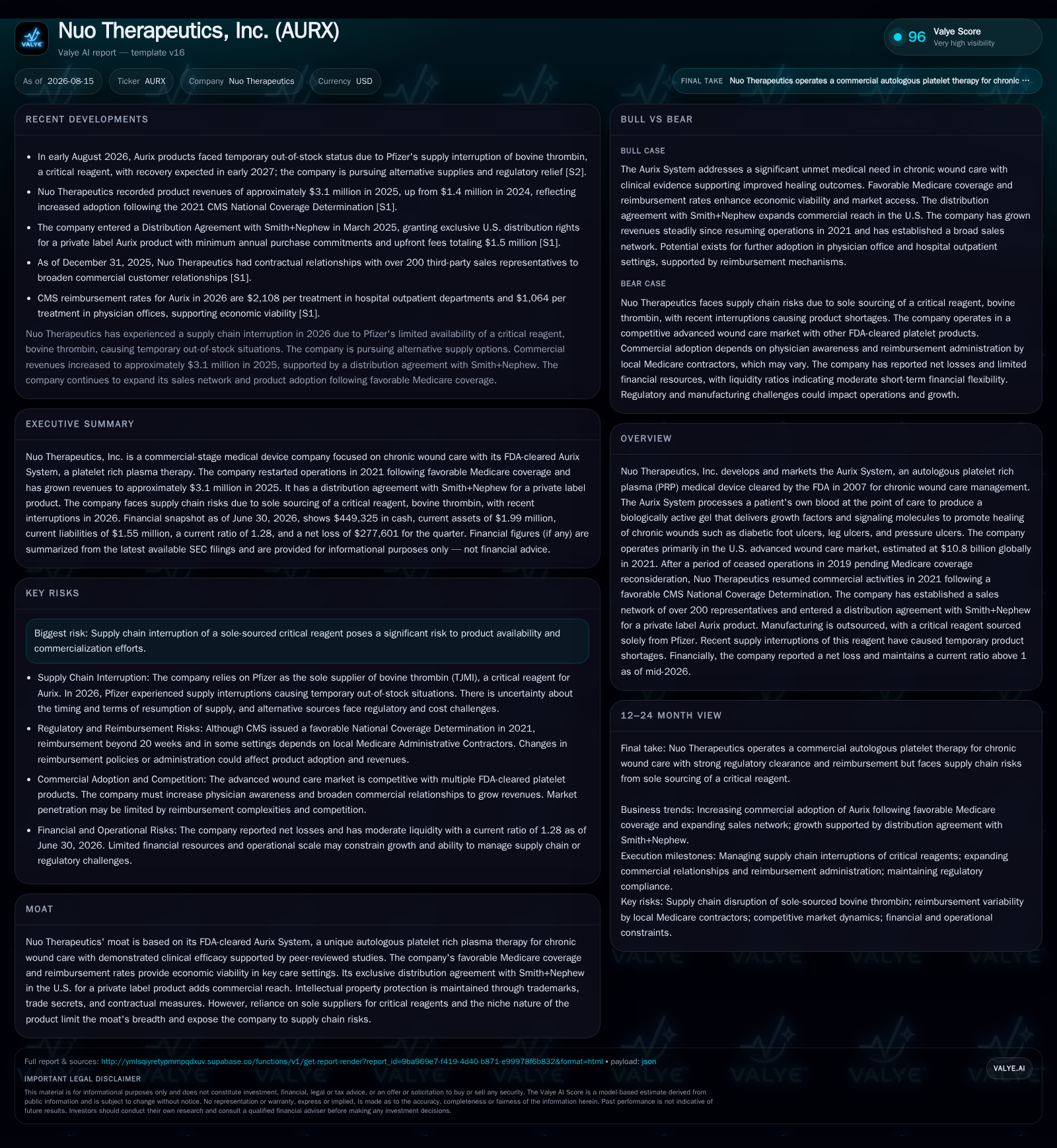
Nuo Therapeutics, Inc. continues to build commercial traction for its FDA-cleared Aurix System, an autologous platelet rich plasma (PRP) device for chronic wound care, with revenues growing to approximately $3.1 million in 2025 following a resumption of operations in 2021 under a favorable Medicare National Coverage Determination. However, the company recently disclosed a significant supply chain disruption impacting its sole sourced bovine thrombin reagent from Pfizer, leading to temporary out-of-stock conditions and uncertainties around long-term availability and pricing. The business model hinges on provider adoption supported by reimbursement, and distribution partnerships such as the exclusive private label agreement with Smith+Nephew augment reach but also expose operational dependencies. Financially, Nuo continues to operate at a loss with limited liquidity, underscoring the importance of supply continuity and market expansion execution in determining its path to profitability.
Recent Operating Update
To mitigate this disruption, Nuo has engaged proactively with the FDA drug shortage group and Pfizer to explore alternative packaging configurations or bulk supply ahead of anticipated resumption. Additionally, the company is pursuing longer-term mitigations including sourcing human recombinant thrombin or foreign suppliers pending regulatory clearance ([S2]). Nonetheless, these alternatives carry execution risks given FDA oversight and potential proprietary supplier dynamics.
Financially relevant is Nuo's Interim Loan Agreement enhancement completed May 29, 2026 ([S3]), which increased lender commitments up to $2 million, providing liquidity buffer amid operating losses and supply risks. As of June 30, 2026, cash and equivalents stood at roughly $449k with current liabilities at around $1.55 million resulting in a working capital ratio of approximately 1.28 ([F1]). Notably, reported total debt remains zero as per most recent balance sheet data ([F1]), indicating limited leverage but ongoing funding needs as operations scale.
Business Model Analysis
Nuo Therapeutics operates in the advanced wound care segment focused on chronic wound management through proprietary biologic medical devices. Its flagship product, the Aurix System (FDA-cleared via Section 510(k) since 2007), is an autologous platelet rich plasma (PRP) point-of-care device that processes patient blood to produce a hematogel rich in growth factors and signaling proteins crucial for tissue regeneration ([S21], [S22]).
The company's revenue primarily derives from direct sales of Aurix kits to healthcare providers who treat wounds such as diabetic foot ulcers—an area with significant unmet clinical need due to complex healing challenges affecting millions annually ([S22]). Monetization operates on product unit sales supplemented by revenue-sharing under an exclusive U.S. Distribution Agreement with Smith+Nephew for a Private Label version of Aurix ([S24], [S26]). This partnership enhances market penetration leveraging Smith+Nephew's established sales channels though dependence on their order volumes introduces variability.
Reimbursement mechanisms are central; following initial stalled commercialization efforts linked to prior Medicare non-coverage decisions, CMS issued a National Coverage Determination (NCD) effectively supporting payment for autologous PRP therapies including Aurix starting April 2021 ([S22], [S23]). The NCD underpins provider incentives by establishing pathway reimbursement during treatment durations up to twenty weeks for qualifying chronic wounds. Consequently, payor acceptance drives adoption alongside clinical validation.
Aurix technology differentiates through biologic authenticity—using patient's own platelets activated to release hundreds of natural growth factors that encourage angiogenesis and cell proliferation pivotal for wound closure ([S23]). Peer products include other platelet-derived therapies cleared by FDA but compete within an advanced wound care ecosystem encompassing dressings and emerging regenerative medicine platforms offered by companies like Organogenesis or Integra LifeSciences.
Industry Structure & Competitive Positioning
The advanced wound care market is large ($~10.8 billion globally circa 2021), fragmented across various product categories including advanced dressings, devices like Aurix, and biologics targeting ulcer management (). Key dynamics involve regulatory approval status (FDA clearance or premarket approval), third-party reimbursement policies especially Medicare coverage levels, clinical outcome evidence acceptance among providers, and distribution network breadth.
Nuo ranks as a niche player whose moat derives from specialized autologous PRP technology combined with demonstrated clinical efficacy documented under Medicare’s Coverage with Evidence Development program (). Nevertheless, its competitive vulnerability arises from reliance on single-source critical inputs—specifically Pfizer’s TJMI reagent—introducing supply continuity risk uncommon among larger peers equipped with diversified supplier bases or vertically integrated manufacturing ([S2], ).
The exclusive Private Label distribution agreement with Smith+Nephew positions Nuo strategically within established surgical/distributor networks enhancing reach beyond its own ~200 sales representatives currently deployed mostly across private office wound care offices and some hospital settings ([S26]). However, Smith+Nephew’s commitment levels remain variable subject to product uptake success; any termination could materially reduce Nuo’s revenues given limited portfolio breadth ([S24]).
Regulatory complexity also shapes competitive moat: Nuo must continuously maintain quality system compliance compliant with ISO 13485 standards and FDA Good Manufacturing Practices while navigating evolving reimbursement rulemaking that could alter Medicare or private payer coverage levels over time ([S6], ).
Growth Drivers
Several structural tailwinds support Nuo’s growth thesis:
- The aging demographic trend alongside increasing diabetes incidence elevate chronic wound patient volumes annually.
- Favorable Medicare coverage since 2021 substantially improved payor economics allowing healthcare providers confidence in reimbursed use.
- Ongoing clinical validation via peer-reviewed studies demonstrating Aurix’s biological impact enhances medical community acceptance crucial for adoption acceleration.
- Expansion of direct sales force from early re-commercialization phase (started mid-2022) aims to broaden provider base beyond initial evaluation accounts toward routine usage.
- Partnership distribution through Smith+Nephew leverages their expansive channels aiding penetration into new hospital systems or facilities otherwise difficult for a smaller company to access.
- Regulatory approvals enabling marketing within international jurisdictions could unlock additional markets provided data submission requirements are met.
Continued revenue growth was evident increasing from $1.4 million in 2024 to about $3.1 million in 2025 consistent with expanding customer footprint ([S22], [F1]). This momentum will depend heavily on managing supply constraints caused by reagent availability issues while maintaining flexibility toward reimbursement policy updates.
Risks & Constraints
Primary risk centers on supply chain fragility given sole sourcing of TJMI thrombin from Pfizer leading to product shortages starting mid-2026—a material threat given no immediate alternative approved reagent exists ([S2]). Delays or failure to secure sustained supplies could lead not only to lost sales volume but also damage reputation among providers relying on consistent availability.[Supply issues have driven temporary out-of-stock situations impacting both branded Aurix units and private label partner products].
Additional risks include:
- Continued operating losses underscore dependency on external financing; failure to raise capital suitably could curtail operations or delay strategic initiatives ([S20], [S3]).
- Market adoption challenges remain since many chronic wound treatments have entrenched habitual use patterns; persuading providers requires demonstrable efficacy plus reimbursement stability.
- Regulatory changes either tightening clearance criteria or altering reimbursement rules could negatively impact usage economics.
- Competition from other biologic therapies or emerging regenerative technologies may erode market share particularly if those alternatives offer broader indications or easier clinical workflows.
- Dependence on Smith+Nephew introduces concentration risk where termination or reduced order volumes would materially impact revenues given limited alternative channels currently developed.
- Limited product portfolio breadth exposes Nuo financially if Aurix fails commercial expectations without pipeline diversification.
What To Watch Next
Key near-term milestones include:
- Resolution timing around TJMI supply chain constraints: monitoring Pfizer negotiations progress or FDA facilitated short-term relief strategies provides leading signal on availability recovery.[S2]
- Expansion pace of direct sales representatives beyond current footprint: incremental hires indicate commitment toward broadening direct market access while offsetting partner concentration risk.[S26]
- Sales trajectory data during remainder of fiscal year will clarify whether supply interruptions materially dampen revenue momentum.
- Any updates regarding alternative reagent commercialization such as human recombinant thrombin approval status will be critical inflection points.[S2]
- Monitoring updates on reimbursement policy refinement by MACs (Medicare Administrative Contractors) ensuring proper coding application under the CMS NCD framework avoids billing disputes slowing adoption.[S22]
- Financial liquidity events including additional equity issuances or loan facility draws reflect underlying capital sufficiency relevant for sustaining operating continuity.[S3]
Financial Profile Discussion
As of June 30, 2026, Nuo held cash and equivalents totaling approximately $449 thousand with current assets near $1.99 million against current liabilities around $1.55 million yielding a current ratio of about 1.28 — indicative of marginal near-term liquidity buffer but not ample runway for aggressive scaling without external financing support ([F1]). Total debt was reported as zero as per latest available balance sheet metrics signaling no traditional leverage burden but reliance on interim loan agreements noted earlier providing up to $2 million in commitments ([F1], [S3]).
Operating losses continue reflecting early-stage commercial ramp dynamics with net losses approximately $2.5 million recorded in both fiscal years ending December 31, 2024 and December 31, 2025 respectively consistent with heavy spending on SG&A expansion particularly sales force development coupled with modest R&D outlays given mature device status ([S1], [F1]). Negative cash flow generation remains an ongoing challenge until sustainable adoption rates translate into positive gross margin contributions exceeding fixed cost absorption thresholds.
Capital allocation appears focused primarily on commercial infrastructure build-out while addressing urgent supply chain contingencies given their critical bearing on revenue continuity; subsequent financial flexibility depends heavily on successful capital raises which historically have included issuance of equity-linked securities and warrants bundled within loan agreements as evidenced recently by complex interim warrant issuances tied to loan financings ([S3]).
Overall financial sustainability hinges upon accelerating top-line growth aided by stable reimbursement contributions while managing cost structure prudently amid evolving operational scale constraints posed by component availability issues.
Disclaimer: This analysis does not constitute investment advice. It synthesizes public SEC filings and industry context to evaluate operational developments without projecting investment outcomes.
Disclaimer: This is research-only, informational analysis and not investment advice. It may include AI-generated interpretation and general industry context. Always verify important details using primary sources.

Comments