
AMASS BRANDS Faces Liquidity Pressures While Leveraging Good Twin’s Organic Non-Alcoholic Wine Leadership
The company reports sales growth but struggles with operating losses and tight liquidity amid contract restructuring.
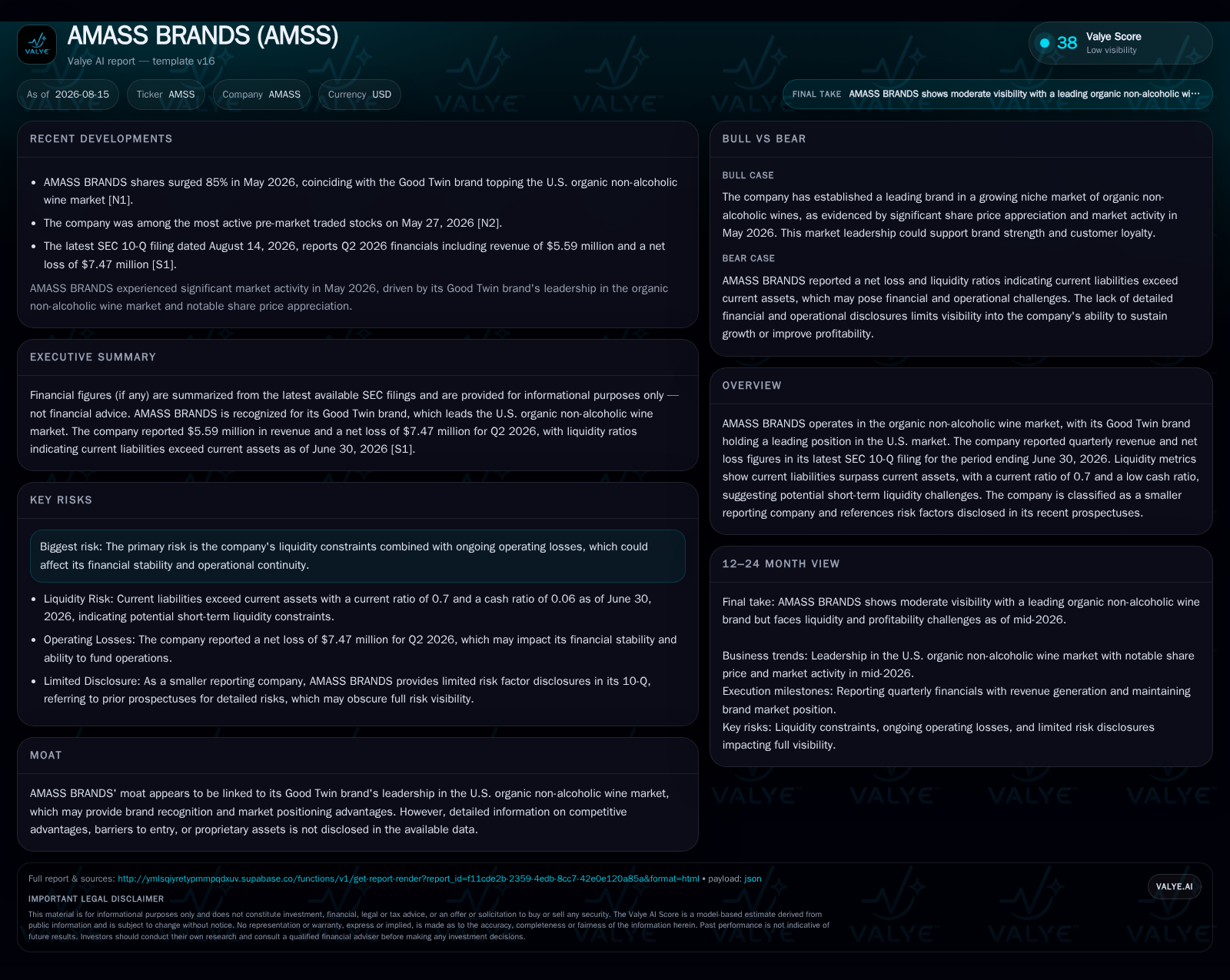
AMASS BRANDS, operating in the organic non-alcoholic wine niche through its Good Twin brand, reported quarterly revenue of $5.59 million with net losses of $7.47 million for Q2 2026, highlighting ongoing profitability challenges. The company recently terminated a major multi-year purchase agreement with Full Glass Wine Co., replacing it with a settlement and equity redemption arrangement affecting future revenue visibility. Liquidity metrics show current liabilities of $25.36 million exceeding current assets of $17.77 million, yielding a current ratio of 0.7, signaling potential near-term cash flow constraints. Growth is supported by rising demand for organic non-alcoholic beverages and Good Twin’s brand positioning, but risks from supply chain complexity and financial stability remain critical to monitor.
Recent Operating Update
AMASS BRANDS filed its latest quarterly report on August 14, 2026, covering the period ending June 30, 2026. The company generated revenue of approximately $5.59 million but incurred an operating loss close to $6 million and a net loss of approximately $7.47 million during this quarter [F1]. This sizable loss relative to revenue highlights the cost structure challenges typical for early-stage or niche beverage companies heavily investing in brand development, supply chain execution, and capacity build-out.
A material development disclosed in an August 5 event filing involves the termination of a Multi-Year Wine Purchase Agreement initially signed in February 2024 with Full Glass Wine Co., LLC (FGWC) [S3][S16]. This agreement obligated Full Glass Licensing to purchase about $4 million worth of inventory (~111,333 cases). The termination replaced volume-based purchase obligations with a fixed settlement amount of $427,000 — partly payable by July 31 — along with an option for equity redemption via application of a $406,000 deposit against certain membership units held by the company within FGWC at a unit price near $8.77 [S16].
The restructuring significantly shifts AMASS BRANDS’ revenue predictability from committed wholesale shipments to more discretionary future purchases tied to complex equity arrangements involving FGWC units. This raises short-term topline visibility questions but could reduce working capital strain from large-scale inventory manufacturing prior to sales realizations.
Business Model Analysis
AMASS BRANDS operates principally through its Good Twin brand in the niche organic non-alcoholic wine segment within the broader beverage sector focused on wellness-oriented consumers seeking alcohol-free options made from organically certified ingredients. The company monetizes primarily by selling finished wine products sourced from organic grapes processed through proprietary or contracted production facilities.
Revenue generation is influenced by:
- Direct-to-consumer (DTC) e-commerce sales enabling higher average selling prices but requiring marketing spend.
- Wholesale distribution agreements supplying retailers and specialty stores enhancing market reach but often at lower margins.
- Potential licensing or strategic partnership deals adding incremental channels.
Cost structure drivers impacting margins include raw material sourcing costs (organic certification heightens input costs), bottling and packaging expenses tailored for premium positioning, fulfillment logistics across multi-channel routes, and promotional intensity necessary to build brand awareness amid competitive beverage categories.
Inventory turnover speed is critical given product freshness considerations inherent to beverage shelf life; slow sell-through would exacerbate obsolescence risks especially in a financially stretched environment.
Industry Structure and Competitive Position
The organic non-alcoholic beverage industry enjoys favorable consumer tailwinds as health-conscious demographics expand alcohol-free consumption preferences alongside increasing trust in organic certifications ensuring ingredient quality standards.
Within this landscape, AMASS BRANDS’ Good Twin stands out as a leading U.S.-based organic non-alcoholic wine brand according to company disclosures and sector research analogs, giving it advantage in brand recognition among consumers valuing both wellness orientation and taste authenticity.
Nonetheless, competition arises not only from pure-play non-alcoholic wine producers but also traditional alcoholic beverage companies extending their portfolios into alcohol-free variants (sometimes leveraging deeper distribution networks), as well as emergent innovative brands targeting younger demographics via DTC models infused with social media marketing prowess.
Peer brands such as Kin Euphorics or Ritual Zero Proof highlight how diversified flavor innovation combined with lifestyle branding can shift consumer adoption curves quickly; while Ariel Vineyards exemplify comparable positioning in the niche non-alcoholic wine segment emphasizing heritage and winemaking craftsmanship.
Growth Drivers
Key growth levers for AMASS BRANDS encompass:
- Consumer trends decisively favoring alcohol alternatives that support moderation without sacrificing social rituals or taste experience — amplified by broader wellness movements.
- Expanded distribution footprint including stronger retail partnerships across specialty health stores and mainstream outlets plus enhancement of DTC channels improving margin retention per unit sold.
- Ongoing innovation in product formulation offering diversified flavor profiles meeting evolving consumer palates while maintaining stringent organic certification compliance.
- Marketing investments building Good Twin’s premium yet approachable brand identity to capture share particularly among younger adults who prioritize authenticity together with health benefits.
- Regulatory support preserving clear labeling standards protecting organic claims which reinforce consumer trust essential for category growth.
Risks and Watchpoints
Liquidity remains a pressing risk vector given that current liabilities stand notably above current assets—$25.36 million versus $17.77 million—as of Q2 end resulting in a current ratio of just 0.7 [F1]. This suggests dependency on external financing or rapid cash inflows to meet short-term obligations without operational disruption.
Counterparty concentration risk is also present due to reliance on agreements like those formerly embodied with Full Glass Wine Co., whose purchase commitment termination introduces uncertainties around scheduled volumes and revenue cadence [S3][S16]
Supply chain vulnerabilities stem from complexities inherent in sourcing certified organic grapes consistent with quality expectations while managing inventory turnover rates sensitive to freshness demands.
High promotional intensity required to penetrate a crowded beverage shelf may compress gross margins if discounting erodes price realization faster than volume grows.
Regulatory shifts affecting definitions or enforcement related to organic certification or non-alcoholic classification could impose additional compliance costs or lengthen time-to-market for new varieties.
What To Watch Next
Investors and industry watchers should focus on:
- Completion status of outstanding settlement payments from Full Glass anticipated by July 31 impacting immediate working capital inflow [S16].
- Updates on future sales volumes post-agreement restructuring indicating whether AMASS can regain stable wholesale revenue streams or must pivot more toward DTC growth.
- Improvements in gross margin percentages evidencing enhanced pricing power or reduced reliance on promotions reflecting healthy consumer demand pull.
- Cash runway extensions potentially via exercising of warrants amended recently to lower exercise prices incentivizing capital infusion supporting growth investments [S14][S20][S23].
- Enrollment in additional retail partnership deals expanding physical presence beyond existing distribution channels reinforcing market share expansion ambitions.
- Any disclosure concerning supply chain disruptions affecting production schedules or raw material availability that would signal near-term fulfillment risks.
Financial Profile Discussion
As of June 30, 2026, AMASS BRANDS holds approximately $1.57 million in cash against total debt nearing $1.65 million—yielding marginal net debt position—but current liabilities outstrip current assets by roughly $7.6 million resulting in a current ratio below the benchmark level of around 1 that generally denotes comfortable short-term liquidity [F1]
Revenue generation remains modest at just under $5.6 million quarterly; however, operating income is negative approaching nearly $6 million loss incurred during Q2 alone indicating that fixed operating expenses dominate the cost base relative to scale thus far achieved [F1]
These factors illustrate that while the company's market-leading brand presence provides strategic value probable over long term driven by industry tailwinds for organic non-alcoholic wines, substantially improved operational execution capable of scaling revenues faster than expenses is imperative for financial stability going forward.
Loan covenant flexibility or alternative capital sources will be critical given limited internal cash flow generation capacity currently evident from negative profitability figures recorded [F1]
This analysis reflects data available as of mid-August 2026 based on SEC filings through Q2 results complemented by recent material event disclosures outlining fundamental contract renegotiations impacting AMASS BRANDS’ revenue operations amidst wider sector growth dynamics supportive of its product portfolio focus. Readers should continuously monitor subsequent filings for evolving liquidity status updates and milestone achievements related to channel expansion or working capital management initiatives noted herein.
Disclaimer: This is research-only, informational analysis and not investment advice. It may include AI-generated interpretation and general industry context. Always verify important details using primary sources.

Comments