
StableCoinX Advances Ethena Ecosystem Infrastructure with Early-Stage Commercialization Amid Regulatory and Execution Challenges
StableCoinX progresses validator operations, middleware platform rollout, and institutional distribution while managing technological complexity and regulatory uncertainty.
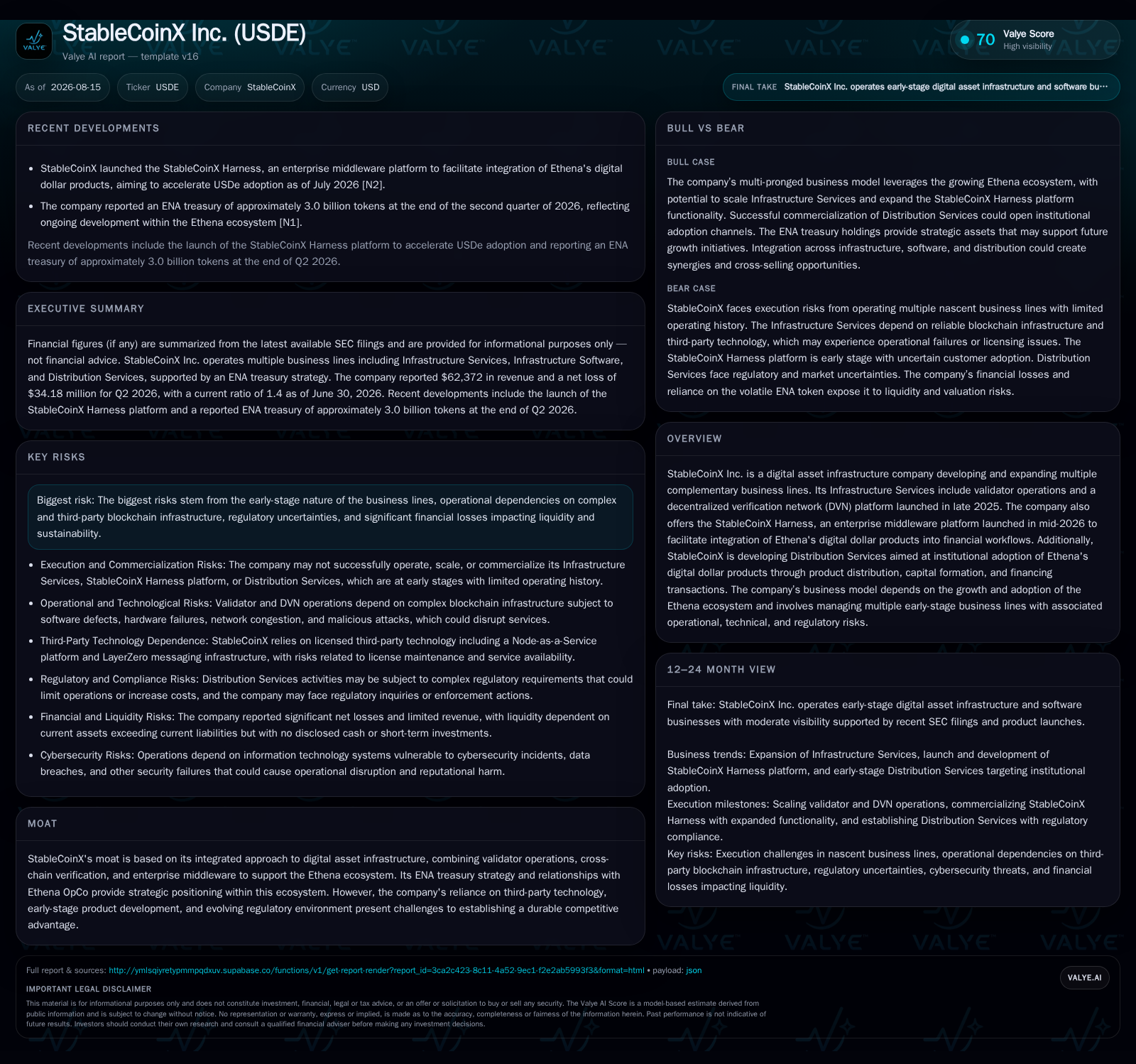
StableCoinX Inc. is building a multi-faceted blockchain infrastructure and digital asset platform centered on the Ethena ecosystem. Its core operations include validator node services, a middleware software platform called StablecoinX Harness for integrating Ethena’s digital dollar stablecoins, and emerging institutional distribution services. The company’s recent quarterly report highlights early commercialization with modest revenue but significant operating losses driven by development and scaling costs. Growth depends on ecosystem adoption, regulatory clarity, and successful product integration. Key risks include infrastructure operational complexity, regulatory shifts, treasury token volatility, and execution in nascent business lines.
Recent Operating Update
StableCoinX Inc.’s latest quarterly filing dated August 14, 2026 outlines ongoing progress across its three integrated business lines—Infrastructure Services, Infrastructure Software, and Distribution Services—all designed to support the expansion of the Ethena blockchain ecosystem [S2][S3]. Validator node operations began on Ethereum mainnet in October 2025 with decentralized verifier node (DVN) services following shortly after. These infrastructure components have initiated commercial activity generating transaction-based revenue primarily from cross-chain message verification involving Ethena assets; however, overall adoption remains at an early stage [S4][S9].
The StablecoinX Harness middleware platform became commercially available mid-2026 to facilitate enterprise integration of Ethena’s USDe and USDtb digital dollar stablecoins via a unified API layer [S6][S11]. Initial functionality focuses on payment routing and gas abstraction with plans for phased rollouts adding treasury management, liquidity controls, workflow automation, reporting tools, and interoperability features. Monetization is expected from recurring SaaS subscription fees supplemented by transaction-based charges upon broader enterprise uptake
Distribution Services are under active development targeting institutional uptake of Ethena digital dollar products through capital formation activities including direct acquisitions and off-balance sheet sponsored investment vehicles. A May 2026 non-exclusive distribution partnership agreement with Ethena OpCo formalizes StableCoinX’s role in channeling these products into institutional markets [S4][S12]. This segment remains nascent with commercialization timing uncertain
Supporting these efforts is StableCoinX’s sizable ENA governance token treasury—approximately 3 billion tokens reported at quarter-end—which strategically aligns the company’s interests with the Ethena ecosystem’s growth trajectory while offering operational flexibility to support staking or protocol governance functions [N1][S14]. This concentrated token holding exposes the company to market price volatility risks as well as regulatory scrutiny related to crypto asset management
Business Model Insights
StableCoinX generates revenue through complementary streams tied directly to its integrated role within the Ethena ecosystem. Infrastructure Services monetize validator operations through fees linked to transaction volumes validated on Ethereum mainnet and cross-chain messaging involving stablecoins supported by DVNs [S4][S22]. Middleware revenues hinge on successful onboarding of enterprise customers to the Stablecoin Harness platform which consolidates payment routing APIs alongside advanced treasury functionalities into subscription plus usage-fee models post-commercial launch [S6][S11][S22].
Institutional Distribution Services aim to earn fees from structuring capital formation deals around bundled digital dollar products such as USDe—backed by delta-hedged crypto collateral—and USDtb—collateralized by tokenized money market instruments managed by Anchorage Digital Bank. Revenue derives from product acquisition volumes facilitated through distribution agreements as well as financing transactions executed via specialized investment vehicles [S6][S18]
The ENA governance token treasury plays a dual strategic role: it underpins network security functions like staking related to validator operations while also serving as a treasury asset managed by an Investment Committee overseeing capital allocation decisions including token purchases or liquidity provisions subject to collaboration agreement restrictions that limit transfers without Ethena Foundation consent [S12][S20]. This creates considerable operational leverage tied closely to ecosystem adoption dynamics
Industry Structure & Competitive Positioning
StableCoinX operates at the intersection of blockchain infrastructure provision and enterprise fintech integration for digital dollar stablecoins. It occupies a competitive space alongside emerging players combining node validation services (similar to Blockdaemon), enterprise middleware platforms (akin to Consensys), stablecoin issuers (comparable to Circle), and institutional distribution facilitators (with parallels to Anchorage Digital). Its strategic focus on delivering coordinated validator infrastructure plus middleware APIs tightly integrated with distribution channels within the Ethena ecosystem differentiates it from standalone providers.
However, many peers benefit from longer operational histories, deeper financial resources enabling extensive R&D or geographic expansion, established customer bases across verticals, or broader regulatory licensing facilitating faster scaling or more comprehensive solutions. Competition intensifies amid technology commoditization in node validation coupled with rapid innovation demands for middleware sophistication—a challenging nexus where timely market entry combined with robust compliance frameworks are critical success factors [S23].
Growth Drivers
Growth opportunities stem from rising institutional interest in programmable digital dollar stablecoins driving demand across all business segments. Expanding Infrastructure Services beyond Ethereum mainnet onto multiple blockchains aligns with industry trends toward multi-chain interoperability potentially enlarging addressable markets. Incremental feature releases enhancing StablecoinX Harness capabilities—especially treasury automation—are pivotal for enterprise adoption given market preferences for consolidated API solutions.
Successful execution of Distribution Services leveraging partnership agreements could unlock new revenue streams aligned with increasing capital inflows seeking compliant exposure to crypto-backed stablecoins amid evolving regulatory acceptance. Additionally, ENA token economics may amplify value capture if network effects sustain demand growth combined with prudent treasury management optimizing risk-adjusted returns.
Risks and Watchpoints
Operating complex validator nodes alongside DVN infrastructure entails substantial execution risk from potential software bugs, hardware failures, network outages or cybersecurity breaches that could disrupt service availability or damage reputation [S16]. Regulatory ambiguity pervades all aspects—from licensing requirements for validators to custody regulations for digital assets—and shifting policies could force abrupt business model changes or elevate compliance costs impacting profitability.
The early commercialization status of Infrastructure Software together with nascent Distribution Services introduces uncertainty around revenue timing or scale potentially pressuring cash flows amid competitive forces from incumbents offering alternative integration or distribution solutions [S14][S28]. Concentrated exposure within the Ethena ecosystem—including reliance on ENA token valuation—adds volatility risk limiting diversification despite multiple operating lines being developed concurrently.
Progression in expanding validator nodes across additional blockchains beyond Ethereum mainnet will gauge scalability of Infrastructure Services.
Equally important is securing definitive Distribution Service contracts utilizing the May 2026 partnership framework through executed financing deals or sponsored vehicle launches generating fee income streams. Regulatory developments clarifying treatment of token treasuries or licensing criteria for validator operations remain key variables shaping strategic risk assessments.
Financially relevant signals involve tracking quarterly revenue growth relative to operating loss trends illuminating pathways toward sustainable breakeven amidst typical capital intensity characterizing early-stage blockchain infrastructure companies.
Financial Profile Discussion
For Q2 2026 ended June 30th, StableCoinX reported approximately $62 thousand in revenue—a reflection of early commercial activity mainly from Infrastructure Services validating cross-chain transactions involving Ethena assets [F1]. Operating losses totaled roughly $36 million driven predominantly by investments in product development for Stablecoin Harness enhancements alongside build-out expenses associated with establishing Distribution Services capabilities plus general administrative scaling costs.
The balance sheet shows minimal leverage exposure with total debt near $24 thousand balanced against about $19 million in current assets yielding a current ratio around 1.4 that supports short-term liquidity needs [F1]. However, sustained cash burn underscores the importance of accelerating revenue growth or securing additional financing given ongoing investments required for scaling operations.
Overall financial profile aligns with typical patterns among emerging blockchain service firms making substantial upfront commitments before realizing meaningful recurring revenues from subscription or transactional fee models linked to network utilization; prudent management of this transition phase remains critical.
Disclosure: This analysis is based exclusively on publicly available filings dated through August 14–15, 2026 along with relevant news releases. It does not constitute investment advice nor endorsement of any securities discussed herein.
Disclaimer: This is research-only, informational analysis and not investment advice. It may include AI-generated interpretation and general industry context. Always verify important details using primary sources.

Comments